
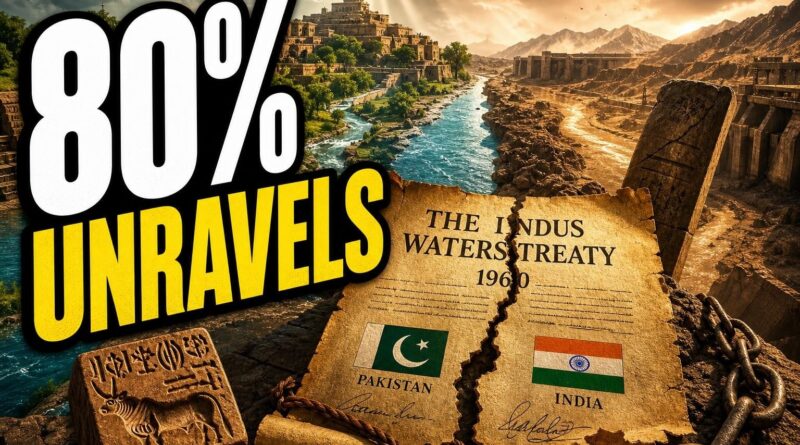
The Indus Waters Treaty: Pakistan’s 80% River Deal Unravels
The Indus Waters Treaty: Pakistan’s 80% River Deal Unravels
This week, Pakistan made a public appeal asking India to “respect” the Indus Waters Treaty. What that headline doesn’t tell you is the extraordinary story behind it — a 65-year-old water deal that divided six rivers between two nuclear-armed neighbours, and why it’s now on the edge of collapse.
The Most Lopsided Water Deal in History
September 19, 1960. Karachi, Pakistan. Indian Prime Minister Jawaharlal Nehru and Pakistani President Mohammad Ayub Khan sat down and signed one of the most consequential water agreements ever written.
The Indus Waters Treaty divided six major rivers of the Indus Basin between the two countries. India got the three Eastern Rivers — the Beas, the Ravi, and the Sutlej. Pakistan got the three Western Rivers — the Indus, the Chenab, and the Jhelum.
On paper, it sounds balanced. Three rivers each. Clean lines.
Then you look at the numbers.
The Eastern Rivers that went to India carry a total mean annual flow of 33 million acre-feet. The Western Rivers that went to Pakistan carry 135 million acre-feet. The result: India received roughly 20% of the total water carried by the entire Indus river system. Pakistan received 80%.
Two nuclear-armed neighbours. One treaty. And one side walks away with four times the water.
For history buffs, the sheer asymmetry of this deal is the first thing that demands an explanation.
Why Would India Agree to That?
The deal didn’t happen in a vacuum. The World Bank brokered the negotiations — a rare case of an international financial institution stepping into a dispute between two sovereign nations over something as fundamental as water.
The logic behind the split wasn’t about fairness in the abstract. It was about geography and dependency. The Western Rivers — the Indus, Chenab, and Jhelum — flow directly through what became Pakistani territory. Pakistan’s agriculture, its population centres, its entire downstream civilization had grown around those rivers for centuries. Cutting off access would have been catastrophic.
India, meanwhile, had the Eastern Rivers flowing through Punjab. The Beas, Ravi, and Sutlej were sufficient for India’s needs in that region — and India retained full rights to use them without restriction.
The treaty also gave India limited rights to use the Western Rivers for specific purposes: non-consumptive uses, limited irrigation, and run-of-river hydropower projects. Not ownership. Not diversion. Just carefully defined usage rights.
It was a compromise built to prevent war over water. For over six decades, it largely worked — surviving two full-scale wars between India and Pakistan in 1965 and 1971, and multiple crises in between. That durability made the Indus Waters Treaty famous in international law circles as one of the most resilient bilateral agreements ever negotiated.
The Pahalgam Attack That Changed Everything
The treaty’s reputation for surviving conflict met its hardest test recently.
Following a deadly terror attack in Pahalgam, Kashmir — which killed 26 tourists — India took a step that stunned international observers: it unilaterally declared the Indus Waters Treaty “in abeyance.” Not suspended through negotiation. Not terminated through the treaty’s own legal process. Simply paused, by India’s own declaration.
The message was unmistakable. India was linking water rights to cross-border terrorism for the first time in the treaty’s history.
Pakistan’s response was immediate. It turned to the Permanent Court of Arbitration in The Hague and argued that India had no legal authority to suspend the treaty on its own terms.
The PCA agreed. In a unanimous Supplemental Award of Competence, the court ruled that “it was not open to India to suspend proceedings unilaterally,” affirming that the treaty remains in force unless both parties agree to terminate it together.
India’s reply was equally firm: it rejected the PCA award as “illegal and void.” India’s Ministry of External Affairs argued that the court’s very formation was itself a violation of the treaty’s own dispute resolution protocol — meaning India didn’t just disagree with the ruling, it disputed whether the court had any right to rule at all.
Two countries. Two legal positions. Neither willing to move.
What This Means for 300 Million People
Strip away the legal language and what remains is a water crisis with a human face.
Pakistan’s agriculture is almost entirely dependent on the Western Rivers that the treaty secured for it. The Indus Basin irrigates one of the largest contiguous irrigation systems on Earth. Millions of farmers, hundreds of cities, and the food security of an entire nation are downstream of this treaty’s survival.
India’s position — that the treaty cannot be insulated from Pakistan’s conduct on terrorism — represents a fundamental shift in how New Delhi views the agreement. For decades, the official Indian position was that water and security were separate tracks. That separation has now been explicitly challenged.
The Permanent Court of Arbitration’s ruling adds a third layer: international law says the treaty is still in force. India says that ruling itself is invalid. Pakistan says India is in violation. And the World Bank, which brokered the original deal in 1960, has no enforcement mechanism to compel either side.
This is not a legal technicality. When two nuclear-armed neighbours disagree about whether a court has jurisdiction over their water rights, the consequences reach every village along every river in the Indus Basin.
Final Thought
The Indus Waters Treaty survived the 1965 war, the 1971 war, and decades of hostility that would have shredded most international agreements. What it may not survive is the question India has now placed on the table: can a water treaty remain permanently insulated from everything else happening between two countries?
The PCA’s unanimous ruling says yes — the treaty is in force regardless. India’s rejection of that ruling says the question is still open. Pakistan’s public appeal this week is a sign that Islamabad knows it has 80% of the Indus Basin’s water secured on paper — and is watching that paper come under pressure in ways the 1960 negotiators never anticipated. Whether the World Bank’s most celebrated water deal holds together may depend less on rivers and more on what happens in Kashmir.
Frequently Asked Questions
Why did India get less water in the Indus Waters Treaty?
India received only 20% of the Indus river system’s water because the Western Rivers naturally flow through Pakistani territory. The World Bank-brokered deal prioritized geography and Pakistan’s dependency on those rivers for agriculture and population centers.
What rivers did India and Pakistan each get under the Indus Waters Treaty?
India received the three Eastern Rivers — the Beas, Ravi, and Sutlej. Pakistan received the three Western Rivers — the Indus, Chenab, and Jhelum — which carry roughly 135 million acre-feet of water annually.
Is the Indus Waters Treaty still in effect today?
The treaty, signed in 1960 and brokered by the World Bank, is currently under serious strain. Pakistan has publicly appealed to India to respect the agreement amid a Kashmir crisis that is pushing the 65-year-old deal toward potential collapse.
Recommended Reading
Explore these hand-picked resources to dive deeper into this topic:
- The Indus Waters Treaty: A History by Salman M.A. Salman and Ariel Dinar
- The Partition: The Story of the Indian Subcontinent by Ramachandra Guha
- National Geographic: India’s Water Crisis (Documentary Series)
As an Amazon Associate, we earn from qualifying purchases. This helps support Fact Storm Hub at no extra cost to you.
Sources
- https://treaties.un.org/doc/Publication/UNTs/Volume%20419/volume-419-I-6032-English.pdf
- https://en.wikipedia.org/wiki/Indus_Waters_Treaty
- https://www.lowyinstitute.org/the-interpreter/indus-treaty-verdict-when-water-outlasts-war
- https://www.youtube.com/watch?v=XXHiIz-mwS8
- https://www.wionews.com/pakistan/pakistan-s-desperate-attempt-pleads-to-india-in-four-letters-to-reconsider-decision-on-indus-waters-treaty-1749222944674

Watch the Video
🤖 AI Content Disclosure
This article was created using AI-assisted research and writing tools, then reviewed for quality and accuracy. Facts are sourced from publicly available web research, but readers should verify critical information from primary sources.
Published for educational and entertainment purposes. Last reviewed: June 2026