
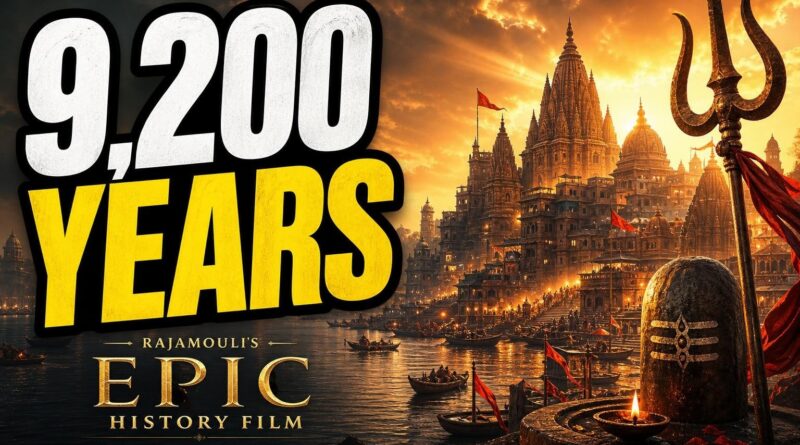
Rajamouli’s Epic 9,200-Year History Film Set in Varanasi
Rajamouli’s Epic 9,200-Year History Film Set in Varanasi
Right now, somewhere in Hyderabad’s open land, a 7,000-year-old city is under construction.
Not a CGI render. Not a green screen. A full-sized, physical replica of ancient Varanasi — built brick by brick, scaled down by about 30%, for S. S. Rajamouli’s next film.
And that’s just the set. The production has also taken its cameras to Odisha, Kenya, and — in a historic first — Antarctica’s Ross Ice Shelf, making Varanasi one of the most geographically ambitious shoots in Indian cinema history. It is, in fact, the first Indian film ever to shoot in Antarctica, and only the fourth film in the world to do so. The entire film has also been shot for IMAX — making it not just one of the most ambitious Indian productions ever, but a landmark in the format’s global history. Every frame of that ambition will breathe at the scale it deserves.
But geography isn’t even the most staggering number attached to this project. That honour belongs to the budget: ₹1,400 crore (approximately $168 million USD) — what The Indian Express has called Indian cinema’s most expensive production ever.
The Director Who Made the World Pay Attention
Before we get to what Rajamouli is building, it’s worth understanding why the world is watching him build it.
In 2022, a Telugu-language film called RRR did something that almost never happens: it crossed every language barrier, every cultural wall, and landed on global stages that Indian cinema had never reached before. Critics who had never watched a South Indian film were writing essays about it. Audiences who couldn’t read the subtitles fast enough were watching it twice.
Rajamouli didn’t stumble into that moment. He engineered it — through scale, emotion, and a filmmaker’s instinct for what makes people lean forward in their seats. RRR didn’t just perform well; it announced that Indian storytelling, told at full ambition, could compete with anything made anywhere in the world. The film’s global reach was further underscored in 2026, when Varanasi made its international debut at CCXP Mexico 2026 — following directly in RRR‘s record-breaking footsteps.
That’s the context behind every headline about Varanasi. When Rajamouli commits to a project, the question isn’t whether people will watch. The question is: how far is he willing to go this time?
The answer, apparently, is across multiple eras — spanning all the way from 7,200 BCE through to 2071, weaving through global catastrophes, asteroid threats, and a race to prevent civilisational collapse. At the centre of it all is Mahesh Babu in a dual role: playing both the hero Rudhra, a Shiva devotee on a mysterious mission that spans continents and centuries, and the Hindu deity Rama himself — a nod to the film’s deep roots in Hindu mythology and the Ramayana. His first look, unveiled to thunderous response, showed him as a fierce warrior astride a white bull, a image that immediately became one of Indian cinema’s most talked-about visuals of 2026. Alongside him, Priyanka Chopra stars as the female lead, while Prithviraj Sukumaran rounds out the principal cast in a key role.
The Team Behind the Vision
Varanasi is not a one-man show, even if Rajamouli’s name is the one that stops conversations. The film was co-written by Rajamouli himself, with the story crafted by V. Vijayendra Prasad — his father and longtime collaborator, the same storytelling mind behind Baahubali and RRR — alongside S. S. Kanchi. Dialogues have been penned by Deva Katta, a writer whose ear for character and weight of language makes him a fitting choice for a story this vast.
Behind the camera, cinematographer P. S. Vinod is responsible for capturing everything from the ancient ghats of Varanasi to the frozen expanse of Antarctica — a range that would challenge any lens in the world. Visual effects, which will inevitably carry much of the film’s 9,200-year sweep, are being handled by V. Srinivas Mohan, one of Indian cinema’s most accomplished VFX supervisors. And the score — the emotional architecture beneath all of it — belongs to M. M. Keeravani, the composer who won an Academy Award for Naatu Naatu from RRR and who understands better than almost anyone how to make a Rajamouli film feel inevitable.
A Release Date Worthy of the Ambition
Varanasi is scheduled for theatrical release on 7 April 2027. That date carries weight. It gives the production the runway it needs to finish one of the most technically complex films ever attempted in India, and it positions the film for a global conversation at a scale that even RRR — for all its extraordinary reach — never quite had the infrastructure to fully capitalise on.
The world already knows Rajamouli’s name. On 7 April 2027, it will know Varanasi.
🤖 AI Content Disclosure
This article was created using AI-assisted research and writing tools, then reviewed for quality and accuracy. Facts are sourced from publicly available web research, but readers should verify critical information from primary sources.
Published for educational and entertainment purposes. Last reviewed: September 2026