
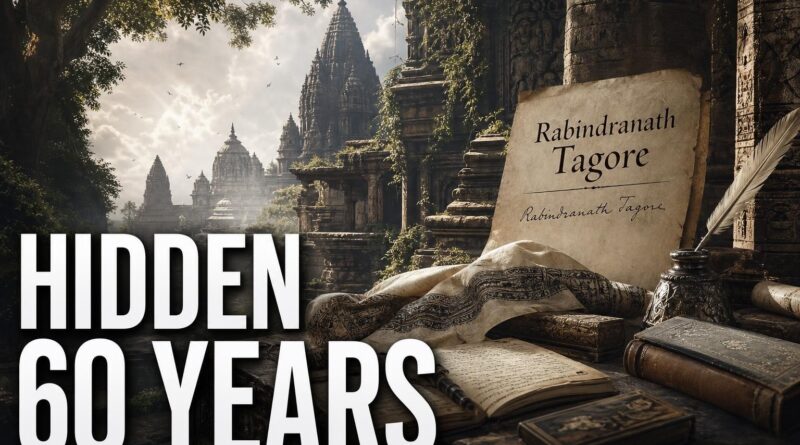
Rabindranath Tagore: The Untold Secrets
Rabindranath Tagore: The Untold Secrets
Today, August 8, marks Baishe Shraban — the 22nd day of the Bengali month of Shraban, and the anniversary of Rabindranath Tagore’s death in 1941. Across Kolkata, people are laying flowers at Jorasanko, performing Rabindra Sangeet in open courtyards, and gathering to remember a man who, by any honest measure, was one of the strangest and most extraordinary figures in modern history.
But here’s what the tributes rarely mention: Tagore didn’t just write poems. He wrote over fifty volumes of poetry, composed music, painted, built a university, won the Nobel Prize, accepted a knighthood from the British Crown — and then handed it back in protest.
That last part is the story worth telling.
The Boy Who Never Finished School
Rabindranath Tagore was born on May 7, 1861, in Calcutta — the youngest son of Debendranath Tagore, one of the most influential religious reformers in nineteenth-century Bengal. His father led the Brahmo Samaj, a new religious sect that pushed back against rigid orthodoxy and championed reason, education, and social reform. Growing up in that household meant growing up in the middle of a revolution — not one fought with weapons, but with ideas.
And yet, Tagore hated formal school. He found the rigid classroom system suffocating, and he largely educated himself through reading, observation, and the charged intellectual atmosphere of his family home. In the colonial India of the 1860s and 1870s, rejecting the English-style education system was quietly radical.
What he built instead of a degree was a body of work that would eventually run to a hundred thousand pages of print — poetry, short stories, plays, essays, songs, and paintings. Fifty volumes of poetry alone. To put that in perspective, most celebrated poets produce three or four collections in a lifetime. Tagore produced fifty.
The Nobel That Landed Like a Thunderclap
By the early twentieth century, Tagore was already celebrated across Bengal. But the world outside India had barely heard his name.
That changed in 1913, when Tagore won the Nobel Prize in Literature. The prize went to a poet from Calcutta — writing in Bengali, a language most of the Western world had never encountered — for his collection Gitanjali, a series of devotional poems he had translated into English himself on a sea voyage to England. The translations were spare, musical, and unlike anything European readers had seen. The award landed like a thunderclap.
Jawaharlal Nehru, India’s first Prime Minister, captured the scale of what Tagore represented. In The Discovery of India, Nehru wrote that “Tagore and Gandhi have undoubtedly been the two outstanding and dominating figures in the first half of the twentieth century.” Not of India. Of the century. Nehru wasn’t comparing Tagore to other Bengali writers. He was placing him alongside the man who reshaped global politics. That is the measure Nehru thought Tagore deserved.
The Knighthood He Gave Back
Two years after the Nobel, in 1915, the British Crown knighted Tagore. Sir Rabindranath Tagore. It was the highest formal honour the colonial government could bestow, and it signalled something important: the British establishment wanted to claim him. A Nobel laureate with a knighthood was useful. It suggested the Empire produced — or at least tolerated — greatness.
Tagore accepted. And then, within a few years, he resigned the honour in protest against British policies in India.
The breaking point was the Jallianwala Bagh massacre — the moment British troops opened fire on a peaceful gathering in Amritsar, killing hundreds of unarmed civilians. His letter to the Viceroy made clear that the honour had become inseparable from the government’s violence. The knighthood, in that light, was something he could no longer carry.
This was not a safe move. Tagore was in his late fifties, internationally recognised, with everything to lose from antagonising the colonial government. He gave it back anyway. The gesture cost him nothing materially and everything symbolically — which is precisely why it still resonates more than a century later.
The University in the Forest
Around the same time, Tagore was building something that had nothing to do with politics and everything to do with his deepest conviction: that education should feel like freedom, not confinement.
In 1918, Tagore founded Visva-Bharati — a university at Shantiniketan, a place his father had originally developed as a retreat in rural Bengal. The name means “the world in a home.” Tagore designed it as a space where students would learn outdoors, under trees, in an environment that wove Indian classical traditions together with the best of global thought. No rigid walls. No colonial syllabuses. A genuine attempt to imagine what education could look like if it began from curiosity rather than compliance.
On his 70th birthday, Tagore delivered an address at Visva-Bharati — a man who had rejected formal schooling as a child, now standing at the university he had built with his own vision. The symmetry is almost too neat to be true. But it is.
Visva-Bharati still exists today, now a central university of India, carrying forward an institution that began as one poet’s argument against the way the world taught its children.
Why Baishe Shraban Still Matters
Tagore died in 1941. That’s 85 years ago. And yet every year, on Baishe Shraban, Kolkata stops.
There are floral offerings at Jorasanko — the family home where he was born and where he died. There are performances of Rabindra Sangeet, the genre of music he created, which now encompasses thousands of compositions and holds its own distinct place in Bengali cultural life. There are talks, readings, and gatherings that draw people who may not be able to name a single poem but who feel, instinctively, that something important is being marked.
That instinct is not misplaced. Tagore was a poet who built a university, a knight who handed back his knighthood, and a man who wrote in a language the world didn’t know — until it did. Nehru placed him alongside Gandhi. The Nobel committee placed him among the greatest writers on earth. And every August 8, Kolkata places flowers at his door.
Some legacies don’t need explaining. They just need remembering.
Frequently Asked Questions
Why did Rabindranath Tagore return his knighthood?
Tagore returned his knighthood to the British Crown as a protest, rejecting the honor after accepting it. This act of defiance highlighted his opposition to British colonial policies in India.
How many books did Rabindranath Tagore write in his lifetime?
Tagore produced an extraordinary body of work totaling around a hundred thousand pages of print, including fifty volumes of poetry alone, far surpassing most celebrated poets who produce only three or four collections.
Why did Rabindranath Tagore never finish school?
Tagore found the rigid English-style classroom system suffocating and chose to educate himself through reading, observation, and the intellectually charged atmosphere of his family home in colonial Calcutta.
Recommended Reading
Explore these hand-picked resources to dive deeper into this topic:
- Selected Poems by Rabindranath Tagore
- The Home and the World by Rabindranath Tagore
- Tagore: A Life by Ketaki Kushari Dyson (Documentary/Biography Film)
As an Amazon Associate, we earn from qualifying purchases. This helps support Fact Storm Hub at no extra cost to you.
Sources
- https://en.wikipedia.org/wiki/Rabindranath_Tagore
- https://www.poetryfoundation.org/poets/rabindranath-tagore
- https://www.nobelprize.org/prizes/literature/1913/tagore/biographical/
- https://www.britannica.com/biography/Rabindranath-Tagore
- https://blogs.loc.gov/international-collections/2017/02/rabindranath-tagore-a-great-indian-poet-and-writer/
🤖 AI Content Disclosure
This article was created using AI-assisted research and writing tools, then reviewed for quality and accuracy. Facts are sourced from publicly available web research, but readers should verify critical information from primary sources.
Published for educational and entertainment purposes. Last reviewed: August 2026