
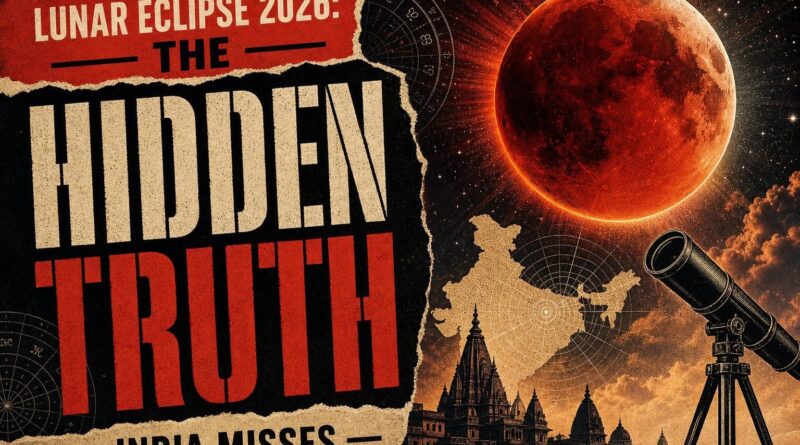
Lunar Eclipse 2026: The Hidden Truth India Misses
Lunar Eclipse 2026: The Hidden Truth India Misses
This Raksha Bandhan, something extraordinary is happening in the sky — and almost no one in India will witness it.
On August 28, 2026, the same night families across India tie rakhis and celebrate the bond between siblings, a partial lunar eclipse will sweep across the other side of the world. Nearly 96% of the Moon’s surface will disappear into Earth’s shadow. And India will miss every second of it.
That’s the story. And it’s stranger than it sounds.
What’s Actually Happening on August 28, 2026
Partial lunar eclipses happen when the Moon passes through Earth’s dark inner shadow — called the umbra — but doesn’t pass through completely. That’s the textbook definition. Here’s where August 28 gets unusual.
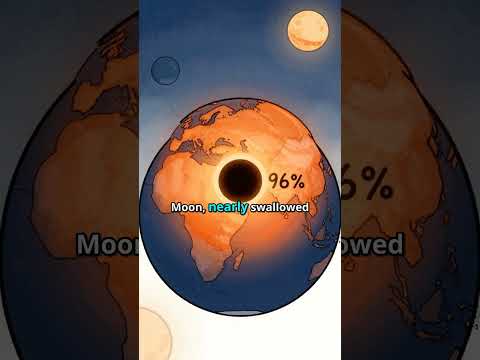
The umbral magnitude of this eclipse is 0.9319. In plain terms: 96% of the Moon’s disk will be covered by Earth’s darkest shadow. That’s not a “partial” eclipse in the casual sense — that’s the Moon nearly vanishing. At maximum coverage, only a thin sliver of the Moon will remain in direct sunlight, while the rest sits deep inside Earth’s shadow, turning a deep, blood-orange red.
The greatest point of the eclipse hits at 04:12:53 UTC — which translates to 09:43 AM IST on August 28. By that time in India, the Moon has already set below the horizon. The show is over before India even wakes up to it.
The partial eclipse phase alone runs for 3 hours and 18 minutes. The entire event, from the first contact with Earth’s outer shadow to the last, lasts 5 hours and 38 minutes. That’s not a fleeting celestial moment — it’s a half-night event for the people lucky enough to be on the right side of the planet.
Why India Misses It — And Who Gets the Front Row
The Moon doesn’t care about geography, but Earth’s rotation does. At the moment this eclipse reaches its peak, the Moon is simply below the horizon across all of India. The umbral phase — the dramatic, visually striking portion — is completely invisible from the Indian subcontinent.
So who gets to watch?
All of South America has a clear, full view. Most of North America sees the eclipse from start to finish. Observers in Europe, Africa, and the Middle East catch it low near the horizon at moonset — a brief, dramatic window before the Moon disappears from their sky too.
For observers in South America and North America, August 28 delivers a rare near-total partial eclipse with nearly 96% umbral coverage. For anyone in Mumbai, Delhi, or Chennai — it simply doesn’t exist that night.
This geographic divide is a reminder of something easy to forget: space events are not universal broadcasts. They’re location-dependent, like a concert that only plays in certain cities.
The Raksha Bandhan Question — Does the Eclipse Affect the Rituals?
When news of a lunar eclipse on Raksha Bandhan circulated, a reasonable question followed: does Sutak Kaal apply?
Sutak Kaal is the period of ritual restriction that traditionally precedes a lunar eclipse — a time when certain religious activities are paused out of respect for the celestial event. In traditional practice, this window begins several hours before the eclipse and ends only after the Moon is ritually cleansed.
The answer for 2026 is clear: because the lunar eclipse is not visible in India, Sutak Kaal does not apply. Religious authorities and almanac traditions generally hold that eclipse-related restrictions only apply in regions where the eclipse can actually be seen. Since the Moon is below the horizon across India during the entire umbral phase, there is no ritual impact.
All Raksha Bandhan ceremonies — the rakhi tying, the puja, the family rituals — can proceed exactly as they normally would. The eclipse happening on the other side of the world changes nothing for celebrations in India.
August 2026: The Rarest Kind of Month
August 2026 doesn’t just have a lunar eclipse — it has both a solar eclipse and a lunar eclipse within the same calendar month, a combination that occurs far less frequently than either eclipse type on its own.
August 12, 2026 — Hariyali Amavasya — brings a total solar eclipse. Sixteen days later, the partial lunar eclipse arrives on August 28. Two eclipses. One month. Neither visible in India.
Solar and lunar eclipses always occur near opposite phases of the Moon — a solar eclipse at new moon, a lunar eclipse at full moon. For both to fall within a single calendar month, the timing of the Moon’s orbit and its crossing points with Earth’s orbital plane have to align in a very specific way. When that alignment happens, astronomers take notice.
The fact that both events fall outside India’s viewing window in the same month is its own statistical curiosity — a month of celestial drama unfolding just out of reach.
What 96% Coverage Actually Looks Like
It’s worth pausing on that number: 0.9319 umbral magnitude, nearly 96% of the Moon’s disk inside Earth’s darkest shadow.
A total lunar eclipse — where 100% of the Moon enters the umbra — turns the Moon a deep red or orange, because Earth’s atmosphere bends sunlight around the planet and scatters it onto the Moon’s surface. That’s the famous “blood moon” effect.
At 96% coverage, the Moon doesn’t quite reach that full transformation. But it comes extraordinarily close. The portion inside the umbra will glow with those same reddish hues — the scattered light of every sunrise and sunset on Earth simultaneously projected onto the Moon’s surface. The thin sliver still in direct sunlight will appear bright white by contrast, making the color difference between the two portions stark and dramatic.
For observers in South America watching with binoculars or a telescope, the visual contrast — bright white edge against a deep red-orange body — will be one of the more striking sights the night sky offers in 2026. India gets the festival. The rest of the world gets the eclipse.
Frequently Asked Questions
Will the lunar eclipse on Raksha Bandhan 2026 be visible in India?
No, the lunar eclipse on August 28, 2026 will not be visible in India. At the time of greatest eclipse (09:43 AM IST), the Moon has already set below the Indian horizon, making it completely invisible from the country.
How much of the Moon will be covered during the August 2026 partial lunar eclipse?
During the August 28, 2026 partial lunar eclipse, approximately 96% of the Moon’s surface will be covered by Earth’s darkest shadow (umbra), with an umbral magnitude of 0.9319, causing the Moon to appear deep blood-orange red.
What time does the lunar eclipse reach its peak on August 28 2026?
The lunar eclipse reaches its greatest point at 04:12:53 UTC on August 28, 2026, which translates to 09:43 AM IST. The partial eclipse phase alone lasts 3 hours and 18 minutes, with the entire event spanning 5 hours and 38 minutes.
Recommended Reading
Explore these hand-picked resources to dive deeper into this topic:
- Cosmos: A Spacetime Odyssey by Carl Sagan
- The Universe in a Nutshell by Stephen Hawking
- Celestron 70mm Refractor Telescope
As an Amazon Associate, we earn from qualifying purchases. This helps support Fact Storm Hub at no extra cost to you.
Sources
- https://zendaruniverse.com/updates/chandra-grahan-2026-aug-28-raksha-bandhan-lunar-eclipse-india-time-sutak/
- https://www.drikpanchang.com/eclipse/lunar-eclipse-date-time-duration.html
- https://news.abplive.com/religion/will-sutak-affect-raksha-bandhan-2026-know-the-impact-of-the-lunar-eclipse-in-india-1860051
- https://www.indiatvnews.com/lifestyle/spirituality/solar-eclipse-lunar-eclipse-surya-grahan-chandra-grahan-sutak-lagega-ya-nahi-raksha-bandhan-grahan-2026-07-24-1049327
- https://www.myzodiaq.in/en/online-library/festivals-and-astrology/festival-muhurat-ritual-2026/rakshabandhan-lunar-eclipse
🤖 AI Content Disclosure
This article was created using AI-assisted research and writing tools, then reviewed for quality and accuracy. Facts are sourced from publicly available web research, but readers should verify critical information from primary sources.
Published for educational and entertainment purposes. Last reviewed: August 2026