
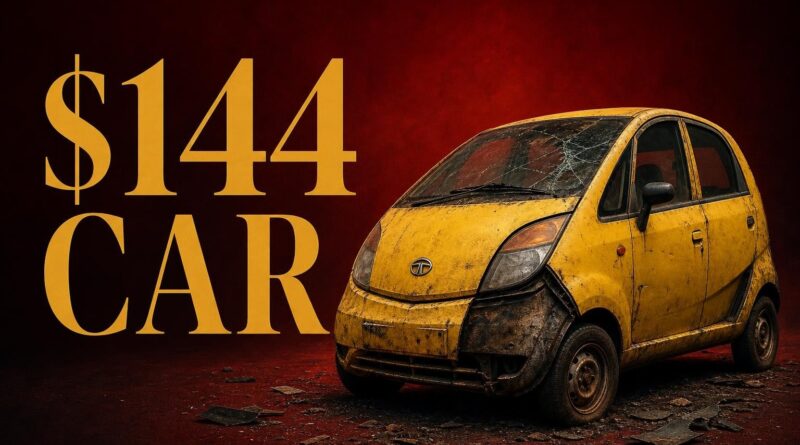
Why India’s Cheapest Car Failed Spectacularly
Why India’s Cheapest Car Failed Spectacularly
Tata sold 10,339 EVs in May 2026. Mahindra, its closest rival, sold 6,210 in the same month. Tata Motors is, by a wide margin, winning the electric race in India. And now, quietly, one of its own design heads is asking a question that would have sounded ridiculous five years ago: what if the Nano came back?
Not as a cheap car. As an electric one.
The Dream That Ratan Tata Built
The original Tata Nano launched commercially in 2009 with one of the most ambitious goals in Indian automotive history: bring four-wheel mobility to families who had never been able to afford it.
Think about what that actually meant. Millions of Indian families were travelling on two-wheelers — sometimes all four of them, through rain, through heat, on highways. The Nano was designed to change that. One roof. Four wheels. A price that didn’t require a second mortgage.
On paper, it was a genuine engineering achievement. Tata’s team had built a real car at a price point that global manufacturers said was impossible. The world noticed. Journalists flew in. Awards were discussed. Ratan Tata himself had championed it for years.
For a brief moment, the Nano felt like it could rewrite what Indian mobility looked like.
The Label That Became a Trap
Here’s where the story turns.
The moment the Nano was marketed as the “world’s cheapest car,” something shifted in how Indian buyers saw it — and not in the direction Tata had hoped.
In India, a car has never been just a vehicle. It is a statement. It signals where a family has arrived, what they’ve worked toward. When the Nano became synonymous with “cheapest,” it stopped being aspirational. Buyers who could afford it began to wonder what it said about them. Buyers who stretched a little further bought a conventional hatchback instead.
The positioning that was meant to be a selling point became the reason people walked away. Indian consumers didn’t want the cheapest car. They wanted a car that didn’t feel cheap. That distinction — small in words, enormous in consequence — is what unravelled the Nano’s commercial future. Sales declined. Production eventually stopped.
The car that was supposed to democratise Indian roads quietly disappeared from showrooms.
The Render That Caught a Design Head’s Eye
Fast-forward to 2026. Tata Motors’ India Design Head, Ajay Jain, sits down for an interview with ABP Auto Live. Someone asks him about the AI-generated renders of an electric Nano that have been circulating online — sleek, rounded, unmistakably Nano in silhouette but reimagined for a different era.
Jain’s response was careful, but it landed like a signal flare.
He confirmed he had seen the renders. He said they represent what people want from the brand. And then he said something that sent automotive enthusiasts into a spiral: it would be his pleasure, he said, to sit at the same table in a few years and announce the comeback of the Nano — in an electric avatar.
To be clear: Tata Motors has not officially confirmed a new Nano. There is no announced development programme, no launch timeline, no specifications on record. Ajay Jain was explicit that the AI renders should not be read as a product announcement.
But a design head doesn’t say “it would be my pleasure” about something he thinks is impossible.
Why the Timing Actually Makes Sense
Forget nostalgia for a moment. Look at the numbers.
Tata sold 10,339 EVs in May 2026 alone. The company is not experimenting with electric — it is leading it. The infrastructure, the manufacturing knowledge, the consumer trust in Tata’s EV lineup — all of it exists right now in a way it simply didn’t when the original Nano was struggling.
More importantly, the problem the Nano was trying to solve hasn’t gone away. Indian families still need affordable, practical urban transport. Traffic in cities like Mumbai and Pune has only grown denser. Fuel prices remain a pressure point for middle-income households. A small, affordable electric car — one that doesn’t carry the “cheapest” stigma but instead carries the “smart urban choice” framing — lands in a completely different cultural moment than the 2009 original did.
The original Nano failed partly because the market wasn’t ready for it, and partly because it was sold wrong. An electric Nano wouldn’t be the car for people who can’t afford better. It would be the car for people who are smart enough to not want more than they need.
That’s a different story entirely.
Final Thought
The original Nano’s tragedy wasn’t the engineering — it was the label. “World’s cheapest car” told buyers exactly what Tata didn’t want them to feel: that choosing it was settling. An electric Nano in 2026 or beyond wouldn’t carry that weight. It would arrive in a market where Tata has already sold over 10,000 EVs in a single month, where small and efficient is increasingly seen as intelligent rather than inferior. Ajay Jain’s words weren’t a product launch. But they were something more interesting — a signal that the people inside Tata Motors haven’t forgotten what the Nano was supposed to mean. Whether the car comes back or not, that idea — affordable mobility as genuine aspiration — never really left.
Frequently Asked Questions
Why did the Tata Nano fail in India?
The Tata Nano failed largely because being marketed as the ‘world’s cheapest car’ made it unappealing to Indian buyers, who view cars as status symbols. The cheapest label removed its aspirational value, causing buyers to choose conventional hatchbacks instead.
What was the original purpose of the Tata Nano?
The Tata Nano was launched in 2009 to provide affordable four-wheel mobility to Indian families who previously travelled on two-wheelers. Ratan Tata championed it as a way to give millions of families a safer, covered alternative at an unprecedented price point.
Is the Tata Nano coming back as an electric car?
Tata Motors design heads have quietly raised the possibility of reviving the Nano as an electric vehicle, not as a cheap car. This comes as Tata dominates India’s EV market, selling 10,339 electric vehicles in May 2026.
Recommended Reading
Explore these hand-picked resources to dive deeper into this topic:
- The Innovators: How a Group of Hackers, Geniuses, and Geeks Created the Digital Revolution by Walter Isaacson
- India Unbound: The Social and Economic Revolution from Independence to the Global Information Age by Gurcharan Das
- Startup India Documentary Series (entrepreneurship case studies)
As an Amazon Associate, we earn from qualifying purchases. This helps support Fact Storm Hub at no extra cost to you.
Sources
- https://www.youtube.com/watch?v=w3AqoGqvbsA
- https://www.autopunditz.com/post/tata-nano-ev-comeback-revival-hinted
- https://www.cartoq.com/car-news/tata-nano-comeback-electric-vehicle/
- https://www.cardekho.com/tata/nano-ev
- https://www.google.com/goto?url=CAESegHuR6pNw53XVg22D27TqgQkZC3zbEQooXXl-Rn8JnDXEKIdpGLstUYBQbQgkYMwB5tG3hJ1db0-8EMXHGxd9XJ3KFWABh7FkSrBc0ieVVTSwcnVn0ARduSq1eIpgi5TdjgGwAHTojO2GtvQrdxFES7vtuP4KgQHjOyW
🤖 AI Content Disclosure
This article was created using AI-assisted research and writing tools, then reviewed for quality and accuracy. Facts are sourced from publicly available web research, but readers should verify critical information from primary sources.
Published for educational and entertainment purposes. Last reviewed: August 2026