
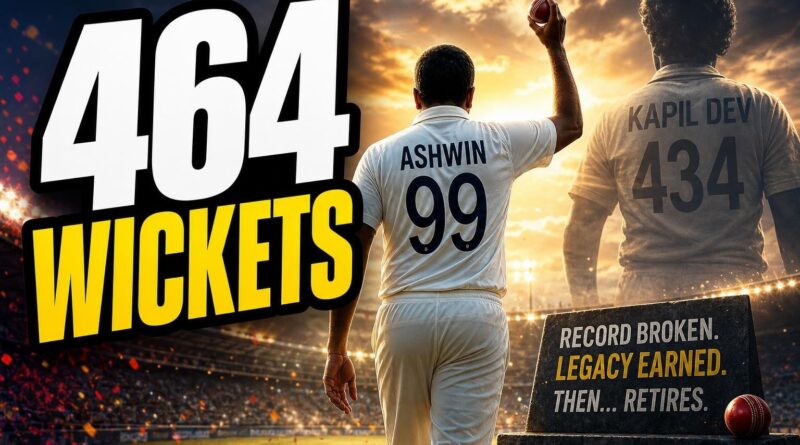
Ashwin Breaks Kapil Dev’s Record, Then Retires
Ashwin Breaks Kapil Dev’s Record, Then Retires
December 2024. Australia series. Third Test. And just like that, Ravichandran Ashwin — India’s second-highest wicket-taker in Test history — announced his retirement from international cricket, effective immediately.
No farewell tour. No final home match. No standing ovation at Chepauk. Just a quiet exit from the sport he had dominated for over a decade.
And now, in IPL 2026, he’s still turning his arm over for Rajasthan Royals — while Sunrisers Hyderabad are apparently struggling to figure out how to handle him. The internet in India is buzzing. But to understand why Ashwin’s story cuts so deep, you have to start long before any of this.
The Boy From Madras Who Became a Weapon
Born on 17 September 1986 in Madras — what we now call Chennai — Ravichandran Ashwin grew up in a city that breathes cricket. Tamil Nadu has produced legends, but off-spinners who could genuinely trouble the world’s best? That was a different ask entirely.
Ashwin’s debut came in June 2010 — first in ODIs against Sri Lanka on 5 June, then in T20Is against Zimbabwe just a week later on 12 June. The format-hopping debut told you something: selectors weren’t sure where he fit. He was a spinner in an era when India already had Harbhajan Singh. He was a lower-order batter who could actually bat. He was a thinker in a sport that often rewards instinct over calculation.
His Test debut arrived on 6 November 2011 against West Indies, when he was handed cap number 271. From that moment, he began building something that would take the cricketing world years to fully appreciate.
The Number That Rewrote Indian Cricket History
Kapil Dev’s 434 Test wickets had stood as India’s second-highest Test wicket tally for decades. Not just a record — a monument. Kapil was India’s original fast-bowling hero, the man who lifted the 1983 World Cup. His wicket tally felt untouchable.
In March 2022, Ashwin touched it — and then passed it.
That single moment reframed everything. Here was an off-spinner, not a pace bowler, dismantling a record that had survived the careers of Kumble, Srinath, Zaheer, Harbhajan, and a dozen others. Ashwin didn’t just sneak past Kapil — he did it methodically, wicket by wicket, series by series, across every continent where India played Test cricket.
To be clear about where he stands: Anil Kumble’s 619 Test wickets remain India’s all-time record. Ashwin sits at number two. But the Kapil Dev milestone mattered differently — it marked the moment the cricket world had to stop treating Ashwin as “a very good spinner” and start treating him as one of the greatest bowlers India has ever produced.
The Retirement Nobody Saw Coming
By December 2024, Ashwin had spent over a decade at the top of Indian Test cricket. The third Test of the Australia series ended — and he was done.
No press conference scheduled weeks in advance. No emotional send-off. The announcement came with the abruptness of a wicket falling on the first ball of the day — sudden, clean, final.
What makes this retirement genuinely striking isn’t just the timing. It’s the contrast. Ashwin had just surpassed Kapil Dev’s record two years earlier. He was still effective. Still thinking batsmen out, not just bowling at them. And yet he chose to stop.
Cricketers of his stature usually squeeze every last cap out of their international career. Ashwin did the opposite. He decided the terms of his own exit — and he did it on a tour of Australia, thousands of kilometres from home.
The Chapter Nobody Expected: Major League Cricket
After the retirement announcement, something unusual happened. Ravichandran Ashwin — India’s second-greatest Test wicket-taker — signed a contract to play for a US-based Major League Cricket team.
Read that again.
A 38-year-old off-spinner who had just walked away from Test cricket at the highest level was now heading to a league that most Indian cricket fans couldn’t name three teams from. It wasn’t a farewell gesture. It was a genuine cricket move — a sign that Ashwin had no interest in simply fading out. He wanted to keep competing, just on his own terms.
This matters for Indian cricket fans because it signals something larger: the generation of cricketers who built their careers in the Test arena are increasingly finding second acts in franchise cricket globally. Ashwin isn’t chasing relevance. He’s choosing where he wants to play — and that choice is a statement in itself.
IPL 2026: Still Turning, Still Troubling
Which brings us to right now. IPL 2026. Rajasthan Royals. And Ravichandran Ashwin is still very much in the game.
His recent figures tell the story plainly: 2 wickets for 41 runs against RR on 20 May 2025, and 2 wickets for 48 runs against PBKS on 8 April 2025. These aren’t the numbers of a cricketer going through the motions. They’re the numbers of a bowler who still understands the geometry of a T20 innings better than most.
The current buzz — SRH apparently lacking the tactical awareness to handle Ashwin — fits a pattern that has followed him his entire career. Teams keep underestimating him. They look at the age, the format, the era, and they miscalculate. Then he takes their wickets.
In T20 cricket, where raw pace and power often dominate the conversation, Ashwin has always been the inconvenient exception — the spinner who makes you think, makes you second-guess, and then makes you walk back to the pavilion wondering what just happened.
Final Thought
Ashwin’s story isn’t really about the SRH tactical oversight or even the IPL 2026 season. It’s about what happens when a cricketer refuses to let anyone else define his career arc. He surpassed Kapil Dev’s 434 wickets in March 2022 — one of the most storied numbers in Indian cricket — and then, two years later, retired on a tour of Australia without waiting for a farewell. He signed with Major League Cricket when most players his age are looking for commentary roles. And now he’s still picking up wickets in the IPL at an age when the format is supposed to have moved on from him.
The question isn’t whether Ashwin belongs in T20 cricket in 2026. The numbers say he does. The real question is why, after everything he’s achieved, so many teams still haven’t figured out how to read him.
Frequently Asked Questions
When did Ravichandran Ashwin retire from international cricket?
Ravichandran Ashwin announced his retirement from international cricket in December 2024, during the Australia series in the Third Test, with no farewell tour or final home match — just an immediate and quiet exit.
How many Test wickets did Ravichandran Ashwin take in his career?
Ashwin surpassed Kapil Dev’s long-standing record of 434 Test wickets, making him India’s second-highest wicket-taker in Test history, a monument many considered untouchable for decades.
When did Ravichandran Ashwin make his Test debut for India?
Ashwin made his Test debut on 6 November 2011 against West Indies, receiving cap number 271, having already debuted in ODIs against Sri Lanka on 5 June 2010 and T20Is against Zimbabwe on 12 June 2010.
Recommended Reading
Explore these hand-picked resources to dive deeper into this topic:
- Straight Drive: My Life in Cricket by Ravichandran Ashwin
- The Test: My Life Through Cricket by Virat Kohli
- ESPN+ Cricket Documentary Series (streaming sports content)
As an Amazon Associate, we earn from qualifying purchases. This helps support Fact Storm Hub at no extra cost to you.
Sources
- https://en.wikipedia.org/wiki/Ravichandran_Ashwin
- https://www.espncricinfo.com/cricketers/ravichandran-ashwin-26421
- https://www.cricbuzz.com/profiles/1593/ravichandran-ashwin
- https://www.youtube.com/@AshwinRavi99
- https://www.raviashwin.com/
Watch the Video
🤖 AI Content Disclosure
This article was created using AI-assisted research and writing tools, then reviewed for quality and accuracy. Facts are sourced from publicly available web research, but readers should verify critical information from primary sources.
Published for educational and entertainment purposes. Last reviewed: June 2026