
Solar Eclipse: Why the Moon Perfectly Blocks the Sun
Solar Eclipse: Why the Moon Perfectly Blocks the Sun
In three days, a shadow travelling at thousands of kilometres per hour will sweep across the Atlantic Ocean and plunge parts of Spain into darkness at midday — for the first time in over a century. The window lasts exactly two minutes and 18 seconds. Eclipse chasers have already booked their flights. And the reason any of it is possible comes down to a coincidence so improbable it has no scientific explanation.
That’s not poetry. That’s physics. Here’s how it works.
The Cosmic Coincidence Nobody Talks About
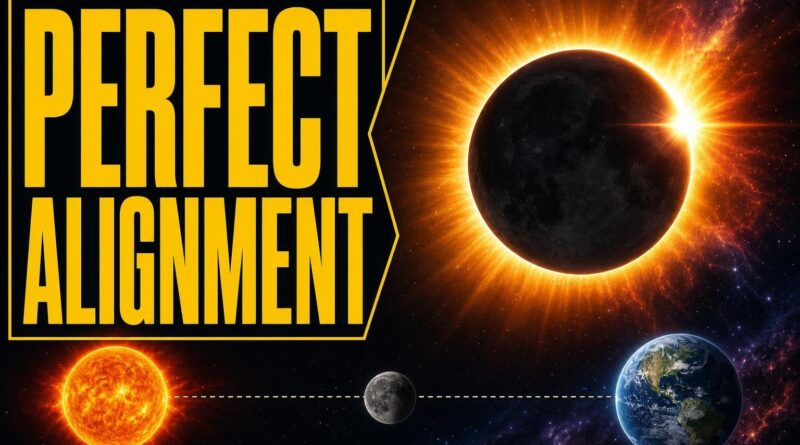
The sun is roughly 400 times wider than the moon. That gap is so vast that the moon should look like a pea trying to cover a basketball — a faint dimming at best, nothing more.
But the sun is also about 400 times farther from Earth than the moon is. Those two numbers cancel each other out almost perfectly. From the surface of Earth, the moon and the sun appear almost exactly the same size in the sky.
That’s not a law of physics. It’s not written into the structure of the universe. It’s a coincidence — and it’s the reason that when the moon slides between Earth and the sun at precisely the right angle, it fits like a key in a lock. The blazing disc vanishes. The sky drops to an eerie twilight. Stars appear at noon. And the sun’s outer atmosphere — the corona, normally invisible against the sun’s overwhelming glare — blazes into view like a white crown around a hole in the sky.
No other planet in our solar system has a moon that produces this effect. We live on the one world where it happens. That alone should make you stop.
So Why Doesn’t It Happen Every Month?
The moon completes one orbit around Earth roughly every month. Logic says there should be a solar eclipse every time it passes between Earth and the sun. They’d be routine. Nobody would cross an ocean to see one.
The reason that doesn’t happen comes down to five degrees.
The moon’s orbit is tilted by about five degrees relative to Earth’s path around the sun. That sounds small. In space, it creates enormous misses. Most months, when the moon passes between Earth and the sun, it slides slightly above or slightly below the solar disc. No alignment, no eclipse.
A total solar eclipse only occurs when the geometry lines up exactly: the moon must be at the precise point in its tilted orbit at the same moment it’s passing between Earth and the sun. When that rare combination clicks into place, the moon’s shadow — called the umbra — carves a narrow strip across Earth’s surface. That strip is the path of totality. Step outside it, even by a short distance, and you’ll see only a partial dimming. Step inside it, and the sky goes dark at midday.
On August 12, 2026, that strip runs across Greenland, Iceland, northern Spain, and a small portion of Portugal.
August 12, 2026: What’s Actually Happening
The timeline is precise. At approximately 4:58 p.m. UTC on August 12, the moon’s shadow makes first contact with Earth and totality begins at its opening location. The shadow then races westward across the Atlantic, sweeping over Iceland and Greenland before descending into Europe.
Maximum eclipse — the moment when totality reaches its longest duration anywhere on the path — arrives at 5:46 p.m. UTC. At that peak point along the centreline, the sky will go dark for two minutes and 18 seconds.
By roughly 6:34 p.m. UTC, the shadow lifts from its final location and the eclipse ends.
That full sequence — from first contact to last — runs just under two hours. But the darkness itself, for any single location in the path, lasts no more than two minutes and 18 seconds. That is the window eclipse chasers will cross continents to stand inside.
For those outside the path — including observers in India, where this eclipse will not be visible — multiple astronomy outlets are streaming the event live.
A Century Without Darkness: Why Spain Matters
For the cities of northern Spain sitting inside the path of totality, August 12, 2026 carries a weight that goes beyond astronomy. The Iberian Peninsula has not experienced a full solar eclipse in more than a century. Entire generations have been born, lived full lives, and died without once seeing the sky go dark at midday over their home.
That changes on August 12. Astronomers, photographers, and travellers are already converging on northern Spain, drawn by the combination of the eclipse path and the likelihood of clear August skies. For many locals, it will be the only total solar eclipse they ever witness from their own country.
That context matters. A total solar eclipse isn’t just a visual event — it’s a sensory one. Temperatures drop. Animals go quiet. The wind shifts. And for two minutes and 18 seconds, a region that has waited over a hundred years gets to see stars at five in the afternoon.
August 2026’s Second Eclipse
The August 12 solar eclipse doesn’t close out the month alone. On August 27–28, a partial lunar eclipse follows — and together, these two events are the last eclipses of 2026.
A lunar eclipse runs on opposite geometry. Instead of the moon blocking sunlight from reaching Earth, Earth blocks sunlight from reaching the moon. The moon passes through Earth’s shadow. In a total lunar eclipse, the moon turns deep red — lit only by light that has filtered through every sunrise and sunset happening simultaneously around Earth’s rim. August 27–28 brings a partial version: only a portion of the moon enters Earth’s shadow.
Two eclipses in a single month, closing out the year. It’s a reminder that these events, rare as they feel from the ground, follow a clockwork logic. Astronomers calculated the date of the August 12 eclipse long before anyone alive today was born. The next one already has a date too.
Final Thought
Two minutes and 18 seconds. That’s the entire window — and Spain hasn’t had one in over a century. What makes solar eclipses genuinely extraordinary isn’t the spectacle alone. It’s that they exist because of a coincidence so precise — the sun being 400 times wider than the moon, and 400 times farther away — that if either number shifted even slightly, the corona would never be visible, eclipse chasing wouldn’t exist, and no one would ever have stood in a field at 5:46 p.m. on an August afternoon and watched stars appear. The universe didn’t owe us that. It just happened to work out.
Frequently Asked Questions
Why does the moon perfectly block the sun during a solar eclipse?
The sun is about 400 times wider than the moon, but also 400 times farther away, making them appear almost exactly the same size from Earth. This remarkable coincidence allows the moon to completely cover the sun’s disc.
Why doesn’t a solar eclipse happen every month?
Although the moon orbits Earth roughly every month, its orbit is tilted by about five degrees relative to Earth’s path around the sun, meaning the moon usually passes above or below the sun rather than directly in front of it.
What can you see during a total solar eclipse that you normally can’t?
During a total solar eclipse, the sun’s outer atmosphere, called the corona, becomes visible as a glowing white crown around the darkened disc — normally hidden by the sun’s overwhelming brightness.
Recommended Reading
Explore these hand-picked resources to dive deeper into this topic:
- Astrophysics for People in a Hurry by Neil deGrasse Tyson
- The Universe in a Nutshell by Stephen Hawking
- Solar Eclipse Glasses (ISO 12312-2 certified)
As an Amazon Associate, we earn from qualifying purchases. This helps support Fact Storm Hub at no extra cost to you.
Sources
- https://www.timeanddate.com/live/
- https://www.nationalgeographic.com/science/article/august-2026-total-solar-eclipse
- https://www.wired.com/story/two-eclipses-august-how-to-see-them/
- https://www.youtube.com/watch?v=NN58l6ERiDg
- https://theskylive.com/solar-eclipse?id=2027-08-02&cc=IN
🤖 AI Content Disclosure
This article was created using AI-assisted research and writing tools, then reviewed for quality and accuracy. Facts are sourced from publicly available web research, but readers should verify critical information from primary sources.
Published for educational and entertainment purposes. Last reviewed: August 2026