
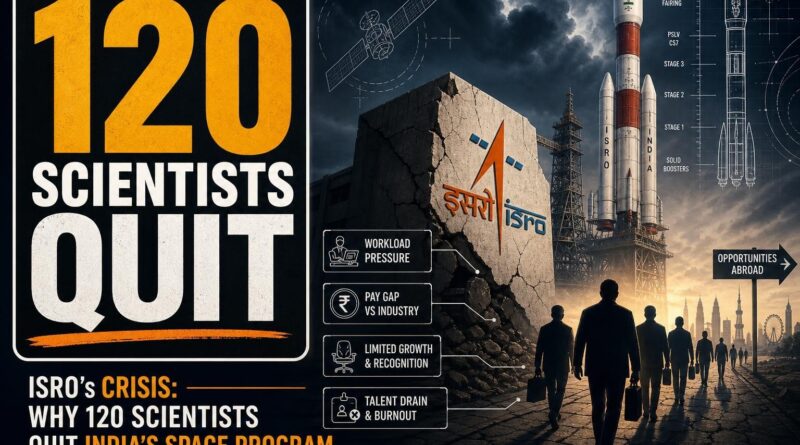
ISRO’s Crisis: Why 120 Scientists Quit India’s Space Program
ISRO’s Crisis: Why 120 Scientists Quit India’s Space Program
one of the six largest space agencies in the world. The organisation that sent a spacecraft to the Moon’s south pole. The same team now preparing to send Indian astronauts into orbit.
And right now, at least 120 of its scientists have walked out the door.
This week, news broke that a wave of resignations from ISRO — including personnel who worked on the SpaDeX and Chandrayaan-3 missions — was serious enough to make the Modi government act. New approval norms for scientists seeking to resign or take voluntary retirement are being introduced. A national-level expert committee has been formed to investigate an anomaly in a PSLV vehicle.
Something is clearly wrong inside Indian space’s most important institution. But to understand why this matters so much, you need to understand what ISRO actually is — and how extraordinary it is that it exists at all.
The Organisation That Wasn’t Supposed to Work
ISRO was formed in 1969. India at that point had no satellite, no launch vehicle, and no space infrastructure. The country had just come through a war, was managing food shortages, and was nowhere near the list of nations anyone expected to become a space power.
The organisation that ISRO replaced — INCOSPAR — had been running on ambition and very little else. When ISRO took over, it inherited that ambition and slowly, painstakingly, built the hardware to back it up.
What it built over the following decades is genuinely remarkable. ISRO is now one of the six largest space agencies in the world. It operates one of the largest fleets of communication satellites — the INSAT system — and one of the most extensive remote sensing satellite networks on Earth, the IRS constellation. These aren’t prestige projects. They power India’s weather forecasting, disaster management, crop monitoring, and rural communications.
The agency didn’t get here by spending like NASA. It got here by being extraordinarily careful with money and extraordinarily demanding of its people. That second part is now creating a problem.
The Resignations Nobody Saw Coming
At least 120 scientists have left ISRO in recent months. That number alone would be alarming at any space agency. But the specific people leaving make it worse.
Among those who resigned are personnel from the SpaDeX mission and the Chandrayaan-3 mission. These aren’t junior hires who joined for two years and moved on. These are specialists who worked on some of the most complex engineering projects India has ever attempted — the kind of institutional knowledge that takes a decade to build and cannot be replaced with a job posting.
The government’s response tells you how seriously this is being taken. India has introduced stricter approval norms for scientists who want to resign or take voluntary retirement. In plain terms: leaving ISRO is now harder than it used to be. That is an unusual step for any government to take with its own employees, and it signals that the exits are happening faster than the system can absorb.
A national-level expert committee has also been constituted to review an anomaly in a PSLV vehicle — India’s workhorse rocket, the one that has launched satellites for dozens of countries. Whether the two developments are connected is not yet clear. But the timing means ISRO is managing a talent crisis and a technical investigation simultaneously.
What Scientists Leave For — And Why It Matters
The research doesn’t give us a single stated reason why 120 scientists resigned. But the pattern itself is the story.
Private space companies are growing fast in India. AgniKul Cosmos, for example, is preparing for Mission 02 — and its board now includes former ISRO chief Somanath as an Observer. That detail is significant. When the person who led ISRO moves toward a private rocket startup, it reflects a broader shift in where Indian space ambition is being channelled.
This is not unique to India. NASA has faced the same dynamic for decades — its best engineers trained in government labs, then recruited by SpaceX or Blue Origin at salaries the government couldn’t match. The difference in India is that the private space ecosystem is newer, which means ISRO’s talent pool is being drawn on before the agency has had time to build a replacement pipeline.
The introduction of stricter exit norms might slow the outflow. But it doesn’t address the underlying question: what makes a scientist choose to stay?
The Mission That Can’t Afford to Lose People
Gaganyaan is ISRO’s most ambitious project. India’s first crewed spaceflight. The programme that would make India only the fourth country to independently send humans to space.
Progress is continuing. ISRO successfully conducted an Integrated Main Parachute Air Drop Test — the IMAT — for the Gaganyaan Programme. That test is a critical safety milestone: it validates the parachute system that would bring the crew module back to Earth safely. Getting that right is non-negotiable.
But Gaganyaan is also exactly the kind of mission that depends on continuity. You cannot swap out the engineers who designed the life support system halfway through development and expect nothing to change. Every resignation from the Gaganyaan team is not just a personnel loss — it is a potential delay, a re-learning curve, a safety review that needs to start again.
This is why the 120 resignations are not just an HR headline. They are a mission-critical problem for a programme that has national and international eyes on it.
Final Thought
ISRO’s story has always been one of doing more with less — less money, less infrastructure, less time than its rivals. That constraint built a culture of extraordinary dedication. But dedication is not infinite, and the resignation of at least 120 scientists, including veterans of Chandrayaan-3 and SpaDeX, reveals the cost of decades of under-investment in the people behind the missions. The government’s decision to tighten exit norms is a response, not a solution. The real test will come when Gaganyaan’s crew module sits on the launchpad — and whether the team that designed it is still in the room to see it fly.
Frequently Asked Questions
Why are ISRO scientists resigning in 2024?
At least 120 ISRO scientists have resigned, including personnel from the SpaDeX and Chandrayaan-3 missions. The situation was serious enough for the Modi government to introduce new approval norms for resignations and form a national-level expert committee.
How many scientists have quit ISRO recently?
At least 120 scientists have walked out of ISRO, prompting the Indian government to take action by introducing new approval norms for scientists seeking to resign or take voluntary retirement from the organisation.
What is ISRO and why is it important to India?
ISRO, formed in 1969, is one of the six largest space agencies in the world. It operates India’s INSAT communication satellites and IRS remote sensing network, which power the country’s weather forecasting, disaster management, crop monitoring, and rural communications.
Recommended Reading
Explore these hand-picked resources to dive deeper into this topic:
- The Idea of India by Sunil Khilnani
- Failures and Fixes: How India Can Compete in the Global Economy by Kiran Mazumdar-Shaw
- ISRO Mars Mission Documentary (space exploration film)
As an Amazon Associate, we earn from qualifying purchases. This helps support Fact Storm Hub at no extra cost to you.
Sources
- https://www.isro.gov.in/
- https://en.wikipedia.org/wiki/ISRO
- https://in.linkedin.com/company/officialisro
- https://www.britannica.com/topic/Indian-Space-Research-Organisation
- https://www.theregister.com/science/2026/07/14/indias-crewed-space-mission-is-ready-for-splashdown-but-not-launch/5270879

Watch the Video
🤖 AI Content Disclosure
This article was created using AI-assisted research and writing tools, then reviewed for quality and accuracy. Facts are sourced from publicly available web research, but readers should verify critical information from primary sources.
Published for educational and entertainment purposes. Last reviewed: July 2026