
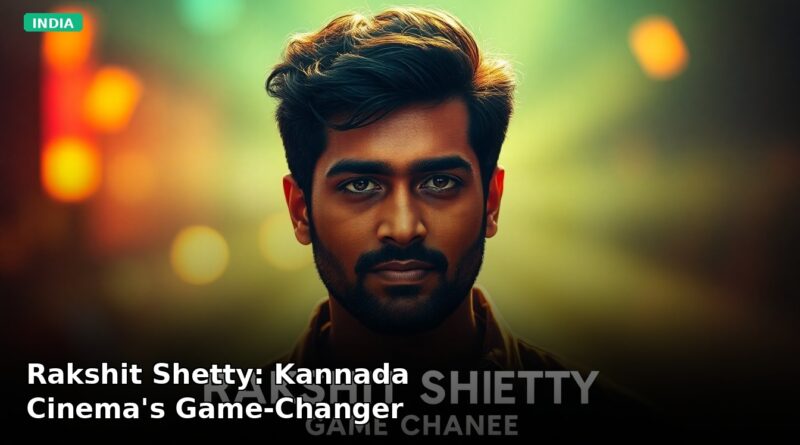
Rakshit Shetty: Kannada Cinema’s Game-Changer
Rakshit Shetty: Kannada Cinema’s Game-Changer
Rakshit Shetty’s family is celebrating this week — prayers, homam, and havan filling their home in what feels like a deeply personal moment made public. But while the photos circulating today show a man surrounded by warmth and ritual, they don’t tell you the stranger, more compelling story: how an Electronics and Communications Engineering graduate from Udupi quietly became one of Indian cinema’s most decorated independent filmmakers.
One National Film Award. Three Filmfare Awards South. Four Karnataka State Film Awards. Five SIIMA Awards.
That’s not a lucky streak. That’s a pattern. And patterns have reasons.
The Boy from Udupi Who Chose the Wrong Career (On Paper)
Born on 6 June 1983 in Udupi, Karnataka, Rakshit Shetty followed a path that made complete sense to everyone around him. He enrolled at NMAM Institute of Technology and earned a bachelor’s degree in Electronics and Communications Engineering — the kind of credential that opens doors in Bengaluru’s tech corridors, not on film sets.
Udupi in the 1980s and 1990s wasn’t producing Bollywood stars. It was producing engineers, doctors, and businesspeople. The Tulu-speaking coastal belt of Karnataka has a reputation for hard work and practicality, not cinematic ambition. So when Rakshit pivoted toward filmmaking, it wasn’t the obvious move — it was, by almost every conventional measure, the reckless one.
But the engineering background didn’t disappear. It shaped how he thinks about storytelling — methodically, structurally, with an eye for systems. You can see it in how his films are constructed: emotional architecture built on precise foundations, not improvised sentiment. The technical mind didn’t leave the building. It just found a different kind of circuit to wire.
The Debut Nobody Remembers, and the Film That Changed Everything
His debut film, Namm Areal Ond Dina in 2010, came and went without leaving a significant mark. That happens. Most filmmakers’ first films are learning exercises, not calling cards.
The calling card came with Simple Agi Ondh Love Story. The title itself signals the philosophy — simple, direct, honest. In a Kannada film landscape that had its own established grammar of action and spectacle, a film that announced its simplicity in its own name was a quiet act of defiance. Audiences responded. Critics responded. And Rakshit Shetty, the engineer-turned-filmmaker, suddenly had a reputation to build on.
What’s worth noting about this trajectory is how deliberate it looks in hindsight. He didn’t chase the biggest budget or the most commercial template. He built a voice first — a recognisable sensibility that audiences could trust. That trust, accumulated slowly, is what made everything that came after possible.
Paramvah Studios: The Infrastructure Behind the Art
Most actors who succeed in Indian cinema eventually produce a film or two. Fewer build an actual production and distribution infrastructure. Rakshit Shetty built Paramvah Studios — a company that doesn’t just make his films but handles their distribution as well.
This matters more than it sounds.
In Indian cinema, the gap between a great film and a seen film is often a distribution problem. Stories get made and then lost because they can’t reach the screens that would receive them. By controlling both production and distribution, Rakshit gave himself — and the stories he wanted to tell — a fighting chance at actually being seen.
It’s the kind of structural thinking that, again, reflects the engineering mindset. You don’t just build the product. You build the pipeline. Paramvah Studios is that pipeline, and it’s what separates Rakshit Shetty from talented filmmakers who remain perpetually dependent on larger studio systems to carry their work forward.
777 Charlie: The Film That Proved the Audience Was Ready
777 Charlie, released in 2022, became the highest-grossing film of Rakshit Shetty’s career. The subject matter alone was a risk by conventional commercial logic — a story centred on a dog, with emotional depth as its primary currency rather than action sequences or romantic spectacle.
The film didn’t just succeed in Karnataka. It crossed language barriers and found audiences across India, which is the real measure of a story that transcends its regional origins. For a filmmaker who had spent years building a reputation for sincerity over spectacle, 777 Charlie was the moment the mainstream caught up with what his audience already knew.
The numbers confirmed what the awards had been saying for years: Rakshit Shetty’s instincts about what Indian audiences actually want — as opposed to what they’re assumed to want — were correct. Emotional honesty, when executed with craft, travels. It doesn’t need to be dressed up in the familiar formulas.
Thirteen Awards, One Consistent Signal
Step back from the individual films and look at the full picture: one National Film Award, three Filmfare Awards South, four Karnataka State Film Awards, five SIIMA Awards. Thirteen major recognitions across different bodies, different years, different categories.
Awards are imperfect measures of quality — everyone knows this. But thirteen of them, spread across national and regional platforms, from industry bodies and state governments alike, represent something harder to dismiss: consistent peer recognition across time. This isn’t a single film catching lightning in a bottle. This is a body of work that keeps clearing the bar.
Kannada cinema has produced celebrated filmmakers before. But Rakshit Shetty occupies a specific position — the actor-writer-producer-filmmaker who controls his own creative ecosystem, who came from outside the traditional film family networks, and who built his reputation on emotional storytelling rather than scale.
The Rashmika Chapter: What It Actually Tells Us
The research record shows one personal detail that circulated widely: Rashmika Mandanna, who debuted in 2016, was previously engaged to Rakshit Shetty before her career took its own remarkable trajectory. It’s the kind of biographical footnote that generates search traffic and tabloid interest.
But the more interesting read is what it reflects about timing and trajectory. Rakshit was already an established name in Kannada cinema when Rashmika was beginning. Their paths diverged — professionally and personally — and both went on to build careers that speak for themselves. That’s the full story. The rest is noise.
What the engagement and its end actually illustrates is that public figures carry personal lives alongside professional ones, and the two don’t always move in the same direction. Rakshit Shetty’s story isn’t defined by that chapter. It’s defined by the films, the studio, and the awards shelf.
Final Thought
This week’s photos of Rakshit Shetty’s family performing homam and havan are a reminder that behind the National Film Award and the 777 Charlie box office numbers is someone who remains, at his core, rooted in the coastal Karnataka culture that shaped him. The engineer from Udupi who built Paramvah Studios didn’t reinvent himself — he extended himself, carrying the rigour of NMAM Institute of Technology into a creative industry that rewards exactly that kind of disciplined thinking. Thirteen awards later, the pattern is clear: in Indian cinema, the filmmakers who build their own infrastructure and trust their own instincts tend to outlast the ones who only follow the formula.
Frequently Asked Questions
What is Rakshit Shetty’s educational background?
Rakshit Shetty earned a bachelor’s degree in Electronics and Communications Engineering from NMAM Institute of Technology in Udupi, Karnataka, before pivoting to a career in filmmaking.
How many awards has Rakshit Shetty won in his career?
Rakshit Shetty has won one National Film Award, three Filmfare Awards South, four Karnataka State Film Awards, and five SIIMA Awards, reflecting a consistent pattern of critical and industry recognition.
Where was Rakshit Shetty born and when?
Rakshit Shetty was born on 6 June 1983 in Udupi, Karnataka, a coastal region known for producing engineers and businesspeople rather than filmmakers.
Recommended Reading
Explore these hand-picked resources to dive deeper into this topic:
- The Monk Who Sold His Ferrari by Robin Sharma
- Thinking, Fast and Slow by Daniel Kahneman
- Masterclass Annual Subscription (online learning platform)
As an Amazon Associate, we earn from qualifying purchases. This helps support Fact Storm Hub at no extra cost to you.
Sources
- https://www.imdb.com/name/nm5756214/mediaindex/
- https://en.wikipedia.org/wiki/Rakshit_Shetty
- https://timesofindia.indiatimes.com/topic/Rakshit-Shetty/photos
- https://in.bookmyshow.com/person/rakshit-shetty/28480
- https://www.filmibeat.com/celebs/rakshit-shetty/photos.html

🤖 AI Content Disclosure
This article was created using AI-assisted research and writing tools, then reviewed for quality and accuracy. Facts are sourced from publicly available web research, but readers should verify critical information from primary sources.
Published for educational and entertainment purposes. Last reviewed: June 2026