
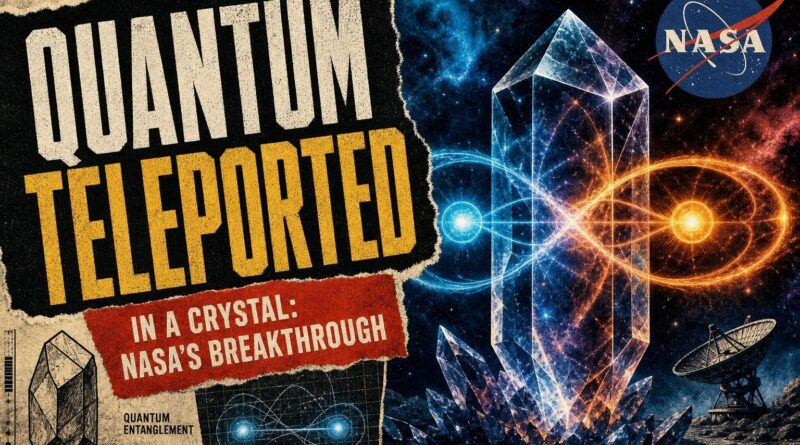
Quantum Entanglement in a Crystal: NASA’s Breakthrough
Quantum Entanglement in a Crystal: NASA’s Breakthrough
Recently, researchers at TU Wien published findings in Nature Physics that quietly rewrote what physicists thought was possible. Inside a centimeter-sized crystal — something small enough to sit in the palm of your hand — they detected a measurable, high degree of quantum entanglement. Not between two carefully isolated particles in a lab. Across the entire crystal, collectively, at a scale nobody had achieved before.
That’s the story. And to understand why it matters, you need to start at the beginning.
What Quantum Entanglement Actually Is
Most explanations of quantum entanglement start with “spooky action at a distance” — a phrase Einstein used, and one that’s been repeated so many times it’s lost all meaning. So let’s try something different.
Imagine two coins. You flip them on opposite sides of the planet. Normally, each coin lands heads or tails completely independently. But entangled particles don’t work that way. When two particles become entangled, their quantum states are linked — measuring one instantly tells you something definitive about the other, no matter how far apart they are.
Here’s the precise scientific framing: quantum entanglement is the phenomenon in which the quantum state of each particle in a group cannot be described independently of the state of the others (Wikipedia). They don’t just influence each other. They are, in a meaningful sense, a single system — even when separated by vast distances (Caltech Science Exchange).
Scientists at Caltech describe entanglement as an “emergent property” — something that arises from the connection between particles, not from any individual particle alone. It isn’t a signal. It isn’t a force. It’s a relationship baked into the fabric of quantum reality.
For decades, this was a phenomenon studied at the smallest possible scales: individual atoms, photons, carefully controlled pairs of particles. The idea that it could exist at human-visible scales felt like science fiction.
Until now.
The Crystal That Changed the Scale
The Institute of Solid State Physics at TU Wien — the Vienna University of Technology — is where this particular boundary got broken. Researchers there, including Prof. Silke Bühler-Paschen, were studying a material described as a “strange metal.”
The name isn’t informal shorthand. Strange metals are a formally recognized class of materials that defy conventional physics in ways that run deeper than any single measurement. Their electrical resistance doesn’t follow the rules that govern ordinary metals — but that’s only the beginning. More fundamentally, the theoretical frameworks physicists rely on to model electron behavior in standard materials simply don’t apply. Strange metals sit in a zone where existing models break down entirely, making them theoretically anomalous, not just electrically unusual. That’s what makes them scientifically significant — and what made the discovery inside one so unexpected.
What the TU Wien team found was something far stranger than the material’s name suggests. Using their experimental setup, they detected a high degree of quantum entanglement — not just between individual atoms, but across entire scales of the crystal simultaneously. The entanglement wasn’t confined to a pair of particles tucked away in a corner of the lattice. It was a collective property of the whole structure.
To put that in perspective: a centimeter is roughly the width of your thumbnail. This wasn’t a particle accelerator experiment. This was a piece of matter you could hold between two fingers — and it was exhibiting behavior that, until recently, physicists believed required near-perfect isolation at the atomic scale.
The findings were published in Nature Physics, one of the most rigorous peer-reviewed publications in the field. This wasn’t a preprint or a preliminary claim. It cleared the bar.
Why “Macroscopic” Is the Word That Matters
Three letters separate old physics from new physics here: M-A-C. Macroscopic.
For most of quantum mechanics’ history, the “quantum world” and the “everyday world” have been treated as separate territories. Quantum effects — superposition, entanglement, tunneling — live at the scale of atoms and subatomic particles. The everyday world of tables, crystals, and human hands operates by classical rules. This boundary, sometimes called the quantum-to-classical transition, has been one of the most debated lines in all of physics.
What the TU Wien result does is push that line. A centimeter-sized crystal is not a quantum system in the traditional sense. It contains an enormous number of atoms — far beyond what anyone has managed to maintain in an entangled state through conventional methods. The fact that entanglement was detected not just present but measurably high across the collective constituents of this crystal suggests that macroscopic quantum behavior isn’t just theoretically possible. It’s physically real, and it’s sitting inside materials that already exist.
This matters for a reason that goes beyond pure curiosity. Quantum technologies — quantum computers, quantum sensors, quantum communication networks — have all faced a common bottleneck: keeping entanglement alive and stable at scales large enough to be useful. If entanglement can exist naturally in bulk materials like strange metals, that bottleneck looks very different than it did before.
The Bigger Question This Opens Up
So why did nobody find this sooner?
Part of the answer is instrumentation — detecting entanglement across a macroscopic object requires experimental techniques that have only recently become sensitive enough. Part of it is material selection. Strange metals sit at a peculiar intersection of quantum behavior and bulk matter, which makes them unusual candidates for this kind of investigation. Most research into entanglement has focused on carefully engineered systems — isolated qubits, trapped ions, photon pairs — precisely because controlling the environment is easier at smaller scales. Nobody was looking for entanglement inside a crystal you could pick up with your fingers, because the assumption was it couldn’t survive there.
The TU Wien findings, published in Nature Physics, suggest that assumption needs revisiting. If strange metals harbor macroscopic entanglement naturally, other materials might too. The question shifts from “can we engineer entanglement into a system?” to “where else is it already hiding?”
That’s not a small question. That’s a new research frontier.
Final Thought
What makes this discovery genuinely consequential isn’t just the physics — it’s the engineering implications that follow. Quantum computers today are fragile machines, requiring extreme isolation and near-absolute-zero temperatures to preserve entanglement long enough to be useful. If naturally occurring bulk materials like strange metals can sustain macroscopic entanglement on their own terms, the path toward stable, scalable quantum technology just got shorter. The crystal Prof. Bühler-Paschen and her colleagues held in their hands may be small. What it points toward is not.
Frequently Asked Questions
What is quantum entanglement in simple terms?
Quantum entanglement is when two or more particles become linked so their quantum states cannot be described independently. Measuring one instantly reveals information about the other, regardless of distance, making them behave as a single system.
What did scientists discover about quantum entanglement in a crystal?
Researchers at TU Wien detected a measurable, high degree of quantum entanglement across an entire centimeter-sized crystal — small enough to hold in your hand — marking a scale of entanglement nobody had previously achieved.
Why does quantum entanglement matter and why is it important?
Quantum entanglement is significant because entangled particles behave as one unified system even when far apart. Scientists at Caltech describe it as an emergent property arising from particle connections, forming a fundamental aspect of quantum reality with broad scientific implications.
Recommended Reading
Explore these hand-picked resources to dive deeper into this topic:
- The Elegant Universe by Brian Greene
- Something Deeply Hidden by Sean Carroll
- Quantum Mechanics Visual Guide (interactive learning kit)
As an Amazon Associate, we earn from qualifying purchases. This helps support Fact Storm Hub at no extra cost to you.
Sources
- https://phys.org/news/2026-06-high-degree-quantum-entanglement-centimeter.html
- https://www.techexplorist.com/high-degree-quantum-entanglement-detected-centimeter-sized-strange-metal-crystal/103294/
- https://scienceexchange.caltech.edu/topics/quantum-science-explained/entanglement
- https://science.nasa.gov/what-is-the-spooky-science-of-quantum-entanglement/
- https://en.wikipedia.org/wiki/Quantum_entanglement
Watch the Video
🤖 AI Content Disclosure
This article was created using AI-assisted research and writing tools, then reviewed for quality and accuracy. Facts are sourced from publicly available web research, but readers should verify critical information from primary sources.
Published for educational and entertainment purposes. Last reviewed: July 2026