
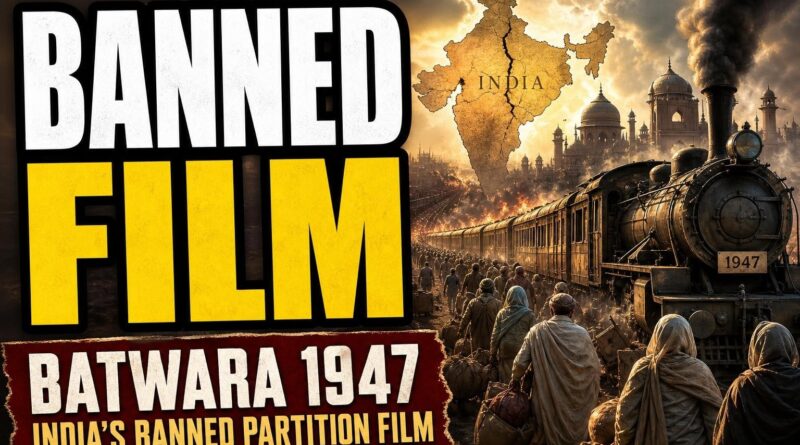
Batwara 1947: India’s Banned Partition Film
Batwara 1947: India’s Banned Partition Film
A film about the partition of India and Pakistan — renamed before it even released. That’s not a spoiler. That’s the story. And the fact that a movie set in 1947 had to change its title in 2026 because of present-day geopolitics tells you everything about why this wound has never closed.
This week, the first look at Batwara 1947 dropped, revealing Sunny Deol, Preity Zinta, Shabana Azmi, and an ensemble cast that immediately set social media on fire. But the headline everyone’s sharing isn’t the cast. It’s the name. Because this film was called something else entirely — until a geopolitical storm forced a change that tells you everything about why this story still matters today.
The Original Name They Couldn’t Keep
Lahore 1947. That was the title.
It borrowed its soul from an old Punjabi adage — the kind of saying that gets passed down not in books, but in kitchens and courtyards. Jis Lahore Nai Vekhya, O Jamya E Nai. Roughly translated: “One who has not seen Lahore has not truly lived.” The phrase doesn’t just describe a city. It describes a world that existed before a line was drawn across a map and two nations were born overnight.
Director Rajkumar Santoshi chose that title deliberately. The film is based on Asghar Wajahat’s celebrated drama of the same name — a work that has been performed across South Asia for decades, exploring the human cost of the 1947 partition with a precision that history textbooks rarely manage.
Then came the rename.
Amid strained relations between India and Pakistan, the title Lahore 1947 was seen as carrying too much political weight. The production — backed by Aamir Khan under his banner Aamir Khan Productions — pivoted. The film became Batwara 1947. Batwara is the Hindi-Urdu word for partition, for division, for the splitting of something that was once whole. In a way, the rename is its own kind of statement. Lahore was the place. Batwara is what happened to it.
Twenty Months in the Making
Principal photography began in February 2024. It wrapped in October 2025. That’s approximately 20 months of filming — a production timeline that, for a Bollywood feature, signals something far beyond a standard commercial release.
For context, most mainstream Hindi films shoot in three to six months. Twenty months represents an unusual scope of production — the kind of commitment that period reconstruction, location complexity, and storytelling ambition demand when a filmmaker refuses to cut corners on a story of this magnitude.
The cinematography is in the hands of Santosh Sivan, one of Indian cinema’s most respected directors of photography. The soundtrack is composed by A. R. Rahman. When you pair Sivan’s lens with Rahman’s score on a story about the partition, you’re not assembling a film crew. You’re assembling a reckoning.
The film is scheduled for worldwide theatrical release on 14 August 2026, distributed by PVR Inox Pictures. The date is not accidental. August 14 is Pakistan’s Independence Day. August 15 is India’s. Batwara 1947 lands in theatres on the exact seam between those two anniversaries.
The Reunion Nobody Saw Coming
Sunny Deol and Rajkumar Santoshi. Nearly three decades apart.
That gap alone is worth sitting with. Their previous collaboration belongs to a different era of Hindi cinema — one before streaming, before the multiplex boom, before the entire economics of Indian film changed beyond recognition. And yet here they are, brought back together by a story about the partition.
Sunny Deol plays the lead. Preity Zinta — in what appears to be a significant return to a major period production — is alongside him. Shabana Azmi, one of the most respected actors in the history of Indian parallel cinema, is part of the ensemble. So are Karan Deol, Ali Fazal, Abhimanyu Singh, Khushi Hajare, and Kanikka Kapur.
The casting sends a signal. This is not a nostalgia project built around one star’s comeback. The ensemble is too carefully constructed for that. Azmi’s presence alone anchors the film in a tradition of serious, socially conscious Indian cinema that has always treated the partition not as a historical footnote but as an open wound.
Aamir Khan producing — rather than acting — is its own kind of statement. His productions carry a particular weight of intention. Batwara 1947 is clearly meant to be experienced, not just watched.
What the Partition Actually Was
August 1947. British India was divided into two independent nations — India and Pakistan — in one of the fastest, most catastrophic border-drawing exercises in modern history.
The Punjab, which had been one of the most culturally unified regions on the subcontinent, was cut in half. The border was drawn by British administrators in a matter of weeks, with catastrophic consequences for millions. Lahore, the historic capital of Punjab — the city of Mughal emperors, of Sikh warriors, of Urdu poetry — fell on the Pakistani side. Families that had lived in the same neighbourhoods for generations found themselves on the wrong side of a line drawn in haste by people with little understanding of the communities they were dividing.
The human cost was staggering. Millions were displaced. Hundreds of thousands died in communal violence. Entire communities evaporated overnight. And the grief of that division — the batwara — has never fully resolved. It lives in family stories, in literature, in the old Punjabi saying that gave Asghar Wajahat’s drama its name.
That saying — Jis Lahore Nai Vekhya, O Jamya E Nai — took on a different meaning after 1947. For the Hindus and Sikhs who fled Lahore and could never return, it became an impossible standard. To have truly lived, you had to have seen a city you could no longer reach.
That’s the emotional architecture Batwara 1947 is building on.
Why This Film Lands Differently in 2026
The rename from Lahore 1947 to Batwara 1947 wasn’t just a production decision. It was a mirror held up to the present.
The fact that a film about 1947 had to change its title in 2026 because of current geopolitical sensitivities tells you something uncomfortable: the partition is not history in the way that most history is history. It is not settled. It is not distant. It is an argument that two nations are still having — in diplomatic cables, in border skirmishes, in the titles of films that haven’t even been released yet.
Batwara 1947 arrives on August 14, 2026 — the night before India turns 79, the same night Pakistan turns 79. It arrives with a cast assembled across generations, a production that took nearly two years to complete, and a title that was itself a casualty of the tensions it set out to explore.
The partition created two countries. Seventy-nine years later, it’s still creating headlines. That’s not a film pitch. That’s the truth this movie is walking into.
Frequently Asked Questions
Why was Lahore 1947 renamed to Batwara 1947?
The film was renamed due to strained geopolitical relations between India and Pakistan, as the title Lahore 1947 was seen as carrying too much political weight. Batwara, meaning partition or division in Hindi-Urdu, was chosen as the new title.
Who is in the cast of Batwara 1947?
Batwara 1947 features a star-studded ensemble including Sunny Deol, Preity Zinta, and Shabana Azmi, whose first look reveal set social media on fire when it dropped.
What is Batwara 1947 based on?
The film is based on Asghar Wajahat’s celebrated drama Lahore 1947, a work performed across South Asia for decades that explores the human cost of the 1947 partition. It is directed by Rajkumar Santoshi and produced under Aamir Khan Productions.
Recommended Reading
Explore these hand-picked resources to dive deeper into this topic:
- Midnight’s Children by Salman Rushdie
- The Partition: The Story of Indian Independence by Patrick French
- India’s Partition: A Lost History (Documentary Series)
As an Amazon Associate, we earn from qualifying purchases. This helps support Fact Storm Hub at no extra cost to you.
Sources
- https://en.wikipedia.org/wiki/Batwara_1947
- https://www.youtube.com/watch?v=Eetinnh7dzI
- https://timesofindia.indiatimes.com/entertainment/hindi/bollywood/news/batwara-1947-teaser-out-sunny-deol-revisits-the-pain-of-partition-preity-zinta-makes-brief-appearance/articleshow/131823069.cms
- https://www.youtube.com/watch?v=27WULwWCBCo
- https://www.indiatoday.in/movies/bollywood/story/meet-the-full-cast-of-aamir-khans-batwara-1947-led-by-sunny-deol-preity-zinta-2928438-2026-06-17
🤖 AI Content Disclosure
This article was created using AI-assisted research and writing tools, then reviewed for quality and accuracy. Facts are sourced from publicly available web research, but readers should verify critical information from primary sources.
Published for educational and entertainment purposes. Last reviewed: June 2026