
Rocky Exoplanet LHS 1140b Has an Atmosphere
Rocky Exoplanet LHS 1140b Has an Atmosphere
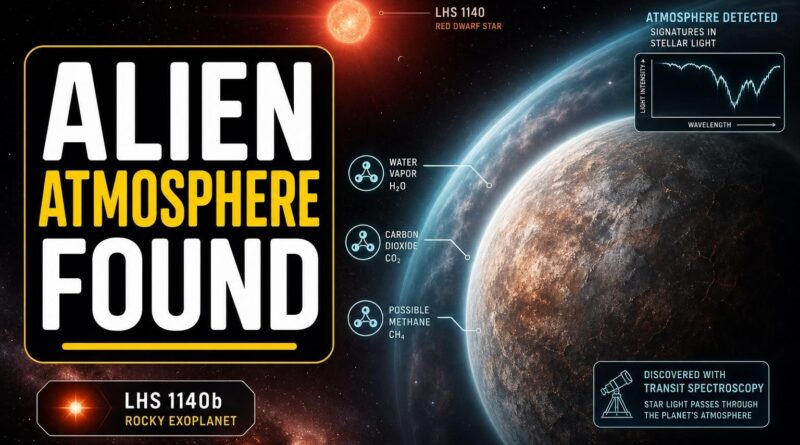
This week, a study published in Science sent a quiet ripple through the scientific world — the kind that starts small, then keeps spreading. A rocky planet 48 light-years away has done something no rocky planet in a habitable zone has ever been confirmed to do: it held onto its atmosphere. That sentence will be in textbooks. It isn’t there yet, but it will be.
A Planet That Shouldn’t Have Survived
red dwarf stars are brutal. They’re the most common type of star in the galaxy, but they spend their early years throwing out violent bursts of radiation — ultraviolet flares and X-rays powerful enough to strip the atmosphere right off any nearby planet.
LHS 1140b orbits one of these red dwarfs, sitting inside the star’s habitable zone — the band of distance where temperatures are, in theory, just right for liquid water to exist on a planet’s surface. Not too hot, not too cold. Most scientists assumed that any rocky planet this close to a red dwarf would have its atmosphere blasted away long ago. The radiation alone should have done it.
And yet, when a team led by Collin Cherubim — who recently completed his Ph.D. in Earth and Planetary Sciences at Harvard University — analysed the data, the atmosphere was still there. The planet is roughly 70 percent larger than Earth, rocky in composition, and somehow, against the odds, it held on.
What the Atmosphere Is Actually Made Of
Scientists detected helium escaping from LHS 1140b’s upper atmosphere — and that detection is the entire foundation of the confirmation.
This is not a nitrogen-oxygen mix like Earth’s. It is not breathable air. The study, published in Science on or around July 16, 2026, is careful on this point: it does not confirm what the inner atmosphere is composed of, and it does not verify whether liquid water exists on the surface. Those questions remain open.
So why does a helium detection matter so much? Because you can only find an atmosphere escaping if one exists in the first place. The helium is the fingerprint. The fact that it’s still leaking out — rather than having been stripped away entirely centuries ago — tells scientists the planet is actively holding onto gas. That’s a fundamentally different situation from the barren, airless rocks we’ve catalogued before.
Think of it this way: if you find smoke, you know there’s a fire somewhere. The helium is the smoke.
Nine Years From Discovery to This Moment
LHS 1140b was first discovered in 2017. That’s nine years between “we found a planet” and “we confirmed it has an atmosphere.” That gap isn’t a failure — it’s a measure of how hard this problem actually is.
Detecting an atmosphere on a planet 48 light-years away requires precision that borders on the absurd. Scientists aren’t looking at the planet directly. They watch starlight filter through the planet’s atmosphere as it passes in front of its star, then analyse the tiny changes in that light to identify which molecules are present — a technique called transmission spectroscopy.
The tools that made this possible didn’t exist at the necessary scale when LHS 1140b was first spotted. Advanced telescopic instruments have since transformed what’s detectable, capable of picking up signals that earlier observatories would have missed entirely. The Cherubim-led study is the result of that improved capability meeting a planet that had been waiting for the right instrument to look at it properly.
Nine years. One confirmed atmosphere. The pace of this science is slow by everyday standards — and extraordinary by the standards of what humans have ever managed to do.
Why This Changes the Search for Life
Here’s what this discovery actually shifts.
Before LHS 1140b, the working assumption in astrobiology was that finding a rocky planet in a habitable zone was only the first step. The second step — confirming it had an atmosphere — seemed years or decades away. Every rocky planet studied in habitable zones had come up empty on that front.
LHS 1140b breaks that assumption. It proves that rocky, habitable-zone planets can hold atmospheres under conditions that should have destroyed them. That changes the probability calculations scientists use when estimating how many potentially life-supporting worlds might exist in the galaxy.
The planet sits approximately 48 to 49 light-years away — close, by cosmic standards. Close enough that future instruments, more powerful than anything currently operational, could study its atmosphere in far greater detail. Scientists could search for water vapour, carbon dioxide, or the chemical signatures that on Earth are produced by living organisms. None of that is confirmed. None of it is claimed by the current study. But the possibility now has a specific address.
Final Thought
The ripple that started with this week’s publication in Science is easy to underestimate. It won’t feel like much on the surface — one planet, one detection, one escaping trace of helium. But ripples don’t stay small.
What Collin Cherubim’s team has handed the scientific community isn’t just a confirmed atmosphere. It’s a methodology. Helium-escape detection — watching for the outermost layer of a distant planet’s gas bleed away into space — has now proven itself capable of answering one of the hardest questions in planetary science: does this world have anything left to hold onto? That technique, applied to the growing catalogue of rocky habitable-zone planets, changes what the next decade of searches can actually look for.
LHS 1140b is 70 percent larger than Earth, orbiting a red dwarf 48 light-years away, and it survived something that should have ended it. The ripple from that survival, and from the method that detected it, is only beginning to move outward.
Frequently Asked Questions
Does LHS 1140b have an atmosphere?
Yes, LHS 1140b has been confirmed to have an atmosphere, making it the first rocky planet in a habitable zone beyond our solar system to achieve this confirmation. Scientists detected helium escaping from its upper atmosphere as evidence.
Could LHS 1140b support life?
It is currently unknown. While LHS 1140b sits in its star’s habitable zone where liquid water could theoretically exist, scientists have not confirmed the atmosphere’s full composition or whether liquid water is present on the surface.
How far away is planet LHS 1140b from Earth?
LHS 1140b is located approximately 48 light-years from Earth. It orbits a red dwarf star and is roughly 70 percent larger than Earth in size.
Recommended Reading
Explore these hand-picked resources to dive deeper into this topic:
- Cosmos: A Spacetime Odyssey by Carl Sagan
- The Three-Body Problem by Liu Cixin
- National Geographic Telescope (stargazing observation tool)
As an Amazon Associate, we earn from qualifying purchases. This helps support Fact Storm Hub at no extra cost to you.
Sources
- https://www.cfa.harvard.edu/news/first-atmosphere-detected-habitable-zone-rocky-world
- https://www.nature.com/articles/d41586-026-02200-5
- https://www.theguardian.com/science/2026/jul/16/atmosphere-lhs-1140b-exoplanet-could-water-scientists
- https://www.space.com/astronomy/exoplanets/astronomers-discover-1st-atmosphere-around-a-rocky-earth-like-planet-in-the-habitable-zone
- https://www.youtube.com/watch?v=twgsq80PD4o
🤖 AI Content Disclosure
This article was created using AI-assisted research and writing tools, then reviewed for quality and accuracy. Facts are sourced from publicly available web research, but readers should verify critical information from primary sources.
Published for educational and entertainment purposes. Last reviewed: July 2026