
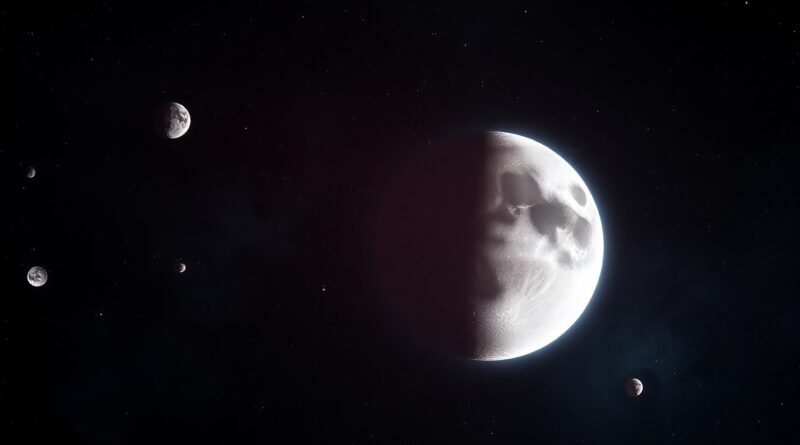
Moon Meteoroid Impacts Seen Live by Artemis II Astronauts
Moon Meteoroid Impacts Seen Live by Artemis II Astronauts
During their historic lunar flyby, the Artemis II crew didn’t just photograph the Moon from a distance. They watched it get hit. Multiple times. In the cold silence of space, small rocks traveling at tens of kilometers per second slammed into the lunar surface — and the astronauts saw every flash. NASA scientists back on Earth were stunned. Not because the Moon gets hit by meteoroids (it does, constantly), but because humans had never witnessed it happening live, from this close, with their own eyes.
This is the discovery that nobody put on the front page — and it might be one of the most important things Artemis II gave us.
1. The Artemis II Crew Saw Between 4 and 6 Meteoroid Impacts During a Single Flyby
Let that number sink in. In the span of one lunar flyby — a mission segment that lasts hours, not days — the Artemis II astronauts reported observing at least four, and possibly up to six, distinct meteoroid impact flashes on the Moon’s surface.
To understand why that’s remarkable, consider the physics. The Moon has no atmosphere. On Earth, when a space rock enters our skies, atmospheric friction burns most of it up — that’s the “shooting star” you see on a clear August night during the Perseids. The Moon has no such protection. Every rock, every grain of cosmic debris, hits the surface at full velocity. No slowdown. No burnup. Just direct impact.
When these meteoroids struck the lunar surface at speeds estimated in the tens of kilometers per second, the kinetic energy released was enormous — instantly vaporizing rock and generating a burst of visible light called an impact flash. These flashes are brief, bright, and unmistakable. And the Artemis II crew caught them with their own eyes, not through a telescope on Earth, not through an automated sensor — but through the windows of their spacecraft, in real time.
Scientists from the lunar science community told Scientific American that the observation genuinely surprised them. Not the existence of the impacts, but the frequency visible in such a short window of time.
2. The Moon Gets Bombarded Constantly — But We’ve Never Had a Front-Row Seat Like This
The Moon is, in the bluntest terms, a cosmic punching bag. Without an atmosphere or a magnetic field strong enough to deflect incoming debris, its surface has been absorbing meteoroid strikes for roughly 4.5 billion years. Every crater you see — from the massive Tycho Basin, 85 kilometers wide, to the tiny pockmarks invisible to the naked eye — is the record of an impact.
NASA’s Lunar Reconnaissance Orbiter has been cataloguing new craters since 2009, identifying thousands of fresh impact sites by comparing photographs taken months or years apart. Researchers estimate the Moon receives somewhere between 11 and 1,000 meteoroid strikes per year that are large enough to create craters at least 10 meters wide. Micrometeorite strikes — tiny particles, but traveling at extraordinary speeds — happen far more frequently, essentially continuously.
But here’s the science gap that Artemis II just cracked open: ground-based observation of lunar impact flashes has always been limited. Telescopes on Earth can catch flashes on the Moon’s dark side during a lunar eclipse or new moon phase. The NELIOTA project, run by the European Space Agency, has been doing exactly this since 2017. But those observations are filtered through 384,000 kilometers of space and Earth’s own atmospheric distortion.
The Artemis II crew was there. Proximity changes everything in observational science. What they saw — and how they described it — gives researchers a qualitative data point that no telescope survey can replicate.
3. The Physics of an Impact Flash Explains Why This Discovery Matters for Future Lunar Bases
Here’s where the physics gets genuinely important — and a little alarming if you’re planning to build a habitat on the Moon.
When a meteoroid traveling at, say, 20 kilometers per second strikes the lunar surface, it’s not just a collision. The energy release follows the kinetic energy formula: KE = ½mv². Double the velocity and you quadruple the energy. A micrometeorite the size of a grape, hitting at 40 km/s, releases energy comparable to a small explosive charge. The impact vaporizes both the meteoroid and a portion of the surrounding lunar regolith (the loose surface rock), generating a plasma plume and that characteristic flash of visible light.
NASA’s science teams have been using impact flash data to model what the lunar surface environment actually looks like for a human crew — not from orbit, but on the ground. The Artemis program’s long-term goal includes the Lunar Gateway station and, eventually, a sustained human presence near the lunar south pole. Understanding meteoroid flux — how often rocks hit, how big they are, what damage they could do — is not an academic exercise. It’s an engineering requirement.
The Artemis II observation adds a crucial human-verified data point to that model. If astronauts on a flyby mission spotted four to six impact flashes in a matter of hours, mission planners need to know: what does that rate mean for a crew living on the surface for 30 days? For a pressurized habitat? For a spacesuit?
The discovery isn’t just beautiful. It’s a safety dataset.
4. Humans Had Never Seen Lunar Impact Flashes From This Vantage Point in History
This is the fact that deserves its own moment of pause.
Twelve humans walked on the Moon between 1969 and 1972. They collected 382 kilograms of lunar rock, deployed seismometers, and planted flags. But none of them — not Neil Armstrong, not Alan Shepard, not Eugene Cernan — reported watching a meteoroid strike the surface in real time from close range.
The Apollo astronauts did experience something related: the seismometers they left behind detected lunar “moonquakes,” some of which were caused by meteoroid impacts. In fact, the Apollo 12 seismometer famously recorded the impact of the Apollo 12 ascent stage crashing into the Moon, and the Moon “rang like a bell” for nearly an hour — a phrase that became one of the most quoted lines in lunar science history. But seeing an impact flash, from close proximity, was not part of their record.
Artemis II changed that. For the first time in the history of human spaceflight, astronauts observed the Moon being actively shaped by the cosmos — not in archived data, not in a textbook diagram, but in the moment, through a spacecraft window.
There’s something almost philosophical about that. The Moon we see from Earth looks static, ancient, frozen. The Artemis II crew saw something different: a living, dynamic surface still being written by the universe.
5. What Scientists Are Now Asking — And Why the Answers Could Redefine Lunar Science
The Artemis II observation has opened at least three significant scientific questions that researchers are now actively pursuing.
First: Can we build a dedicated impact-monitoring instrument for future Artemis missions? Current lunar flash detection relies on Earth-based telescopes with narrow observing windows. A camera system aboard a crewed spacecraft — or mounted on the Lunar Gateway once it’s operational — could monitor the entire lunar surface continuously, building the most comprehensive meteoroid flux map ever created.
Second: What does the impact rate tell us about near-Earth space debris density? The Moon acts as a passive collector of everything in the Earth-Moon system. By measuring how frequently it gets hit, scientists can back-calculate the density of meteoroids in our local region of space — data that’s directly relevant to spacecraft shielding design, satellite protection, and long-duration deep-space missions.
Third: Do the impact flashes reveal anything about subsurface composition? When a meteoroid vaporizes lunar regolith, the spectral signature of the flash carries chemical information about what was beneath the surface. Spectrographic analysis of impact flashes — something that’s technically feasible with the right onboard instruments — could let scientists “read” the Moon’s composition without drilling a single hole.
NASA’s planetary science division has already flagged the Artemis II observation as a prompt to revisit instrument manifests for Artemis III and beyond. Discovery, in real science, doesn’t end with the observation. It begins there.
Final Thought
The Artemis II crew flew around the Moon and came back with something nobody had planned for: eyewitness testimony of the cosmos at work. Between four and six meteoroids, each traveling at tens of kilometers per second, struck the lunar surface while humans watched from a spacecraft window. The impact flashes lasted fractions of a second. The implications will last decades.
This is what human spaceflight does that robotic missions cannot. A rover on the lunar surface would have recorded data. The Artemis II astronauts recorded meaning — the visceral, human understanding that the Moon is not a museum piece frozen in time. It is an active world, still being shaped, still being hit, still telling us things we don’t yet know how to ask.
The next time you look up at the Moon on a clear night, remember: while you’re watching it, the universe is hitting it. And now, for the first time in history, humans have seen it happen.
Frequently Asked Questions
Did Artemis II astronauts see meteoroids hit the Moon?
Yes, during their lunar flyby the Artemis II crew observed between 4 and 6 distinct meteoroid impact flashes on the Moon’s surface in real time through their spacecraft windows, marking the first time humans witnessed this live.
What causes impact flashes on the Moon?
Impact flashes occur when meteoroids strike the lunar surface at tens of kilometers per second, instantly vaporizing rock and releasing enormous kinetic energy as a brief, bright burst of visible light called an impact flash.
Why does the Moon get hit by meteoroids more than Earth?
Unlike Earth, the Moon has no atmosphere to slow down or burn up incoming space rocks. Every meteoroid hits the lunar surface at full velocity with no friction or burnup, making impacts far more frequent and destructive.
Sources
- https://www.wired.com/story/artemis-ii-astronauts-witnessed-6-meteorites-collide-with-the-moon/
- https://www.youtube.com/shorts/bqtS6J70jSs
- https://www.sciencealert.com/nasas-artemis-ii-crew-saw-meteorites-striking-the-moon-in-real-time
- https://www.zmescience.com/science/news-science/artemis-ii-astronauts-saw-6-meteorites-slam-into-the-moon/
Watch the Video
Recommended Reading
Explore these hand-picked resources to dive deeper into this topic:
- A Brief History of Time by Stephen Hawking
- The Right Stuff by Tom Wolfe
- Celestron NexStar 8SE Telescope
As an Amazon Associate, we earn from qualifying purchases. This helps support Fact Storm Hub at no extra cost to you.
Share this story
🤖 AI Content Disclosure
This article was created using AI-assisted research and writing tools, then reviewed for quality and accuracy. Facts are sourced from publicly available web research, but readers should verify critical information from primary sources.
Published for educational and entertainment purposes. Last reviewed: April 2026