
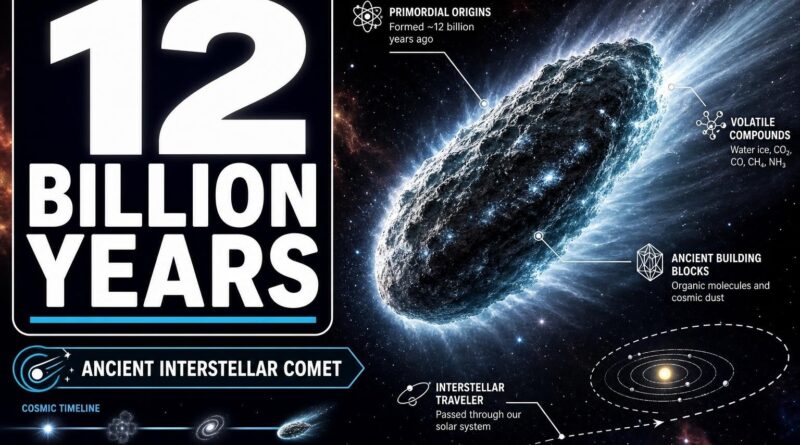
Ancient Interstellar Comet: 12 Billion Years Old
Ancient Interstellar Comet: 12 Billion Years Old
Something is flying through our solar system right now. It doesn’t belong here. And scientists say it may have been travelling through the universe for 12 billion years — nearly three times longer than Earth has existed.
Meet 3I/ATLAS, the interstellar atlas comet that has the entire astronomy world paying attention in 2026.
The Discovery That Stopped Scientists Cold
On 1 July 2025, a telescope system called ATLAS — the Asteroid Terrestrial-impact Last Alert System — picked up a faint moving object in the sky. At first glance, it looked like any other comet drifting through the neighbourhood. Then the calculations came in, and the room went quiet.
This object wasn’t from here.
The comet, formally catalogued as C/2025 N1 (ATLAS) and previously designated A11pl3Z, was on a trajectory that could only mean one thing: it had come from interstellar space. From somewhere else entirely. From outside our solar system, travelling through the vast darkness between stars before arriving — briefly — in our cosmic backyard.
NASA photographed it when it was 277 million miles from Earth. That image, taken across a quarter of a billion miles of empty space, shows a comet that has been moving longer than most things in the universe have existed.
The Third Stranger
3I/ATLAS is only the third known interstellar object ever detected passing through our solar system. The first was 1I/ʻOumuamua, spotted in 2017. A second interstellar object followed after that.
Three visitors in less than a decade. For most of human history, we had no idea these things even existed. Now we’re catching them — and each one arrives carrying clues from a universe we’ve barely begun to understand.
What makes 3I/ATLAS different from its predecessors isn’t just the timing. It’s the age.
Older Than Everything You Know
Our solar system formed roughly 4.5 billion years ago. The Sun, Earth, the Moon, every planet you’ve ever heard of — all of it assembled from a collapsing cloud of gas and dust 4.5 billion years ago. That number feels enormous. It is enormous.
3I/ATLAS may be 12 billion years old.
Read that again. Twelve billion years. Nearly three times older than our entire solar system. When this comet first formed, the Sun didn’t exist yet. Earth didn’t exist yet. The atoms that would eventually become you, your house, your planet — they hadn’t assembled yet. The universe was a completely different place.
Scientists arrived at this figure by studying the comet’s composition — the chemical fingerprint of what it’s made of. Different materials form in different cosmic environments at different points in the universe’s history. The makeup of 3I/ATLAS points to an origin environment that existed long before our neighbourhood of space came into being. The research was published in the journal Nature, which means it has been reviewed and verified by independent scientists.
To put 12 billion years in human terms: if Earth’s entire history were compressed into a single 24-hour day, 3I/ATLAS would have started its journey roughly two and a half days before that day even began.
What It’s Actually Telling Us
Here’s where this stops being just an impressive number and becomes something genuinely important.
Scientists used 3I/ATLAS’s composition to study the environment in which it formed. That’s the real prize. This comet is essentially a time capsule — a frozen sample of conditions that existed in the early universe, billions of years before our solar system was even a possibility.
Most of what we know about the early universe comes from light — ancient light from distant galaxies, captured by telescopes. But 3I/ATLAS is matter. Physical stuff, carrying the chemical record of a place and time we can’t visit. It’s the difference between seeing a photograph of a place and holding a handful of soil from it.
Every comet that forms in a solar system carries the signature of that system’s chemistry. When a comet gets ejected — knocked loose by gravitational forces — it carries that signature with it across the galaxy. 3I/ATLAS has been carrying its signature for 12 billion years, and now it’s passing close enough for us to read it.
That’s not luck. That’s an extraordinary coincidence of scale and timing that may not repeat for generations.
Final Thought
The name ATLAS comes from the telescope system that found it — but the mythological echo is hard to ignore. In Greek myth, Atlas held up the sky. This comet has been crossing that sky for 12 billion years, long before any myth, any civilisation, any planet existed to name it.
What 3I/ATLAS actually represents is a hard limit on how provincial our thinking about space has been. For centuries, we studied our solar system as if it were a closed room. ʻOumuamua in 2017 cracked the door open. 3I/ATLAS has now walked through it carrying evidence from the early universe itself — a universe that was already 7.5 billion years old before our Sun lit up for the first time.
The question scientists are now asking isn’t just “where did this come from?” It’s “how many more are out there, passing through undetected — and what are they carrying?”
Frequently Asked Questions
What is the interstellar comet 3I/ATLAS?
3I/ATLAS is an interstellar comet discovered on 1 July 2025 by the ATLAS telescope system. It originated from outside our solar system and is estimated to be around 12 billion years old, making it older than Earth itself.
When was 3I/ATLAS discovered and who found it?
3I/ATLAS was discovered on 1 July 2025 by ATLAS, the Asteroid Terrestrial-impact Last Alert System. NASA later photographed it when it was 277 million miles from Earth.
How many interstellar objects have been detected in our solar system?
3I/ATLAS is only the third known interstellar object ever detected passing through our solar system. The first was 1I/ʻOumuamua in 2017, followed by a second interstellar object shortly after.
Recommended Reading
Explore these hand-picked resources to dive deeper into this topic:
- Astrophysics for People in a Hurry by Neil deGrasse Tyson
- The Universe in a Nutshell by Stephen Hawking
- Celestron NexStar 130SLT Telescope (computerized reflector telescope)
As an Amazon Associate, we earn from qualifying purchases. This helps support Fact Storm Hub at no extra cost to you.
Sources
- https://www.science.org/content/article/interstellar-comet-unlike-anything-seen-our-solar-system
- https://science.nasa.gov/solar-system/comets/3i-atlas/
- https://www.theguardian.com/science/2026/jun/22/interstellar-comet-may-be-oldest-object-seen-in-our-solar-system-research-finds
- https://en.wikipedia.org/wiki/3I/ATLAS
- https://www.youtube.com/watch?v=09HuNhOEMKY
Watch the Video
🤖 AI Content Disclosure
This article was created using AI-assisted research and writing tools, then reviewed for quality and accuracy. Facts are sourced from publicly available web research, but readers should verify critical information from primary sources.
Published for educational and entertainment purposes. Last reviewed: June 2026