
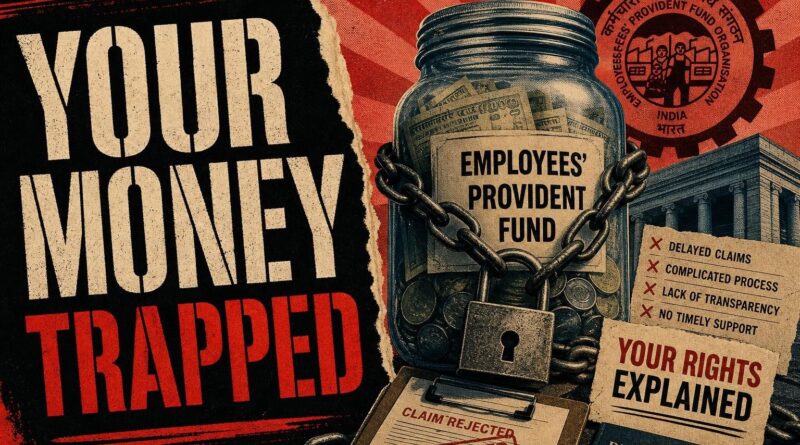
Employees’ Provident Fund: Your Rights Explained
Employees’ Provident Fund: Your Rights Explained
This week, the Telangana High Court delivered a ruling that sent a ripple through every HR department in India. Tata Lockheed Martin lost an appeal over a Rs 14.32 crore provident fund liability — and the court made one thing crystal clear: when an employer breaks the rules, the employee doesn’t pay the price. But to understand why that ruling matters, you need to understand the organisation that made it possible. the Employees’ Provident Fund Organisation has been quietly standing between Indian workers and financial ruin since 4 March 1952. Most people have no idea how it actually works — or how close it came to never existing at all.
What EPFO Actually Is (And Why It’s Not Just a Savings Account)
Most people think of their PF deduction as a forced savings plan. Money goes in every month, you collect it when you leave a job or retire. Simple enough. But that framing misses about two-thirds of what the Employees’ Provident Fund Organisation actually does.
EPFO administers three separate social security schemes simultaneously. The first is the EPF Scheme 1952 — the retirement savings fund most people know. The second is the Pension Scheme 1995, which provides a basic monthly pension after a worker reaches retirement age. The third is the Insurance Scheme 1976, which pays out a lump sum to a worker’s family if they die or become permanently disabled while employed.
Think about what that combination actually means. A factory worker in Pune, a software contractor in Hyderabad, a logistics employee in Chennai — each of them is covered against three of the biggest financial catastrophes a working family can face: outliving their savings, losing income in old age, and dying without leaving anything behind. One organisation, three safety nets, woven together under a single deduction line on a payslip.
EPFO sits under the Ministry of Labour and Employment and operates alongside Employees’ State Insurance — the other major social security agency. Between them, they cover the two most common financial shocks a worker faces: health and retirement. The headquarters at East Kidwai Nagar in New Delhi coordinates a network that reaches into workplaces across the country.
The 1952 Decision That Changed How India Thought About Workers
4 March 1952 wasn’t a random date. It was the moment India made a deliberate choice about what kind of economy it wanted to build.
Partition had displaced millions. The industrial workforce was growing rapidly, but with almost no formal protection. If a mill worker in Ahmedabad lost his job at 60, there was no pension, no savings guarantee, no fallback. The family simply absorbed the loss — or didn’t. The EPF Scheme 1952 was the government’s answer to that vulnerability.
What made it structurally different from charity or welfare was the mechanism: mandatory, employer-matched contributions. The employer couldn’t opt out. The worker couldn’t spend the money early on a whim. The fund accumulated whether times were good or bad, and it sat in an account that belonged to the worker — not the company.
That design principle — that the employer has obligations, not just rights — is exactly what the Telangana High Court reinforced in 2026. The Rs 14.32 crore liability attached to Tata Lockheed Martin, not to the 14 foreign employees at the centre of the dispute. The court ruled that EPFO cannot recover provident fund dues from an employee for an employer’s alleged violation of EPF rules. Seventy-four years after the original scheme was drafted, the founding logic still holds.
The Part Nobody Talks About: International Workers
Here’s something that surprises most people — EPFO doesn’t stop at India’s borders.
The organisation manages social security agreements with other countries, and international workers are covered under EPFO plans in countries where bilateral agreements exist. That means a worker from a partner country, posted to India on a work assignment, isn’t necessarily double-taxed into two separate retirement systems. The bilateral agreement coordinates coverage so contributions flow in one direction, not two.
The Tata Lockheed Martin case puts this in sharp focus. The dispute involved 14 foreign employees — workers who crossed international lines and landed inside India’s provident fund framework. The Rs 14.32 crore liability question wasn’t about whether they were covered. It was about who was responsible for ensuring that coverage was properly funded.
The court’s answer was unambiguous: the employer. Not the worker. Not the worker’s home country. The company that brought them in, employed them, and was obligated under EPF rules to manage their contributions correctly.
For multinational companies operating in India, this ruling is a significant signal. The employees’ provident fund framework doesn’t have a “foreign workers” exemption from employer accountability. If you employ them, you’re responsible for the rules — full stop.
Why the Telangana Ruling Matters Right Now
Tata Lockheed Martin is a joint venture between two of the world’s most recognisable industrial names. If a company of that scale and legal resource lost this appeal, it tells you something important about where the courts are drawing the line.
The Telangana High Court rejected the appeal outright. The Rs 14.32 crore liability stands. And the principle behind the rejection — that EPFO cannot recover provident fund dues from an employee for an employer’s alleged violation — is now reinforced case law.
For ordinary workers, this matters in a very practical way. If your employer has been miscalculating, under-depositing, or misclassifying your PF contributions, the legal exposure for that error sits with the company. You don’t get handed a bill for your employer’s compliance failures. That protection isn’t new — it’s baked into the architecture of the EPF Scheme 1952. But court rulings like this one make it real and enforceable in ways that a policy document alone cannot.
For HR and finance teams at companies with international postings, the ruling is a reminder that the employees’ provident fund rules apply with the same force to foreign employees as to domestic ones. Bilateral agreements handle the coordination. They don’t create exemptions.
Final Thought
The Employees’ Provident Fund Organisation was built in 1952 on a single structural bet: that financial security for workers only works if the obligation falls on employers, not employees. The Telangana High Court’s rejection of Tata Lockheed Martin’s appeal over Rs 14.32 crore in PF liability isn’t a new idea — it’s that same 1952 logic, tested against a multinational joint venture in 2026, and holding firm. The EPF Scheme 1952, the Pension Scheme 1995, and the Insurance Scheme 1976 aren’t three separate programmes — they’re three layers of the same answer to the same question: what happens to a worker when things go wrong? The answer, legally and structurally, has never changed. The employer is responsible. The worker is protected. That’s the deal.
Frequently Asked Questions
What is the Employees’ Provident Fund Organisation (EPFO)?
EPFO is a government body under the Ministry of Labour and Employment that has provided social security to Indian workers since 4 March 1952, administering three schemes covering retirement savings, monthly pension, and life insurance under a single payroll deduction.
What schemes does EPFO cover for employees?
EPFO administers three schemes: the EPF Scheme 1952 for retirement savings, the Pension Scheme 1995 for monthly pension after retirement, and the Insurance Scheme 1976 that pays a lump sum to a worker’s family upon death or permanent disability.
Can an employer make employees lose their PF benefits if they break the rules?
No. As clarified in the Telangana High Court ruling against Tata Lockheed Martin, when an employer violates provident fund rules, the financial liability falls on the employer, not the employee.
Recommended Reading
Explore these hand-picked resources to dive deeper into this topic:
- The Intelligent Investor by Benjamin Graham
- Your Money or Your Life by Vicki Robin and Joe Dominguez
- Zerodha Varsity Learning Platform (financial education portal)
As an Amazon Associate, we earn from qualifying purchases. This helps support Fact Storm Hub at no extra cost to you.
Sources
- https://www.epfindia.gov.in/site_en/
- https://www.epfo.gov.in/
- https://en.wikipedia.org/wiki/Employees%27_Provident_Fund_Organisation
- https://m.economictimes.com/wealth/legal/will/epfo-asks-retired-employee-to-return-rs-2-5-crore-pf-money-over-companys-exemption-lapse-he-fights-in-hc-and-wins/articleshow/131733992.cms
- https://www.deccanchronicle.com/southern-states/telangana/hc-spikes-challenge-to-pf-liability-1877005
🤖 AI Content Disclosure
This article was created using AI-assisted research and writing tools, then reviewed for quality and accuracy. Facts are sourced from publicly available web research, but readers should verify critical information from primary sources.
Published for educational and entertainment purposes. Last reviewed: June 2026