
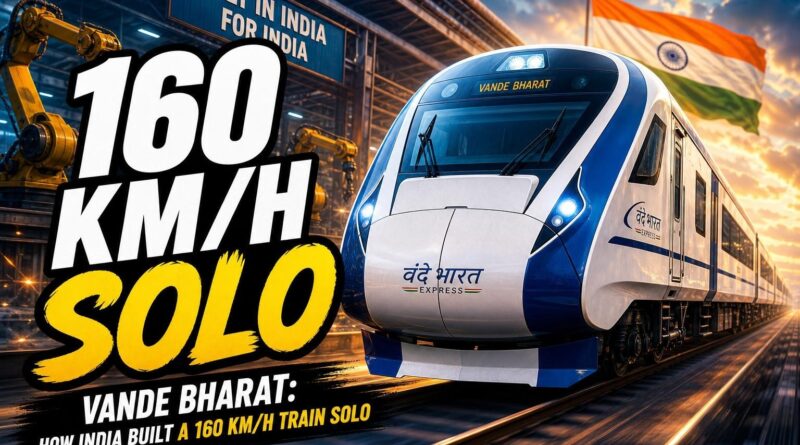
Vande Bharat: How India Built a 160 km/h Train Solo
Vande Bharat: How India Built a 160 km/h Train Solo
June weekends across India look the same right now: packed platforms, sold-out tickets, and thousands of people searching “how to book Vande Bharat” before the seats vanish. In South Central Railway alone, Vande Bharat trains are running at over 110% occupancy — a number that tells you everything about demand. But while everyone’s scrambling for a reservation, almost nobody stops to ask the more interesting question — how did India go from running slow, decades-old rail coaches to engineering a semi-high-speed train entirely on its own?
That story is worth telling.
The Problem Indian Railways Was Trying to Solve
For most of the 20th century, Indian Railways connected the country the only way it knew how: long trains, longer journeys, and coaches that hadn’t changed much in design or speed for generations. The real gap wasn’t on the 2,000-km overnight routes — sleeper trains handled those. The gap was the middle distance. Cities like Chennai and Mysuru, or Delhi and Lucknow — too far to drive comfortably, too short to justify an overnight sleeper, but still slow enough by train to make passengers consider flying.
That 400–800 km corridor was bleeding passengers to budget airlines. And Indian Railways knew it.
The answer had to be a train that was fast enough to compete with air travel on time, comfortable enough to compete on experience, and Indian enough to be built and maintained without depending on expensive foreign technology contracts. The design brief, quietly put together by engineers at the Integral Coach Factory in Chennai, would eventually become the Vande Bharat Express — though in its earliest days inside the factory, everyone simply called it Train 18.
Positioned as the direct successor to the iconic Shatabdi Express service type, Vande Bharat was never just an upgrade — it was a generational leap in what Indian Railways believed it could build on its own soil. And the ambition didn’t stop there. The same philosophy that produced the original Vande Bharat Express has since pushed Indian engineers toward something even more demanding: a full sleeper variant capable of competing on long-distance overnight corridors where the Shatabdi’s successor had no business going at all. By 2026, that sleeper variant has moved well beyond concept — it has been tested at speeds that even the original Vande Bharat Express never reaches in commercial service, hitting a remarkable 180 km/h during its Phase 2 trial run.
What They Built — and How Fast It Actually Goes
February 15, 2019. That’s when the Vande Bharat Express entered commercial service — not as a pilot, not as a trial run, but as a fully operational inter-city semi-high-speed EMU train owned entirely by Indian Railways. The number that defines it commercially is 160 km/h — the maximum operational speed the train is restricted to, and one it genuinely achieves in revenue service on select corridors, most notably the Rani Kamalapati–Hazrat Nizamuddin and Hazrat Nizamuddin routes. That’s not a brochure figure. That’s a timetabled reality on some of India’s best-prepared track.
The train itself comes in three configurations depending on the route and demand: 8 coaches stretching 192 metres, 16 coaches at 384 metres, or the expanded 20-coach variant running 480 metres end to end. Each configuration is an EMU — an Electric Multiple Unit — meaning there’s no separate locomotive. Power is distributed across the train itself, which is part of why it accelerates and decelerates as cleanly as it does.
As of 2026, India’s railway network runs over 82 operational Vande Bharat Express trains across the country. That number, more than any single speed record, is the real proof of what the project achieved. Building one fast train is an engineering milestone. Deploying 82 of them across a network as complex and varied as India’s — different track conditions, different climates, different passenger loads — is something else entirely. Plans are also underway to push the 160 km/h top speed across a wider share of the fleet as infrastructure upgrades on key corridors continue through 2026 and beyond.
Why “Built Solo” Actually Means Something
The phrase gets used loosely in Indian infrastructure coverage, so it’s worth being precise about what it means here. The Vande Bharat Express was designed, engineered, and manufactured at the Integral Coach Factory in Chennai — a public sector facility under Indian Railways — without the kind of technology transfer agreements or foreign joint ventures that have defined most of India’s previous attempts at modernising its rolling stock.
That matters for a few reasons. First, it means the intellectual property stays domestic. When something breaks, when something needs upgrading, when a new variant needs to be designed — Indian engineers don’t need to go back to a foreign licensor for permission or support. Second, it means the cost structure is fundamentally different. A train built on imported technology carries that dependency into every maintenance cycle, every spare part order, every future upgrade. Vande Bharat doesn’t.
The sleeper variant currently in advanced testing in 2026 is the clearest evidence that this self-reliance was real and not just political messaging. You don’t build a 180 km/h test-speed overnight train on your own unless the foundational engineering capability was genuinely yours to begin with.
The Corridor Logic — Where 160 km/h Actually Changes Things
Speed on paper is one thing. Speed that changes travel behaviour is another. The routes where Vande Bharat has had the most visible impact are precisely the ones that fit the original design brief — the 400–800 km middle-distance corridors where flying felt like overkill but the old train was simply too slow to be competitive.
Delhi to Varanasi. Mumbai to Solapur. Chennai to Mysuru. These aren’t random assignments. They’re routes where shaving two or three hours off a journey time tips the calculation for a meaningful share of travellers. When the train is also cleaner, quieter, and more comfortable than what came before — with features like automatic doors, onboard Wi-Fi, and rotating seats in chair car classes — the value proposition becomes hard to argue with.
The 110%-plus occupancy figures in zones like South Central Railway aren’t a mystery. They’re the predictable result of putting the right product on the right routes and pricing it accessibly enough that demand runs well ahead of supply.
What Comes Next
The 82-train fleet of 2026 is not the ceiling. Indian Railways has been scaling Vande Bharat production steadily, and the pipeline includes both more standard-configuration trains for new corridors and the sleeper variant that will eventually take the platform into overnight territory.
The speed target of 160 km/h, currently achieved on the best-prepared corridors, is also set to become more widely available across the fleet as track upgrades on additional routes are completed. The infrastructure work — better signalling, upgraded track geometry, improved level crossing management — is the unglamorous half of the high-speed story that rarely makes headlines but determines whether the train’s capability can actually be used.
What started as Train 18, a quietly ambitious internal project at a Chennai factory, has become the most visible symbol of what Indian Railways can design and build without asking anyone else for the blueprint. Over 82 trains. 160 km/h in commercial service. A sleeper variant pushing 180 km/h in trials. The solo build turned out to be the right call.
🤖 AI Content Disclosure
This article was created using AI-assisted research and writing tools, then reviewed for quality and accuracy. Facts are sourced from publicly available web research, but readers should verify critical information from primary sources.
Published for educational and entertainment purposes. Last reviewed: September 2026