
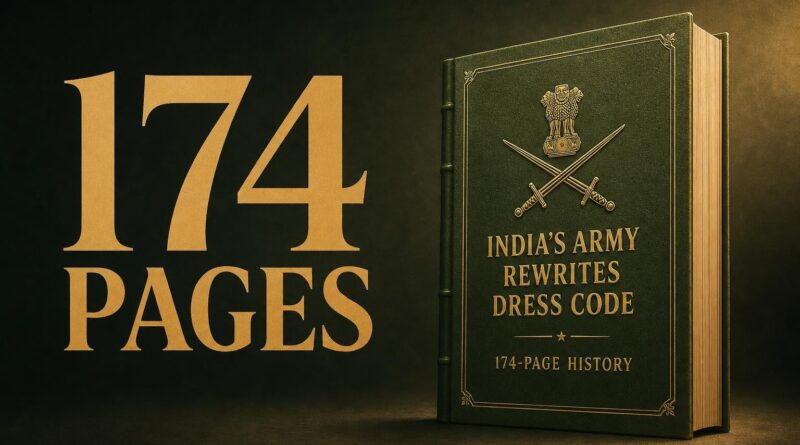
India’s Army Rewrites Dress Code: 174-Page History
India’s Army Rewrites Dress Code: 174-Page History
This week, the Indian Army quietly did something that armies rarely do — it looked in the mirror.
A new 174-page manual called Army Uniforms-2026 landed on desks across the force, and buried inside its pages was a clear signal: the era of dressing like a colonial-era parade is over.
The Uniform That Outlived Its Empire
For decades after independence, the Indian Army carried forward dress traditions it inherited from the British — not out of admiration, but out of institutional inertia. Ceremonial pouch belts. Reviewing officers carrying swords on parade. Terms like “Royal” embedded in official regulations. These weren’t Indian traditions. They were administrative leftovers from a colonial administration that ended nearly eight decades ago.
The previous uniform manual had been issued eight years before Army Uniforms-2026. Eight years. In that time, India launched missions to the Moon, rewrote its criminal law codes, and overhauled the names of colonial-era landmarks across its cities. The army’s dress code, however, sat largely untouched.
That gap matters. Uniforms aren’t just fabric — they’re institutional identity made visible. Every time a reviewing officer picked up a ceremonial sword at a parade, he was, whether anyone acknowledged it or not, performing a ritual designed for a different army, in a different era, serving a different crown.
What Actually Changed — And Why It’s Bigger Than It Looks
The most visible shift is the authorisation of the bandi jacket — a closed-neck garment rooted in Indian design sensibility — for formal settings. This isn’t a minor style update. The bandi is recognisably Indian. Placing it inside a formal dress code is a deliberate act of cultural reclamation.
The ceremonial pouch belt has been removed entirely. The sword — long a compulsory accessory for reviewing officers on parade — is now optional. And the word “Royal,” along with other archaic colonial terminology, has been stripped from the regulations.
Individually, each change might seem cosmetic. Together, they represent a systematic audit of every tradition the army had absorbed from its colonial inheritance — and a conscious decision about which ones to keep.
The 174-page manual also introduces a new winter dress category called 3B, applicable to all ranks. It consists of an angola shirt worn with a battle jacket and beret. Practical, unified, and distinctly modern — it signals that the redesign wasn’t only symbolic. Operational comfort and coherence were part of the brief too.
The Women Officers Provision Nobody Is Talking About
Cold statement of fact: the new regulations formally permit women officers to wear sober-coloured sarees, kurta-salwar, or ankle-length straight pants with a dupatta in formal settings.
This matters more than the headline coverage suggests. Historically, dress codes in uniformed services have defaulted to a male-designed framework, with women’s attire treated as an afterthought — or worse, a controversy. Codifying these options in an official 174-page manual isn’t a gesture. It’s a structural acknowledgment that the Indian Army’s officer corps includes women, and that its formal dress code should reflect that without ambiguity.
The choice of saree and kurta-salwar as authorised formal wear also reinforces the same cultural logic driving the bandi jacket. These are not compromises. They are deliberate choices about what an Indian institution in 2026 should look like.
What This Tells Us About India’s Larger Reckoning
Three deliveries. That’s sometimes all it takes to change the momentum of a match. And three decisions inside this manual — the bandi jacket, the removal of “Royal,” the sword made optional — tell a story about where India is right now.
The country has spent the last several years in an active conversation about colonial legacy: renaming cities, revising curricula, redesigning public symbols. The Indian Army’s uniform overhaul lands squarely inside that conversation. But it does so quietly, institutionally, through a 174-page manual rather than a press conference — which, arguably, makes it more durable.
Armies change slowly by design. That’s a feature, not a flaw. When an institution as disciplined and tradition-bound as the Indian Army decides to rewrite its dress regulations from scratch, it isn’t reacting to a news cycle. It’s making a considered, long-term statement about identity.
The colonial-era dress traditions weren’t abolished because they were offensive. They were replaced because they were no longer accurate. They described an army that no longer exists.
Final Thought
The Army Uniforms-2026 manual will sit in regimental offices for the next eight years — possibly longer. Every parade, every formal dinner, every reviewing officer who sets down a sword he no longer has to carry will be living inside a decision made in 2026. The bandi jacket isn’t just a uniform choice; it’s the Indian Army’s answer to a question that’s been sitting unanswered since 1947: what does an Indian army actually look like when it stops dressing for someone else’s empire? The 174 pages of Army Uniforms-2026 are, at their core, the answer.
Frequently Asked Questions
What is the Indian Army’s new uniform manual Army Uniforms-2026?
Army Uniforms-2026 is a 174-page manual that updates the Indian Army’s formal dress code, removing colonial-era traditions and introducing Indian design elements to reflect a post-independence national identity.
What colonial traditions has the Indian Army removed from its dress code?
The Indian Army has removed the ceremonial pouch belt, made the sword optional for reviewing officers on parade, and eliminated the word ‘Royal’ from official regulations, ending decades-old British-era dress traditions.
What is the bandi jacket and why is it significant for the Indian Army?
The bandi jacket is a closed-neck garment rooted in Indian design tradition, now authorised for formal military settings. Its inclusion in the dress code is considered a deliberate act of cultural reclamation, replacing colonial-era attire with a recognisably Indian alternative.
Recommended Reading
Explore these hand-picked resources to dive deeper into this topic:
- The Discovery of India by Jawaharlal Nehru
- India After Gandhi by Ramachandra Guha
- National Geographic India Magazine (monthly subscription)
As an Amazon Associate, we earn from qualifying purchases. This helps support Fact Storm Hub at no extra cost to you.
Sources
- https://www.hindustantimes.com/india-news/indian-army-drops-colonial-era-dress-traditions-introduces-bandi-jackets-in-new-uniform-code-101781398456620.html
- https://www.moneycontrol.com/news/india/indian-army-drops-colonial-era-dress-traditions-brings-in-bandi-jackets-and-new-uniform-rules-13948921.html
- https://www.msn.com/en-in/news/insight/indian-army-overhauls-dress-code-drops-colonial-era-traditions/gm-GM39F3068A?gemSnapshotKey=GM39F3068A-snapshot-7&uxmode=ruby
- https://thefederal.com/category/news/indian-army-dress-code-colonial-dress-246611
- https://www.ndtv.com/india-news/indian-armys-new-uniform-code-british-era-customs-banned-no-use-of-royal-11635466
🤖 AI Content Disclosure
This article was created using AI-assisted research and writing tools, then reviewed for quality and accuracy. Facts are sourced from publicly available web research, but readers should verify critical information from primary sources.
Published for educational and entertainment purposes. Last reviewed: June 2026