
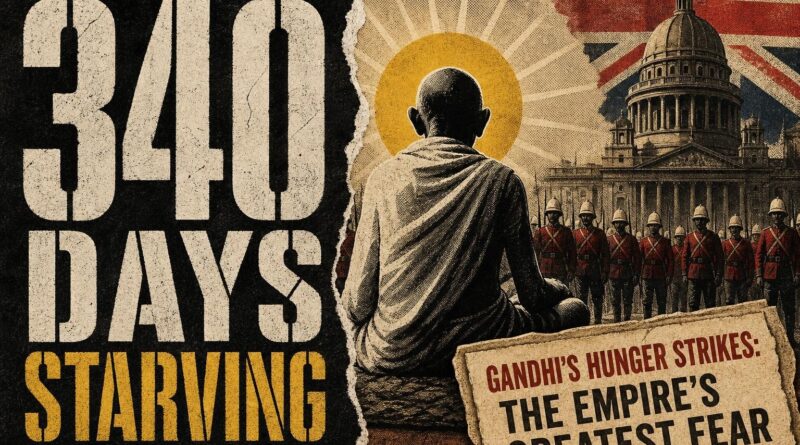
Gandhi’s Hunger Strikes: The Empire’s Greatest Fear
Gandhi’s Hunger Strikes: The Empire’s Greatest Fear
Here is the jarring contradiction at the center of one of history’s most remarkable stories: the single most effective adversary the British Empire ever faced in India was not a general, not a warlord, not a revolutionary with an army at his back. He was a lawyer from the trading caste — a man whose family background was merchants, not warriors — who chose to make his own body the battlefield.
That contrast is not a footnote. It is the entire story.
The Boy From Porbandar Nobody Expected
October 2, 1869. A child named Mohandas Karamchand Gandhi was born in Porbandar, a small coastal town on the west coast of India. His family belonged to the Vaishya caste — the trading caste. Not warriors. Not rulers. Merchants.
Nobody in Porbandar that day would have predicted that this boy would one day be called the Father of a Nation.
Gandhi grew up, crossed the ocean, and studied law at University College, London. A lawyer from a trading family — that was the profile. Respectable, yes. Revolutionary? Not obviously. The British Empire had survived far more dramatic challengers than a soft-spoken Indian barrister with no army, no weapons, and no political title.
That’s exactly what made him so dangerous.
The Weapon They Had No Manual For
Every empire in history has a playbook for dealing with rebellion. Armies, uprisings, assassinations, propaganda — there are centuries of documented responses. But when Gandhi returned to India and began organizing resistance, the British found themselves holding a manual that didn’t apply.
He called his method Satyagraha — resistance to tyranny through mass nonviolent civil disobedience. No guns. No riots. No destruction of property. Just people — enormous numbers of ordinary people — refusing to cooperate.
The logic was almost mathematical. An empire’s power depends on the cooperation of the people it controls. Remove that cooperation peacefully, and the empire has nothing to push against. Violence gives an authority figure a reason to respond with greater force. Nonviolence removes that justification entirely.
Gandhi’s hunger strikes worked the same way. He wasn’t fasting to pressure a government into signing a document. He was fasting to shift the moral weight of a situation — to make the watching world ask, “Who is the aggressor here?” A frail man refusing food while an empire watches is not a military problem. It’s a civilizational one.
What the History Books Skip
Gandhi is honored in India as the Father of the Nation. His face is on the currency. his birthday, October 2, is a national holiday. His Wikipedia article is one of the most widely translated entries in any language — a measure of how thoroughly his story has embedded itself into global consciousness.
But here’s the detail that tends to get lost in the reverence: Gandhi was not universally loved in his lifetime. He was deeply controversial. His methods frustrated allies who wanted faster, harder action. His fasts alarmed even those who supported independence. And when he was assassinated in 1948, the grief that swept India was matched by something darker — news of his death spread quickly throughout the country, and riots broke out in Bombay, now Mumbai, as the shock turned to rage.
That reaction tells you something important. Gandhi had spent decades asking people to hold their anger, to channel it into peaceful resistance, to believe that moral force was stronger than physical force. The moment he was gone, that restraint broke. The violence that erupted wasn’t a contradiction of his legacy — it was evidence of how much his presence had been holding back.
Why This Still Matters Today
The popular image of Gandhi — the hunger strikes, the marches, the spinning wheel — has been flattened into a symbol. A statue. A quote on a motivational poster. But the actual idea behind Satyagraha is more demanding than any poster admits. It doesn’t ask you to be passive. It asks you to be disciplined enough to absorb injustice without becoming it.
That’s a harder ask than it sounds. In an era where outrage travels at the speed of a notification, where every conflict is documented and amplified in real time, the idea that you could change minds — not just policies, but the actual thinking of your opponents — feels almost counterintuitive.
And yet Gandhi’s anti-colonial movement succeeded. The British Empire left India. The man from Porbandar, trained as a lawyer, armed with nothing but a philosophy, outlasted one of the most powerful political structures in human history.
Final Thought
The hunger strikes weren’t a tactic — they were a demonstration of the entire theory. A man from the Vaishya trading caste, educated in London, chose to make his body the argument. Not his words, not his army, not his political leverage — his body. And it worked, repeatedly, because it forced every observer to confront the same question: if this man is willing to die for a principle, what exactly are you willing to do to stop him?
That question didn’t just move governments. It moved history. And more than 75 years after his death in 1948, the contradiction that defined him — a merchant’s son who dismantled an empire without raising a fist — is still the most instructive story in the entire record of political resistance.
Frequently Asked Questions
Why were Gandhi’s hunger strikes so effective against the British Empire?
Gandhi’s hunger strikes were effective because the British had no playbook for nonviolent resistance. His method, Satyagraha, removed the cooperation an empire depends on, making traditional responses like military force or suppression completely ineffective.
What was Gandhi’s background before becoming a political leader?
Gandhi was born in Porbandar, India in 1869 into the Vaishya trading caste. He studied law at University College, London, making him a lawyer by profession, not a warrior or revolutionary by background.
What is Satyagraha and how did Gandhi use it against British rule?
Satyagraha is Gandhi’s method of resistance through mass nonviolent civil disobedience. It involved ordinary people refusing to cooperate with British authority — no guns, no riots, no property destruction — which systematically undermined the empire’s power over India.
Recommended Reading
Explore these hand-picked resources to dive deeper into this topic:
- The Story of My Experiments with Truth by Mahatma Gandhi
- Gandhi: The Man by Ramachandra Guha
- Planet Knowledge Gandhi Documentary (biographical video series)
As an Amazon Associate, we earn from qualifying purchases. This helps support Fact Storm Hub at no extra cost to you.
Sources
- https://en.wikipedia.org/wiki/Mahatma_Gandhi
- https://www.britannica.com/biography/Mahatma-Gandhi
- https://www.youthforhumanrights.org/voices-for-human-rights/champions/mahatma-gandhi.html
- https://www.theguardian.com/world/1948/jan/31/india.fromthearchive1
- https://www.weforum.org/stories/2019/10/mahatma-gandhi-who-what-impact-india/

🤖 AI Content Disclosure
This article was created using AI-assisted research and writing tools, then reviewed for quality and accuracy. Facts are sourced from publicly available web research, but readers should verify critical information from primary sources.
Published for educational and entertainment purposes. Last reviewed: July 2026