
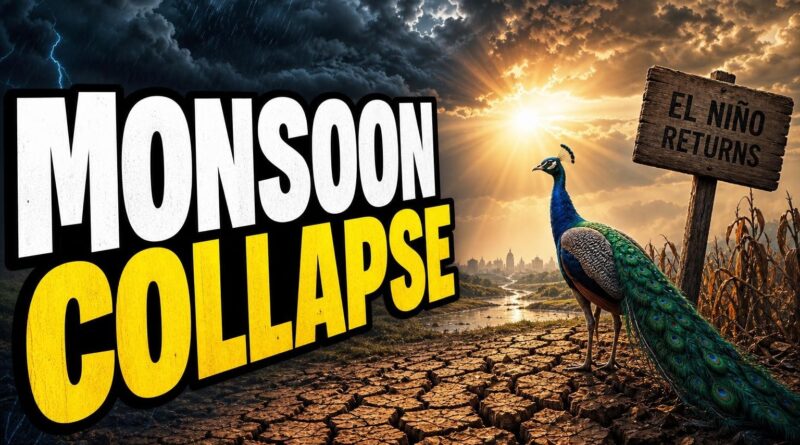
El Niño Returns: India’s Monsoon Crisis Ahead
El Niño Returns: India’s Monsoon Crisis Ahead
June 3, 2026. The World Meteorological Organisation issued a warning that stopped climate scientists mid-conversation: there is a 90% or higher probability that El Niño conditions will persist until at least November. Not a possibility. Not a concern. A near-certainty — covering India’s entire four-month monsoon season.
For a country where hundreds of millions depend on that rain to grow food, that number isn’t a weather statistic. It’s a countdown.
What El Niño Actually Does to India’s Sky
Most people picture El Niño as a distant Pacific Ocean event — something that happens far away and shows up in textbook diagrams. The reality is far more direct.
El Niño is essentially a warming of the central and eastern Pacific Ocean that disrupts the atmospheric circulation patterns the Indian monsoon depends on. When Pacific waters heat up abnormally, they pull moisture and storm energy away from the Indian subcontinent. The result: weaker winds, less cloud formation, and — critically — less rain arriving over India between June and September.
Scientists have already spotted the early warning signs. The Indian Ocean is currently showing less cloud formation and weaker weather activity than usual. That’s not normal pre-monsoon behaviour. It’s the atmosphere already responding to what’s building in the Pacific.
The WMO’s forecast as of June 3, 2026, puts the likelihood of El Niño forming between June and August at 80%. Once it forms, the models agree it won’t be mild. Most forecast models suggest the developing event will be at least moderate — and possibly strong.
The Historical Pattern India Cannot Ignore
Between 1951 and 2022, roughly 60% of El Niño years brought below-average rainfall to India. That’s not a coincidence — it’s a pattern so consistent that Indian meteorologists now treat El Niño years as automatic red flags during monsoon planning.
Major droughts across India have consistently been linked to El Niño events. When the rains fail, the consequences cascade: crop yields drop, reservoir levels fall, and rural communities that have no backup water source face months of hardship.
The most recent El Niño, in 2023–24, was one of the five strongest on record. The world felt it — in heat records, in disrupted rainfall patterns, in agricultural losses across multiple continents. That event ended. But the pattern it belongs to hasn’t.
What makes 2026 different from a standard El Niño warning is the timing. A 90% probability of persistence until November means this won’t be a brief disruption. It covers the full arc of India’s monsoon — from the first rains in June to the final withdrawal in late September and beyond.
2026’s Monsoon: The Lowest Rainfall in 11 Years
India’s meteorological authorities have already made their call. The forecast for 2026 predicts an El Niño-weakened monsoon that will bring the lowest rainfall in 11 years.
Eleven years. That framing matters. It means this isn’t just a “weak monsoon” — it’s the weakest in over a decade, a benchmark that puts 2026 in a category most farmers, water managers, and policymakers haven’t had to navigate since the mid-2010s.
The agriculture sector is the most immediate pressure point. India’s Kharif crops — rice, pulses, soybeans, cotton — are planted during the monsoon months. A significant rainfall deficit at the wrong stage of the growing cycle doesn’t just reduce output; it can wipe out entire harvests in rain-dependent regions.
Reservoirs tell the same story. Many of India’s major dams and water bodies refill almost entirely during the monsoon. A below-average monsoon in 2026 means entering 2027’s dry season with less in reserve — a problem that compounds if the following year brings more of the same.
Why This El Niño Feels Different
Three things make the 2026 warning harder to brush aside than previous alerts.
First, the probability numbers from WMO are unusually high. An 80% chance of formation, climbing to 90% or above for persistence through November — these aren’t hedged forecasts. They reflect a strong consensus across multiple climate models pointing in the same direction.
Second, the baseline is already warmer. Each El Niño now operates on top of a planet that has been steadily heating. That means the temperature anomalies El Niño adds don’t start from a neutral point — they stack on top of an already elevated global temperature, amplifying the effects.
Third, the 2023–24 El Niño — one of the five strongest on record — ended less than two years ago. The climate system is returning to El Niño conditions faster than many scientists expected, leaving less time for ocean and atmospheric patterns to fully reset.
Final Thought
The 90% persistence figure from WMO isn’t the kind of statistic that belongs only in a climate report. It’s the number that should be sitting in every conversation about India’s food supply, water planning, and rural economy heading into the second half of 2026. The monsoon has always been India’s lifeline — and El Niño’s return, forecast to be at least moderate and possibly strong, is arriving precisely when that lifeline is most exposed. The 11-year rainfall low isn’t just a meteorological record waiting to be set. It’s a signal that the decisions made in the next few months — about water storage, crop choices, and drought preparedness — will determine how hard this one actually lands.
Frequently Asked Questions
How does El Niño affect India’s monsoon season?
El Niño warms the central and eastern Pacific Ocean, disrupting atmospheric circulation that India’s monsoon depends on. This results in weaker winds, less cloud formation, and reduced rainfall over India between June and September.
How likely is El Niño to persist through India’s 2026 monsoon season?
According to the World Meteorological Organisation as of June 3, 2026, there is a 90% or higher probability that El Niño conditions will persist until at least November, covering India’s entire four-month monsoon season.
What percentage of El Niño years bring below-average rainfall to India?
Between 1951 and 2022, roughly 60% of El Niño years brought below-average rainfall to India, a pattern so consistent that Indian meteorologists treat El Niño years as automatic red flags during monsoon planning.
Recommended Reading
Explore these hand-picked resources to dive deeper into this topic:
- The Sixth Extinction by Elizabeth Kolbert
- Braiding Sweetgrass by Robin Wall Kimmerer
- Kacey Weather Station (digital climate monitor)
As an Amazon Associate, we earn from qualifying purchases. This helps support Fact Storm Hub at no extra cost to you.
Sources
- https://www.ndtv.com/india-news/super-el-nino-on-the-horizon-will-it-crush-indias-2026-monsoon-or-spare-it-once-again-11522587
- https://www.ndtv.com/india-news/whats-slowing-indias-monsoon-scientists-point-to-indian-ocean-el-nino-11583795
- https://timesofindia.indiatimes.com/india/wmos-el-nino-alert-raises-odds-of-severe-impact-on-monsoon/articleshow/131471238.cms
- https://www.telegraphindia.com/world/united-nations-weather-agency-warns-strong-el-nino-could-bring-extreme-temperatures-over-next-few-months/cid/2163595
- https://www.reuters.com/business/environment/india-expected-have-below-average-monsoon-rains-2026-weather-office-says-2026-05-29/

🤖 AI Content Disclosure
This article was created using AI-assisted research and writing tools, then reviewed for quality and accuracy. Facts are sourced from publicly available web research, but readers should verify critical information from primary sources.
Published for educational and entertainment purposes. Last reviewed: July 2026