
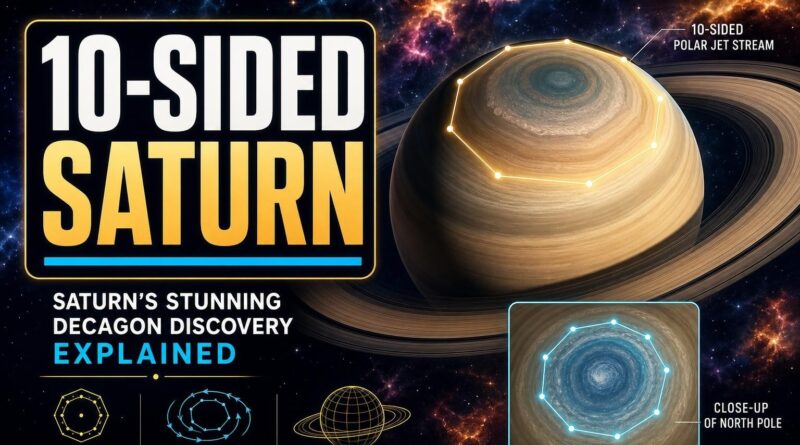
Saturn’s Stunning Decagon Discovery Explained
Saturn’s Stunning Decagon Discovery Explained
NASA’s Hubble Space Telescope has been watching Saturn for decades. Scientists thought they had a reasonable picture of what was happening in that planet’s atmosphere. Then Hubble spotted something at Saturn’s south pole that nobody had seen before — a giant, 10-sided atmospheric wave, perfectly encircling the pole like a geometric stamp pressed into the clouds.
A decagon. On Saturn. Evolving in real time.
Wait, WHAT?
Saturn Already Had One Geometric Surprise — This Is the Second
Most people who follow space news have heard of Saturn’s north pole hexagon. It’s one of those facts that sounds made up: a six-sided storm structure, sitting at the top of a gas giant, holding its shape across thousands of kilometres of swirling atmosphere. Scientists have studied it for years. It became one of Saturn’s most iconic features.
Here’s the thing nobody expected: the south pole had something too.
Where the north has a hexagon — six sides — the south now has a decagon. Ten sides. And unlike a static feature frozen in place, this structure is described as giant and evolving, meaning it is actively changing as Hubble watches. That distinction matters. It tells researchers this isn’t a coincidence or a trick of light. It’s a real, dynamic atmospheric wave doing something that physics has to explain.
Two poles. Two completely different geometric structures. One planet. That’s the puzzle sitting on every planetary scientist’s desk right now.
What a “Decagon” Actually Means in an Atmosphere
Forget the geometry class definition for a moment. When researchers call this a decagon, they mean that the atmospheric wave — a ripple in Saturn’s cloud layers, driven by winds and pressure — has organized itself into exactly ten sides. Ten peaks. Ten troughs. Repeating, evenly spaced, all the way around the south pole.
On Earth, atmospheric waves exist too. They wrap around our poles and influence weather patterns across entire continents. But they don’t lock into clean geometric shapes you could draw with a ruler. The fact that Saturn’s atmosphere does this — twice, at both poles, in different shapes — points to something unusual about how gas giants organize their own internal energy.
Think of it like this: if you filled a bowl with water and spun it, the water would swirl in a circle. Now imagine the water spontaneously arranging itself into a perfect hexagon on one side and a perfect decagon on the other. That’s the level of order Saturn is producing in an atmosphere made of gas, moving at speeds no human vehicle has matched.
The discovery, made by Hubble, marks the first time a large atmospheric wave of this kind has been observed at Saturn’s south pole. First time. Ever.
Why Hubble Is Still Catching Scientists Off Guard
Hubble has been in orbit for decades. You might assume that by now, it has seen everything worth seeing in our solar system. Saturn, in particular, has had multiple dedicated missions study it up close.
And yet — Hubble is still finding structures that dedicated Saturn missions missed.
That says something important about how science actually works. A single observation campaign, no matter how thorough, captures one window in time. Hubble’s long-term monitoring of Saturn means it can track changes across years, watching the atmosphere shift through seasons. Saturn’s seasons are long — the planet takes roughly 29 Earth years to orbit the Sun. What Hubble sees today at the south pole may have been invisible or undeveloped during earlier observations. The decagon might be a seasonal structure, appearing and strengthening as Saturn’s south pole tilts toward or away from the Sun.
That’s still an open question. And open questions are exactly what makes this discovery worth watching.
The Bigger Picture: Saturn Is Stranger Than We Thought
A hexagon at the north pole was already hard to explain. A decagon at the south pole — a completely different shape, at the opposite end of the same planet — makes the puzzle significantly deeper.
These aren’t just pretty patterns. Geometric atmospheric waves at planetary poles carry information about wind speeds, atmospheric depth, and how energy moves through a gas giant’s interior. Cracking the physics behind them could reshape how scientists model not just Saturn, but every gas giant in the solar system — including the ones orbiting distant stars that telescopes are only beginning to detect.
Saturn has always been the most visually dramatic planet in our solar system. The rings. The moons. The storms. Now add this: a planet that apparently builds perfect geometric shapes at both poles, in two different configurations, for reasons science hasn’t fully explained yet.
Final Thought
The Saturn decagon isn’t just a new shape to add to the textbook. It’s a direct challenge to existing models of how planetary atmospheres self-organize. The north pole hexagon was already an anomaly. A south pole decagon — different geometry, same planet — means the hexagon wasn’t a fluke. There is a mechanism at work inside Saturn that produces geometric order at its poles, and right now, nobody has a complete explanation for what that mechanism is. Hubble has handed scientists two data points where they expected one. The next step is figuring out what connects them — and whether the gas giants orbiting other stars are doing the same thing in the dark, unseen.
Frequently Asked Questions
What is the Saturn decagon at the south pole?
The Saturn decagon is a giant 10-sided atmospheric wave discovered by NASA’s Hubble Space Telescope at Saturn’s south pole. It encircles the pole completely and is actively evolving, making it a real dynamic atmospheric structure.
How is Saturn’s south pole decagon different from the north pole hexagon?
Saturn’s north pole has a six-sided hexagon structure, while the newly discovered south pole feature has ten sides, making it a decagon. The two poles have completely different geometric atmospheric structures on the same planet.
Who discovered the decagon on Saturn’s south pole?
Scientists using NASA’s Hubble Space Telescope discovered the decagon on Saturn’s south pole. Hubble has been observing Saturn for decades, and this 10-sided atmospheric wave was spotted as something nobody had previously seen.
Recommended Reading
Explore these hand-picked resources to dive deeper into this topic:
- Astrophysics for People in a Hurry by Neil deGrasse Tyson
- The Elegant Universe by Brian Greene
- National Geographic Space Exploration Documentary Series (premium streaming collection)
As an Amazon Associate, we earn from qualifying purchases. This helps support Fact Storm Hub at no extra cost to you.
Sources
- https://science.nasa.gov/missions/hubble/nasas-hubble-tracks-new-decagon-encircling-saturns-south-pole/
- https://www.stsci.edu/contents/news-releases/2026/news-2026-022
- https://science.nasa.gov/asset/hubble/decagon-on-saturns-south-pole-color/
- https://esahubble.org/images/heic2612a/
- https://www.publicnow.com/view/33FAF27A864A33592A7BC1352FC0D42145F77F1A
🤖 AI Content Disclosure
This article was created using AI-assisted research and writing tools, then reviewed for quality and accuracy. Facts are sourced from publicly available web research, but readers should verify critical information from primary sources.
Published for educational and entertainment purposes. Last reviewed: September 2026