
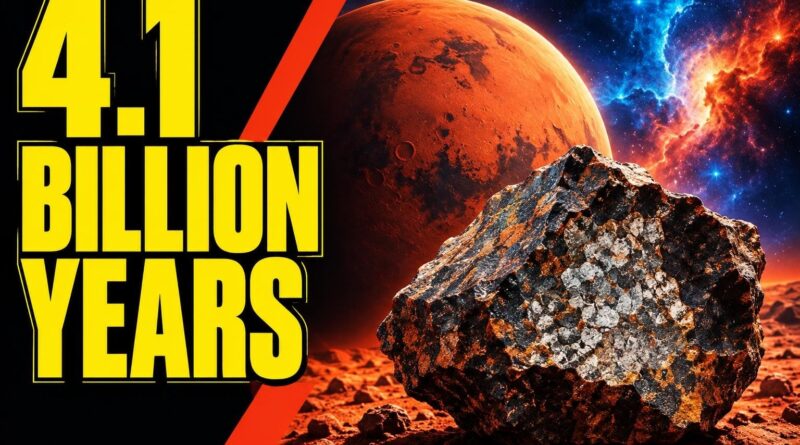
4.1B-Year-Old Martian Meteorite: NASA’s Mars Discovery
4.1B-Year-Old Martian Meteorite: NASA’s Mars Discovery
In 2022, someone walking across a salt plain in Mali’s Sahara Desert found a rose-colored rock. It weighed less than a kilogram. It looked, at a glance, like thousands of other desert stones.
It wasn’t from Earth.
That rock — now called Teghaza 001 — is a Martian meteorite. And a paper published in the journal Science on October 29, 2026, confirmed something that stopped researchers mid-sentence: it formed more than 4.1 billion years ago, making it one of the oldest pieces of Mars ever recovered on this planet. One of the paper’s own reviewers called it a “Rosetta Stone for Mars.”
That’s not a casual comparison. The original Rosetta Stone decoded an entire civilization. Scientists are saying this rock could do something similar — for a planet 140 million miles away.
The Rock That Shouldn’t Be Here
Start with the sheer improbability of what happened.
Mars, at some point billions of years ago, took a massive impact. The collision was violent enough to blast chunks of the planet’s crust into space. One of those chunks — a piece of ancient Martian rock — drifted through the solar system, eventually crossed into Earth’s gravitational pull, survived the heat of atmospheric entry, and landed in the Sahara Desert. It then sat there, undisturbed, until someone found it in 2022.
Teghaza 001 is named after the salt plain in Mali where it was discovered. It weighs nearly 2 pounds — about 800 grams. And it has a distinctive rose color that, as it turns out, is scientifically significant: its mineralogy, the specific mix of minerals locked inside it, matches patterns that NASA’s Mars Reconnaissance Orbiter has observed from orbit in the planet’s cratered southern highlands.
That match matters. It means scientists aren’t just guessing where on Mars this rock came from. They have orbital data that corroborates the story the rock itself is telling.
There are only around 435 confirmed Martian meteorites ever found on Earth. Out of the billions of rocks on this planet, 435 are from Mars. Teghaza 001 is one of them — and it may be the most scientifically valuable one found in years.
4.1 Billion Years. Let That Number Land.
The age of Teghaza 001 is where this story becomes extraordinary.
To establish it, researchers at the UCLA Ion Microprobe (SIMS) Laboratory used a technique called U-Pb dating — uranium-lead dating, one of the most precise methods available for measuring geological age. The result: Teghaza 001 formed more than 4.1 billion years ago.
For reference, Earth itself is roughly 4.5 billion years old. This rock crystallized when the solar system was still young, when Mars had a denser atmosphere, when liquid water almost certainly flowed across its surface. Teghaza 001 is not a relic of ancient Mars. It is ancient Mars — a physical sample from the planet’s earliest chapter.
Most Martian meteorites found on Earth are far younger. The majority formed within the last 1 to 2 billion years, from volcanic activity that reshaped Mars long after its early period ended. Finding a meteorite that reaches back past 4 billion years is genuinely rare. It’s like finding a photograph of a person taken the day they were born, when you only had pictures of them in middle age.
Yang Liu of NASA’s Jet Propulsion Laboratory is the lead author on the Science paper. The research represents a NASA-funded effort to extract as much information as possible from a rock that no rover, no mission, no spacecraft has ever deliberately collected — because it arrived here on its own.
Water on Mars, Written in Stone
The Science paper published in October 2026 wasn’t the only study on Teghaza 001 this year.
A separate paper, published in Science Advances in June, focused on something different: the meteorite’s water content. Specifically, what the chemical signature of water inside Teghaza 001 reveals about how water shaped Mars’s early surface.
This is where the rock earns its “Rosetta Stone” label most directly. Mars today is a frozen desert. Its surface water is locked in polar ice caps, and the planet’s thin atmosphere means liquid water can’t persist. But 4.1 billion years ago, Mars looked different. Evidence from orbiters and rovers has long suggested ancient river channels, lake beds, and possibly even an ocean in the northern hemisphere.
Teghaza 001 carries a chemical record of that water — not as liquid, but as minerals that formed in the presence of it. Reading that record lets scientists reconstruct what the water was like: how abundant, how chemically active, how long it was present. It’s the difference between knowing water existed and understanding what it did while it was there.
That distinction is enormous for anyone thinking about the question that drives most Mars research right now: was Mars ever habitable? Not “did it have water” — we’re increasingly confident it did — but did conditions persist long enough, and were they stable enough, for life to have had a chance?
Teghaza 001 doesn’t answer that question. But it narrows it considerably.
Why This Matters More Than Another Mars Mission Headline
Science news about Mars comes fast. Rover updates, orbital imagery, atmospheric readings — it can start to blur together. So it’s worth being precise about why Teghaza 001 is different.
Every Mars mission to date has studied Mars from Mars, or from orbit. Rovers drill into surface rock. Orbiters scan from above. The data they collect is extraordinary — but it’s filtered through instruments, transmitted across hundreds of millions of miles, and interpreted remotely.
Teghaza 001 is a piece of Mars that scientists can hold in their hands, slice open, and run through laboratories on Earth. The UCLA Ion Microprobe. Mass spectrometers. Electron microscopes. Every analytical tool available to modern science can be pointed at this 800-gram rock directly.
That’s a different category of science. It’s why the 435 confirmed Martian meteorites are so precious — and why a new one, especially one this old, triggers serious scientific attention. Classified as a gabbroic diorite, Teghaza 001’s specific rock type tells geologists about the conditions under which it crystallized: the temperature, the pressure, the chemical environment of early Mars’s crust.
The rock is a data point. But it’s a data point from 4.1 billion years ago, delivered to Earth for free.
Final Thought
The Rosetta Stone comparison isn’t just poetic. The original Rosetta Stone worked because it contained the same message in three scripts — it gave scholars a key to decode what had been unreadable. Teghaza 001 does something structurally similar: its mineralogy matches what Mars Reconnaissance Orbiter sees from orbit, its age reaches back to Mars’s earliest geological chapter, and its water chemistry connects to the planet’s surface history. Three independent lines of evidence, locked in one 800-gram rock found on a salt plain in Mali.
Yang Liu’s October 2026 paper in Science is the formal beginning of what Teghaza 001 will tell us. The deeper analysis — isotope ratios, mineral textures, water chemistry — will take years to fully unpack. But the opening chapter is already clear: Mars was geologically active, water-rich, and chemically complex more than 4.1 billion years ago. The planet that looks dead today had a very different first act. And a rose-colored rock from the Sahara is how we know.
Frequently Asked Questions
What is the Teghaza 001 Martian meteorite?
Teghaza 001 is a rose-colored Martian meteorite found on a salt plain in Mali’s Sahara Desert in 2022. It weighs about 800 grams and is one of the oldest pieces of Mars ever recovered on Earth, dating back over 4.1 billion years.
Why did NASA call the Martian meteorite a Rosetta Stone for Mars?
Scientists used the ‘Rosetta Stone’ comparison because Teghaza 001 could decode key mysteries about Mars, much like the original Rosetta Stone decoded an ancient civilization, offering unprecedented insight into the planet’s earliest history.
How did a piece of Mars end up on Earth?
A massive impact on Mars billions of years ago blasted chunks of the planet’s crust into space. One fragment drifted through the solar system, entered Earth’s gravitational pull, survived atmospheric entry, and landed in the Sahara Desert.
Recommended Reading
Explore these hand-picked resources to dive deeper into this topic:
- The Mars Project by Wernher von Braun
- A Brief History of Time by Stephen Hawking
- National Geographic Mars Explorer Kit
As an Amazon Associate, we earn from qualifying purchases. This helps support Fact Storm Hub at no extra cost to you.
Sources
- https://science.nasa.gov/photojournal/slice-of-martian-meteorite-teghaza-001/
- https://www.jpl.nasa.gov/news/nasa-funded-study-details-one-of-oldest-mars-meteorites-ever-found/
- https://epss.ucla.edu/sims-laboratory-contributes-to-new-study-on-one-of-oldest-known-martian-meteorites/
- https://essopenarchive.org/doi/10.22541/essoar.15001996
- https://www.nytimes.com/2026/10/30/science/space/mars-meteorite-teghaza.html
🤖 AI Content Disclosure
This article was created using AI-assisted research and writing tools, then reviewed for quality and accuracy. Facts are sourced from publicly available web research, but readers should verify critical information from primary sources.
Published for educational and entertainment purposes. Last reviewed: November 2026