
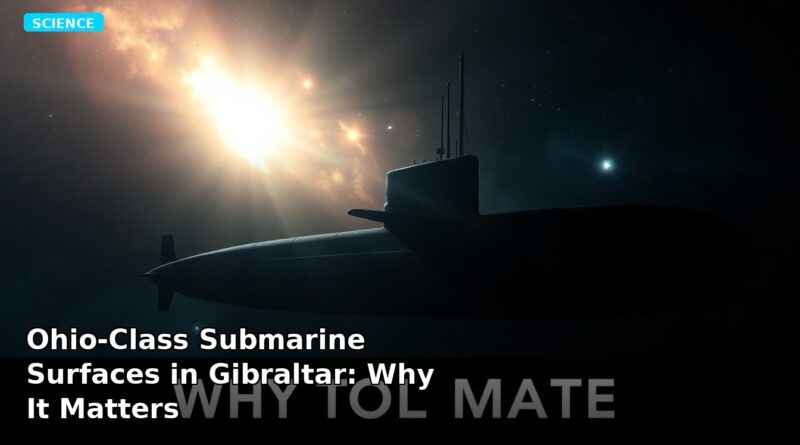
Ohio-Class Submarine Surfaces in Gibraltar: Why It Matters
Ohio-Class Submarine Surfaces in Gibraltar: Why It Matters
This week, something deeply unusual happened off the southern coast of Spain. A nuclear-armed Ohio-class submarine docked in Gibraltar — and the US Navy didn’t just let it happen quietly. They announced it. Posted a photo. Named the crew.
For a weapons system whose entire power depends on nobody knowing where it is, that’s not a routine port call. That’s a message.
The Most Dangerous Secret in the Ocean
The Ohio-class submarine isn’t just a warship. It’s the reason nuclear deterrence works.
The US nuclear triad — land-based missiles, bomber aircraft, and submarines — is designed so that no first strike could ever destroy all three legs at once. But of the three, the submarine leg is the one that keeps adversaries up at night. Land silos can be mapped. Airfields can be targeted. A submarine running silent in 400 metres of open ocean? Good luck.
The US Navy operates 14 of these vessels, each one a nuclear-powered, nuclear-armed platform carrying Trident II ballistic missiles with a range of over 4,500 miles. To put that in context: a missile launched from the mid-Atlantic could reach Moscow, Beijing, or Tehran without the submarine ever leaving international waters. The Pentagon considers the location of every single one of these boats to be among the most classified information in existence.
Which is exactly what makes the Gibraltar docking so striking.
Sunday, May 11, 2026 — Gibraltar Harbour
On Sunday, May 11, 2026, one of those 14 submarines pulled into Gibraltar — a small British territory perched at the very tip of Spain, where the Atlantic meets the Mediterranean.
The Navy’s Sixth Fleet shared a photograph of the vessel and its crew docked in harbour. Their statement was precise: the visit “demonstrates US capability, flexibility, and continuing commitment to its NATO allies.”
Three words in that sentence carry the weight: capability, flexibility, commitment. That’s not a tourism itinerary. That’s a carefully worded signal to every government watching — ally and adversary alike.
Notably, the Navy did not share the name of the submarine. Even in a deliberate show-of-force, some operational details stay locked. The crew’s faces are visible. The hull number is not.
Why Reveal It at All?
Here’s the counter-intuitive part. The Ohio-class submarine’s entire strategic value comes from being undetectable. The research is explicit on this: these submarines are described as “undetectable launch platforms for submarine-launched ballistic missiles, providing the US with its most survivable leg of the nuclear triad.”
So why surface one — literally and figuratively — in a busy European harbour?
Because deterrence is a psychological game, not just a military one. A weapon nobody knows exists deters nobody. The whole architecture of nuclear deterrence rests on the other side believing you have the capability and the will to use it. Most of the time, that belief is maintained through secrecy and rumour. Occasionally, it’s maintained by parking 18,000 tonnes of nuclear-armed submarine next to a NATO ally’s harbour and letting the cameras roll.
Gibraltar sits at one of the most strategically watched chokepoints on Earth — the strait connecting the Atlantic to the Mediterranean, flanked by Europe and Africa. Choosing that location wasn’t accidental.
4,500 Miles — What That Number Actually Means
The Trident II’s range of over 4,500 miles is the number that reframes everything else about this story.
Most people picture a submarine as a coastal weapon — something that sneaks close to shore before striking. The Trident II makes that assumption obsolete. With a range exceeding 4,500 miles, an Ohio-class submarine doesn’t need to be anywhere near its target. It can sit in the middle of the Atlantic, far from any coastline, far from any patrol aircraft, and still hold virtually any point on Earth at risk.
That’s not a tactical weapon. That’s a strategic one — built not to win a war, but to make starting one irrational.
The fact that the Pentagon rarely discloses submarine locations isn’t bureaucratic secrecy for its own sake. It’s the operational foundation of the whole deterrence model. If an adversary doesn’t know where the submarines are, they can never be confident they’ve neutralised them. And if they can’t be confident, they can’t rationally launch first. The submarines don’t need to fire a single missile to do their job. They just need to exist — somewhere, undetected, always.
Final Thought
The Gibraltar docking on May 11, 2026 will be forgotten by next week’s news cycle. But the Ohio-class submarine itself won’t be going anywhere — and that’s precisely the point. Of the 14 boats the US Navy operates, only one surfaced publicly this month. The other 13 are out there right now, running silent, positions unknown. The Trident II missiles they carry can reach over 4,500 miles in any direction. The Pentagon’s decision to show one submarine in Gibraltar while saying nothing about the rest is the whole strategy in miniature: reveal just enough to remind the world the capability exists, then disappear again. The most powerful deterrent in human history works best when you almost never see it.
Frequently Asked Questions
Why did a US Navy Ohio-class submarine surface in Gibraltar?
The US Navy docked an Ohio-class submarine in Gibraltar on May 11, 2026, as a deliberate strategic signal to NATO allies, demonstrating US military capability and flexibility rather than as a routine port call.
How many Ohio-class submarines does the US Navy operate?
The US Navy operates 14 Ohio-class submarines, each carrying Trident II ballistic missiles with a range of over 4,500 miles, capable of reaching targets like Moscow or Beijing from the mid-Atlantic.
Why are Ohio-class submarines so important to nuclear deterrence?
Ohio-class submarines are the hardest leg of the US nuclear triad to detect or destroy, as they run silently at depth in open ocean, making them virtually impossible to target in a first strike.
Recommended Reading
Explore these hand-picked resources to dive deeper into this topic:
- The Hunt for Red October by Tom Clancy
- Silent Running by James F. Calvert
- National Geographic Submarine Documentary Series (underwater exploration videos)
As an Amazon Associate, we earn from qualifying purchases. This helps support Fact Storm Hub at no extra cost to you.
Sources
- https://www.businessinsider.com/iran-war-submarine-nuclear-missiles-photo-2026-5
- https://www.wsj.com/livecoverage/iran-trump-war-news/card/pentagon-shows-off-nuclear-armed-submarine-in-gibraltar-UjaDMa0OVqgpD8jnsaYL
- https://nypost.com/2026/05/11/us-news/pentagon-reveals-location-of-navy-submarine-capable-of-launching-nukes-after-trump-rejects-iran-peace-offer/
- https://www.msn.com/en-us/news/insight/pentagon-discloses-nuclear-sub-in-gibraltar-after-iran-talks-fail/gm-GMF276C5D7?gemSnapshotKey=GMF276C5D7-snapshot-47
- https://www.arabnews.com/node/2643226/world
🤖 AI Content Disclosure
This article was created using AI-assisted research and writing tools, then reviewed for quality and accuracy. Facts are sourced from publicly available web research, but readers should verify critical information from primary sources.
Published for educational and entertainment purposes. Last reviewed: May 2026