
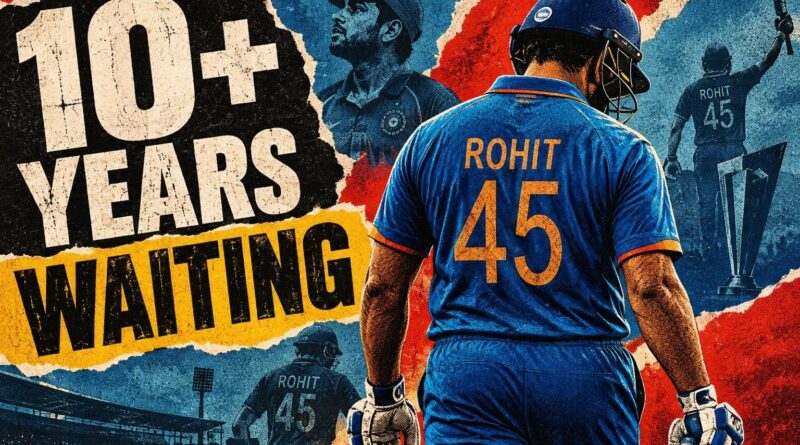
Rohit Sharma’s Long Wait for the Right Role
Rohit Sharma’s Long Wait for the Right Role
There’s a version of Rohit Sharma’s story where he never becomes India’s captain.
Where the kid from Nagpur — born on 30 April 1987 — spends his entire career as a middle-order batsman who flickered brilliantly but never burned long enough to matter. That version almost happened. Not because Rohit lacked talent. But because Indian cricket spent years unable to answer one simple question: where does this man actually bat?
The answer, when it finally arrived, changed everything. This is the story of the wait, the wish, and what it took to turn one into the other.
The Boy from Nagpur Who Didn’t Know Where He Belonged
Rohit Gurunath Sharma made his ODI debut on 23 June 2007 against Ireland. He was 20 years old, right-handed, and already carrying the kind of natural timing that coaches spend careers trying to manufacture in other players.
But for years, nobody could agree on where he fit.
He batted in the middle order. He came in at different positions in different matches. He was talented enough that selectors kept picking him, but not placed consistently enough to dominate. His Test debut didn’t come until 6 November 2013 against West Indies — six full years after his ODI debut — where he received cap number 280.
That six-year gap is the story. It tells you everything about how Indian cricket saw him during those years: a talent, yes, but one without a permanent home in the lineup. The right player, trapped in the wrong role.
The Wish He Couldn’t Say Out Loud
Every cricketer carries a dream that goes beyond runs and trophies. For Rohit, that dream had a precise shape: open the batting in ODIs and Tests, captain the side, and be trusted with both long enough to prove what he was actually worth.
It sounds simple. It wasn’t.
Opening the batting isn’t just a position — it’s a philosophy. It means facing the new ball, setting the tone, absorbing pressure before the pitch settles. For a player like Rohit, whose game is built on timing rather than brute force, getting to the crease early — before the field spreads, before the ball softens — was the difference between a good career and a great one.
The captaincy was the second half of that wish. Not for the title, but for the control. For the ability to shape a team around a clear identity rather than waiting to be shaped by someone else’s vision.
For years, both halves of that wish stayed out of reach.
How Fate Finally Turned
When the opportunity finally came — when Rohit was moved to open the batting in ODIs and eventually handed the captaincy across all formats — the transformation was immediate and undeniable.
The right-handed top-order batter who had spent years being managed as a middle-order option became one of the most destructive openers in Indian cricket history. His secondary skill — right-arm off break — was always there. But it was his primary role, finally clarified, that unlocked everything else.
He is now described as the former captain of the India national cricket team in all formats. That sentence carries an enormous amount of history inside it. The journey from “middle-order batsman searching for a role” to “captain of India across all three formats” is not a straight line. It is a story of patience that would have broken most players, and a stubbornness that the outside world often mistook for complacency.
The lesson buried inside this transformation is one Indian cricket fans know instinctively: the right player in the wrong role is just a wasted talent. The right player in the right role is a legend.
The IPL Thread That Never Broke
While the Test and ODI story was unfolding, there was one constant in Rohit Sharma’s career that never wavered: Mumbai Indians.
His relationship with the franchise is one of the longest and most decorated partnerships in IPL history. He captains Mumbai Indians, and according to the latest reports, he is likely to take over as Mumbai Indians captain again for IPL 2027. That continuity — in a league where franchises rotate captains, trade players, and rebuild rosters every few years — says something about the trust that runs in both directions.
The IPL gave Rohit something the international setup sometimes denied him: certainty. He knew his role, his team trusted him, and he delivered. That foundation of confidence at Mumbai Indians arguably kept his game sharp during the years when international cricket wasn’t always kind to him.
Where Rohit Sharma Stands Right Now
Rohit Sharma’s last Test match was on 26 December 2024 against Australia. That date marks a chapter closing — but not the story ending.
He is set to return to domestic cricket, having informed Mumbai that he will play in the Vijay Hazare Trophy. That decision — a player of his stature choosing to go back to domestic competition — is not a small thing. It signals intent. It signals hunger. It signals that the version of Rohit Sharma who waited years for his shot is still the same person driving decisions today.
The Vijay Hazare Trophy is a List A tournament, a level of cricket that many established internationals skip entirely once they’ve reached the top. Rohit choosing to play it is the cricketing equivalent of a CEO going back to the shop floor — not because he has to, but because he wants to stay sharp, stay connected, and stay ready.
That instinct — to keep proving rather than coasting — is probably what made the long wait survivable in the first place.
Sources: ICC, BCCI, official IPL franchise reports.
Frequently Asked Questions
When did Rohit Sharma make his ODI debut?
Rohit Sharma made his ODI debut on 23 June 2007 against Ireland at the age of 20, already showcasing the natural timing that set him apart from other players.
Why did Rohit Sharma wait so long for his Test debut?
Rohit’s Test debut didn’t come until 6 November 2013 against West Indies, six years after his ODI debut, because selectors couldn’t agree on his best batting position in the lineup.
Where was Rohit Sharma born and what is his date of birth?
Rohit Sharma was born on 30 April 1987 in Nagpur, India. Despite his natural talent, he spent years without a consistent batting role before eventually fulfilling his potential.
Recommended Reading
Explore these hand-picked resources to dive deeper into this topic:
- Rohit Sharma: The Incredible Story of India’s Most Successful Test Captain by Vijay Lokapally
- The Winning Way: Timeless Principles of Leadership and Success by Harsha Bhogle and Anita Bhogle
- Unacademy Plus Subscription (Online learning platform)
As an Amazon Associate, we earn from qualifying purchases. This helps support Fact Storm Hub at no extra cost to you.
Sources
- https://en.wikipedia.org/wiki/Rohit_Sharma
- https://www.cricinfo.com/cricketers/rohit-sharma-34102
- https://www.cricbuzz.com/profiles/576/rohit-sharma
- https://www.imdb.com/name/nm3461887/
- https://www.youtube.com/user/rozsharma
🤖 AI Content Disclosure
This article was created using AI-assisted research and writing tools, then reviewed for quality and accuracy. Facts are sourced from publicly available web research, but readers should verify critical information from primary sources.
Published for educational and entertainment purposes. Last reviewed: November 2026