
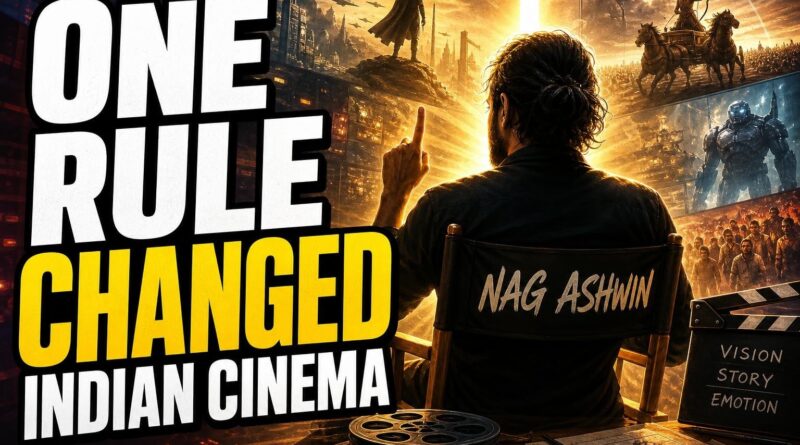
Nag Ashwin’s One Rule That Changed Indian Cinema
Nag Ashwin’s One Rule That Changed Indian Cinema
In 2018, a film about a dead actress — one most people under 30 had never heard of — walked into theatres with no action sequences, no male lead, and a story every major studio had already declined. It became the highest-grossing female-led South Indian film ever made. The director was 32 years old, and he had exactly one previous film to his name.
That is not a fluke. That is a method.
Nag Ashwin’s method is this: finish a film, resist every instinct to make the same film again, and then go somewhere else entirely. Three films in, across three completely different genres, it has produced a National Film Award, a Nandi Award, and a Filmfare Award — each earned in a different creative register. Understanding how he got there is more interesting than the trophy shelf suggests.
The Rule Nobody Else Was Following
Telugu cinema in 2015 had a working formula. Mass entertainers. Larger-than-life heroes. Box-office logic that left almost no room for quiet, character-driven storytelling. Nag Ashwin’s debut, Yevade Subramanyam, ignored all of it.
The coming-of-age film earned him the Nandi Award for Best Debut Director — his first major recognition, and a signal that his instinct to trust audiences with stillness and feeling was not a miscalculation. But the more important signal was what he did next.
He did not make Yevade Subramanyam again.
That refusal — to repeat a success, to settle into a lane, to let one win define the shape of everything that follows — is the single rule that connects every project in his filmography. It is not a rule anyone handed him. It is a rule he appears to have imposed on himself, quietly and consistently, from the beginning.
The Mahanati Gamble
Pitch a biopic about Savitri — a legendary Telugu actress whose personal life was as turbulent as her career — to a room full of producers, and watch the hesitation spread. Female-led biopics in South Indian cinema had no proven commercial template. The genre was considered a liability.
Nag Ashwin made it anyway.
Mahanati released in 2018. It did not just perform — it rewrote what was considered possible. It became the highest-grossing female-led South Indian film, a record that marked just how completely it connected with audiences across Telugu-speaking India and beyond. The National Film Award for Best Feature Film in Telugu followed. So did the Filmfare Award for Best Director in Telugu — two major awards from a single film, in a genre the industry had written off.
What made Mahanati work was not nostalgia. Nag Ashwin approached Savitri’s story with the same honesty he had brought to Yevade Subramanyam — no softening of the difficult parts, no manufactured heroism, no concession to comfort. The result was a film that felt true, and audiences responded to that truth at a scale nobody had predicted.
The Leap Into Science Fiction
Most directors who win national awards for intimate biopics stay in that lane. The critical establishment rewards it. The festival circuit validates it. The safe move after Mahanati was to make another Mahanati.
Nag Ashwin did not make the safe move.
In 2024, he directed Kalki 2898 AD — a science fiction film operating at a scale that placed it among the most ambitious productions in Indian cinema. The jump from a period biopic to big-budget sci-fi is not a small one. It requires an entirely different grammar: visual effects pipelines, world-building logic, the management of audience expectations that come with a mythology-meets-future-world premise.
The fact that he made this leap — without a franchise safety net, without a proven sci-fi playbook in Telugu cinema — is the clearest expression of his rule. When he praised Dhurandhar 2 director Aditya Dhar as a “genius” and lauded Ranveer Singh for “always raising the bar,” it read less like industry diplomacy and more like a filmmaker who genuinely studies other people’s craft and measures himself against it.
Three films. Three completely different registers. One consistent standard.
Why Creative Independence Is the Real Story
Here is the detail that sharpens everything above: Nag Ashwin married Priyanka Dutt in 2015. His father-in-law is C. Aswani Dutt, one of Telugu cinema’s established producers. His sister-in-law is Swapna Dutt. He is, by any measure, an insider.
That context matters precisely because his creative choices have consistently run against the grain of what that industry defaults to. He is not an outsider fighting for access. He is someone with access who keeps choosing the harder, stranger, less commercially predictable path anyway.
That is a different kind of courage — and arguably a more revealing one. It is easy to take risks when you have nothing to lose. It is harder when the safe option is genuinely available to you and you decline it anyway.
Final Thought
One Nandi Award. One National Film Award. One Filmfare Award. All earned before 40. All earned in different genres. Nag Ashwin’s career so far is a case study in what happens when a director refuses to be defined by his last success.
Mahanati could have been the ceiling. He treated it as a foundation, then built something structurally unrelated on top of it. That is the rule — stated simply: never let one win become a template. In an industry that rewards repetition and punishes deviation, it is a harder rule to follow than it sounds.
The question his filmography keeps raising is not whether Nag Ashwin can make another great film. It is whether he will ever make the same one twice. So far, the answer is no — and that refusal is the most interesting thing about him.
Frequently Asked Questions
What is Nag Ashwin’s filmmaking philosophy?
Nag Ashwin follows one core rule: never repeat himself. After each film, he deliberately moves into a completely different genre, refusing to replicate past successes or settle into a comfortable creative lane.
What was Nag Ashwin’s debut film and how did it perform?
His debut was Yevade Subramanyam in 2015, a quiet coming-of-age story that earned him the Nandi Award for Best Debut Director, proving audiences would embrace character-driven storytelling outside Telugu cinema’s mainstream formula.
Why was Mahanati considered a risky film to make?
Mahanati was a female-led biopic about actress Savitri with no action sequences and no male lead, a concept major studios had already declined. Despite the risks, it became the highest-grossing female-led South Indian film ever made.
Recommended Reading
Explore these hand-picked resources to dive deeper into this topic:
- The Art of Asking by Amanda Palmer
- Creativity, Inc. by Ed Catmull
- MasterClass Annual Membership (online learning platform)
As an Amazon Associate, we earn from qualifying purchases. This helps support Fact Storm Hub at no extra cost to you.
Sources
- https://en.wikipedia.org/wiki/Nag_Ashwin
- https://www.imdb.com/name/nm5645455/
- https://www.youtube.com/watch?v=yI1h6agOHQo
- https://letterboxd.com/director/nag-ashwin/
- https://screendollars.com/celebrity/nag-ashwin/
🤖 AI Content Disclosure
This article was created using AI-assisted research and writing tools, then reviewed for quality and accuracy. Facts are sourced from publicly available web research, but readers should verify critical information from primary sources.
Published for educational and entertainment purposes. Last reviewed: June 2026