
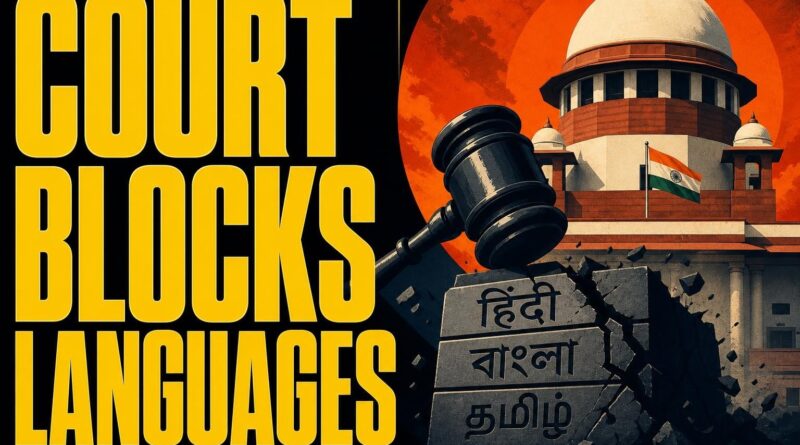
India’s Three-Language Formula: Supreme Court Battle
India’s Three-Language Formula: Supreme Court Battle
This week, thousands of Indian students and parents woke up to a CBSE circular that changed their school year — with less than a month’s notice. The three-language policy debate isn’t new. But the way it landed in 2026 has parents furious, students confused, and petitions sitting in the Supreme Court. Here’s the story behind the rule that’s been dividing India for decades.
The Rule That Sounds Simple — Until You Read the Fine Print
Three languages. That’s all CBSE is asking for.
But a May 2026 circular quietly changed what those three languages had to be. Starting from the 2026-27 academic session, any student entering Class IX must study three languages — and at least two of them must be Indian languages. French, German, or any other foreign language? Those can only count as the third language, not the second.
For students who had already built their subject combination around two foreign languages — say, French and German alongside English — this wasn’t a minor tweak. It was a structural overhaul of their school schedule, dropped on them mid-year.
The circular triggered immediate pushback. Petitions were filed in the Supreme Court. Parents called it rushed. Students in Classes VII, VIII, and IX found themselves caught in the middle of a policy change that technically applied to them — until CBSE stepped back and granted a one-time exemption.
The Exemption That Tells You Everything
Three grade levels — Classes VII, VIII, and IX — were handed a one-time relief by CBSE. Students already studying two foreign languages could continue that combination through Class X, without sitting for a Class X board exam in the Indian language they’d add as a third subject.
That single concession reveals how unprepared the rollout was.
When a policy requires an emergency carve-out for three consecutive grade levels within weeks of announcement, it signals that the implementation timeline was set before the logistics were ready. Parents didn’t just object to the idea of more Indian languages — they objected to textbook shortages and last-minute changes that left schools scrambling.
The National Curriculum Framework (NCF), which underpins this policy, had been in development for years. The circular, apparently, had not.
Where the Three-Language Formula Actually Comes From
Long before CBSE circulars and Supreme Court petitions, the three-language formula was India’s answer to one of the hardest questions a multilingual democracy can face: whose language gets taught in school?
India has hundreds of languages and dozens of official ones. After independence, the question of a national language created deep fault lines — particularly between Hindi-speaking states in the north and non-Hindi-speaking states in the south. The three-language formula emerged as a compromise: students would learn their regional language, Hindi, and English, giving every part of the country a stake in the system.
In practice, it never worked cleanly. Southern states, particularly Tamil Nadu, pushed back hard against Hindi being mandated. Northern states, meanwhile, sometimes treated the “third language” requirement as a formality. The formula survived on paper while implementation varied wildly across states and school boards.
The 2026 CBSE circular is, in many ways, the latest chapter in that decades-old negotiation — now playing out in the age of competitive exams, foreign language certificates, and parents who see French or German as a career advantage.
What the Policy Is Actually Trying to Do
The requirement that at least two of the three languages be Indian isn’t arbitrary. It connects directly to the National Curriculum Framework’s broader goal: that Indian students maintain a meaningful relationship with Indian languages at a time when English dominates professional life and foreign languages are seen as premium add-ons.
The concern driving the policy is real. When students replace an Indian language slot with French or German, they often do so for practical reasons — easier scoring, global utility, parental preference. Over time, regional languages lose their foothold in the curriculum. The three-language formula, enforced with teeth, is meant to reverse that drift.
The policy will be implemented prospectively — starting from Class VI going forward — and will not be applied retrospectively to students already in Classes VII, VIII, or IX. That’s a significant protection for current students. But it also means the full weight of this change will land on the next generation of Class VI entrants.
Final Thought
The three-language formula has always been less about linguistics and more about identity — whose languages matter, whose don’t, and who gets to decide. The May 2026 CBSE circular didn’t invent that tension. It just made it visible again, in the most concrete way possible: a child’s timetable. The Supreme Court petitions will likely shape how the NCF’s language requirements are enforced going forward. But the deeper question — whether a top-down curriculum mandate can genuinely revive the place of Indian languages in schools, or whether it just adds a subject students resent — is one no circular can answer on its own.
Frequently Asked Questions
What is the new three-language policy for CBSE students in 2026?
A May 2026 CBSE circular requires students entering Class IX to study three languages, with at least two being Indian languages. Foreign languages like French or German can only count as the third language, not the second.
Why are parents and students protesting the CBSE three-language formula?
The circular was issued with less than a month’s notice, disrupting students who had already built their schedules around two foreign languages, prompting Supreme Court petitions and widespread criticism over the rushed rollout.
Which CBSE students are exempt from the new three-language rule?
Students in Classes VII, VIII, and IX already studying two foreign languages received a one-time exemption, allowing them to continue that combination through Class X without a board exam in the added Indian language.
Recommended Reading
Explore these hand-picked resources to dive deeper into this topic:
- The Argumentative Indian by Amartya Sen
- India After Gandhi by Ramachandra Guha
- Curiosity Box by CurioCity (monthly learning subscription)
As an Amazon Associate, we earn from qualifying purchases. This helps support Fact Storm Hub at no extra cost to you.
Sources
- https://www.thehindu.com/opinion/editorial/language-decorum-on-the-three-language-formula-in-cbse-schools/article71044771.ece
- https://timesofindia.indiatimes.com/education/news/cbse-relief-on-three-language-policy-classes-7-9-students-allowed-to-continue-with-two-foreign-languages-report/articleshow/132013884.cms
- https://vidyamandir.com/studyhub/cbse-three-language-rule-class-nine/
- https://www.msn.com/en-in/news/insight/cbse-grants-one-time-relief-on-three-language-rule-for-classes-7-9/gm-GM10163FE5?gemSnapshotKey=GM10163FE5-snapshot-3&uxmode=ruby
- https://www.msn.com/en-in/news/insight/cbse-grants-one-time-relief-on-three-language-rule-for-classes-7-9/gm-GM10163FE5?gemSnapshotKey=GM10163FE5-snapshot-3&uxmode=ruby
🤖 AI Content Disclosure
This article was created using AI-assisted research and writing tools, then reviewed for quality and accuracy. Facts are sourced from publicly available web research, but readers should verify critical information from primary sources.
Published for educational and entertainment purposes. Last reviewed: June 2026