
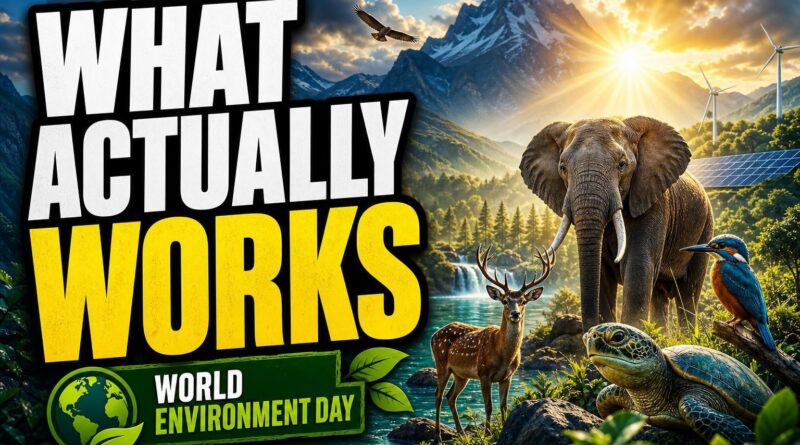
World Environment Day: What Actually Works for Nature
World Environment Day: What Actually Works for Nature
Every June, millions of people scroll past horoscopes, zodiac predictions, and lucky-streak forecasts. But June 5 carries something far older than any astrological calendar — a designation the United Nations gave to this exact date to force the world to confront what it was losing.
World Environment Day. The one day every year when governments, scientists, schoolchildren, and wildlife photographers all point at the same thing and say: this matters.
Here’s what most people don’t know about it.
The Day the UN Decided the Planet Needed a Birthday
Cold statement of fact: World Environment Day was established by the United Nations in 1972, making it the longest-running global platform for environmental public outreach and awareness that exists today.
That year, world leaders gathered in Stockholm for the UN Conference on the Human Environment — the first major international meeting where countries sat down specifically to talk about what industrial civilization was doing to the natural world. The date they chose to commemorate it, June 5, became an annual marker. Not a holiday in the traditional sense. More like a mirror held up to the planet once a year.
What’s striking is the timing. Early June sits at a hinge point in the natural world. In the Northern Hemisphere, migratory birds have just completed their spring journeys. Marine turtle nesting seasons are beginning along tropical coastlines. monsoon systems are building over the Indian Ocean. The natural world is at peak activity — and June 5 lands right in the middle of it.
That overlap isn’t coincidence. It’s a reminder that the calendar of human concern and the calendar of nature are running simultaneously, whether we pay attention or not.
What World Environment Day Actually Measures
Each year, World Environment Day adopts a specific theme — and the themes themselves tell a story about what the planet has been losing decade by decade.
Historically, early themes focused on human settlements and pollution. Later decades brought themes centered on desertification, biodiversity loss, and ecosystem restoration. The progression isn’t random. It reflects the scientific consensus of each era, updated annually as researchers understand more about what’s breaking down and what still has a chance of being saved.
The host country changes each year too, which means the conversation shifts geography. When an African nation hosts, the focus sharpens on savanna ecosystems and poaching pressure. When a South or Southeast Asian country hosts, coral reef degradation and monsoon-dependent agriculture move to the center. This rotating lens is deliberate — environmental damage doesn’t respect borders, but the communities experiencing it first are rarely the ones with the loudest voices in global policy rooms.
For audiences in India, this resonates directly. The subcontinent sits at the intersection of some of the world’s most biodiverse ecosystems: the Western Ghats, the Sundarbans mangrove delta, the Himalayan river systems. June 5 is the one day when that biodiversity gets named publicly, at scale, by institutions with the power to fund its protection.
The Ocean Connection Nobody Talks About in June
Mention World Environment Day and most people picture forests — tree-planting drives, green campaigns, photographs of tigers and elephants. But the ocean story in early June is just as urgent, and far less covered.
June marks the beginning of nesting season for several marine turtle species across the Indian Ocean and the Arabian Sea. Olive ridley turtles, which congregate in mass nesting events called arribadas along India’s eastern coastline, depend on undisturbed beach conditions during exactly this window. Coastal development, artificial lighting, and fishing net entanglement are the three primary threats they face — and all three are human-made problems.
The marine dimension of World Environment Day has grown in recent years as scientists have documented the scale of ocean plastic accumulation and coral bleaching events. The ocean produces roughly half of the oxygen in Earth’s atmosphere through the photosynthesis of marine phytoplankton — microscopic organisms that most people never think about, yet breathe because of, every single day.
That’s the kind of fact that earns a screenshot. Half the air you’re breathing right now has a marine origin. June 5 is partly a reminder that protecting the ocean isn’t an abstract environmental virtue — it’s maintenance on the life-support system.
Why Wildlife Needs a Calendar Too
Animals don’t observe June 5. But early June is, by biological coincidence, one of the most active periods in the wildlife calendar across the Northern Hemisphere and tropical zones simultaneously.
Migratory species that winter in South Asia and East Africa are completing their return journeys northward. Breeding seasons for numerous bird species are at peak intensity. In forest ecosystems across India, the pre-monsoon weeks of June represent a critical feeding window for large mammals before the rains restructure the landscape.
For wildlife photographers and researchers, early June is prime observation season. For conservationists, it’s also the window when human-wildlife conflict tends to spike — as animals range wider in search of water and food before the monsoon arrives, they increasingly encounter human settlements expanding into what were once buffer zones.
World Environment Day landing on June 5 puts a spotlight on these dynamics at precisely the moment they’re most visible in the field. That’s not symbolic. It’s practically useful — it’s when the evidence is easiest to show.
The Zodiac Searches and What They’re Really Asking
Here’s where it gets interesting. On June 5, 2026, the searches trending hardest include Gemini horoscope predictions and Chinese zodiac forecasts for the month. On the surface, that has nothing to do with nature or wildlife.
But look at what people are actually asking when they search for zodiac predictions: What should I pay attention to? What’s coming? What do I need to prepare for?
Those are the same questions World Environment Day was designed to answer — just pointed at a different kind of future. The Chinese zodiac calendar, which assigns an animal to each year in a twelve-year cycle, has its roots in an agricultural society that was deeply attuned to seasonal change, animal behavior, and natural cycles. The animals in that system — the rat, the ox, the tiger, the rabbit, the dragon, the snake — weren’t chosen arbitrarily. They reflected the creatures that shaped daily life in an agrarian world.
The fact that millions of people in India and across Asia are searching for animal-based zodiac forecasts on the same day the UN marks its global nature observance is, at minimum, a reminder that the human relationship with the animal world runs deep. It predates science. It predates conservation policy. It’s baked into how cultures tell time.
Final Thought
World Environment Day has been held on June 5 for over five decades — and in that span, the list of species classified as threatened has grown longer every single decade. That’s the uncomfortable throughline beneath every themed campaign, every tree-planting drive, every government pledge made on this date.
The Olive ridley turtles nesting right now on India’s eastern coastline don’t know it’s World Environment Day. The marine phytoplankton producing half the planet’s oxygen don’t observe the UN calendar. But the date exists precisely because human attention is finite and selective — and without a fixed point on the calendar to force the question, it’s too easy to look away.
June 5 is that fixed point. Whether you found it through a nature search or a horoscope, you’re here now. That’s the whole point.
Frequently Asked Questions
When was World Environment Day established?
World Environment Day was established by the United Nations in 1972, following the UN Conference on the Human Environment held in Stockholm, making it the longest-running global platform for environmental public outreach and awareness.
Why is World Environment Day celebrated on June 5?
June 5 was chosen to commemorate the 1972 Stockholm conference. It also falls during a peak period in the natural world, when migratory birds complete spring journeys, marine turtle nesting begins, and monsoon systems build over the Indian Ocean.
What is the purpose of World Environment Day?
World Environment Day serves as an annual global platform where governments, scientists, and communities draw attention to environmental issues. Each year it adopts a specific theme that reflects what the planet has been losing due to human activity.
Recommended Reading
Explore these hand-picked resources to dive deeper into this topic:
- Silent Spring by Rachel Carson
- The Sixth Extinction by Elizabeth Kolbert
- BBC Planet Earth II (Documentary Series)
As an Amazon Associate, we earn from qualifying purchases. This helps support Fact Storm Hub at no extra cost to you.
Sources
- https://www.astrosage.com/horoscope/monthly-gemini-horoscope.asp
- https://www.youtube.com/watch?v=m-C_e4FqZOM
- https://m.economictimes.com/astrology/others/5-zodiac-signs-lucky-streak-june-5-2026/articleshow/131506248.cms
- https://indianexpress.com/article/horoscope/gemini-monthly-horoscope-june-2026-check-astrological-predictions-for-gemini-love-career-money-10717698/
- https://timesofindia.indiatimes.com/astrology/horoscope/gemini-horoscope-today-june-5-2026-keep-your-money-in-your-wallet-today/articleshow/131489187.cms
🤖 AI Content Disclosure
This article was created using AI-assisted research and writing tools, then reviewed for quality and accuracy. Facts are sourced from publicly available web research, but readers should verify critical information from primary sources.
Published for educational and entertainment purposes. Last reviewed: June 2026