
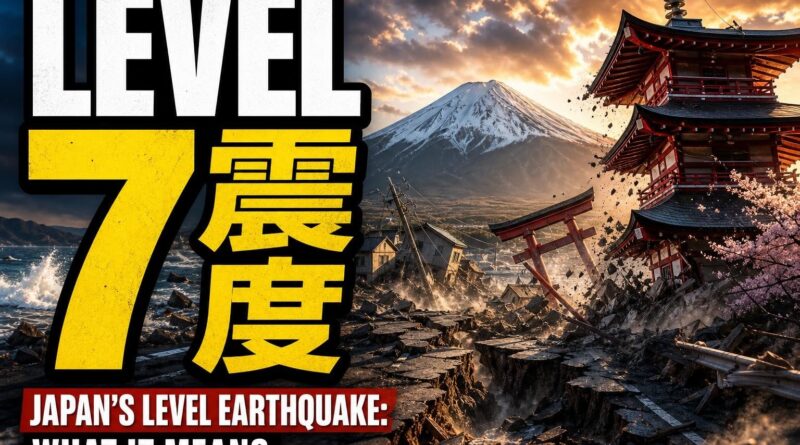
Japan’s Level 7 Earthquake: What It Means
Japan’s Level 7 Earthquake: What It Means
This week, a 7.1-magnitude earthquake struck Japan’s Kumamoto Prefecture at 4:27 p.m. on July 28, 2026. A shopping mall exploded. Houses collapsed. A cargo train derailed. And at least 50 people were rushed to hospitals. But the number that stopped emergency responders cold wasn’t the magnitude — it was the Shindo level. Seven. The highest number on Japan’s shaking scale. A level so rare that most Japanese citizens will never experience it in their lifetime. So what does “Level 7” actually mean — and why does it matter more than the 7.1 magnitude most news reports led with?
The Two Numbers Nobody Explains
When japan earthquakes make headlines, you’ll almost always see two different numbers — and most people have no idea they measure completely different things.
The 7.1 figure is magnitude. It measures the total energy released at the source of the quake, deep underground. Think of it as how loud the explosion was at its origin point.
The Shindo scale is something else entirely. It measures how violently the ground actually shakes at a specific location on the surface — where people live, work, and shop. Japan developed its own Shindo system precisely because a quake’s magnitude doesn’t tell you what it feels like to stand on the ground above it. A powerful quake deep underground might cause moderate shaking. A smaller quake close to the surface can tear a city apart.
Shindo runs from 0 to 7. At Level 1, you might feel a slight tremor. At Level 5, furniture moves and unsecured objects fall. At Level 6, it becomes nearly impossible to stand. Level 7 — the level recorded in Kumamoto Prefecture on July 28, 2026 — is the ceiling. There is no Level 8. It is, by definition, as bad as the scale goes.
That’s the number that matters. And that’s why emergency teams braced for the worst.
What Level 7 Does to a City
Cold fact: at Shindo 7, reinforced concrete structures crack, elevated highways split, and roads buckle mid-traffic.
Every single one of those things happened in Kumamoto on July 28. NHK reported at least 12 collapsed houses. A cargo train derailed. Cracked roads spread across the region, including damage to elevated highways. Prime Minister Sanae Takaichi confirmed power outages, fires, and bridge damage across the affected area — and urged residents to evacuate immediately and follow official instructions.
But the image that defined this earthquake wasn’t a crumbled road or a derailed train. It was the Aeon Mall in Kashima City.
The earthquake triggered a blast inside the mall. Part of the structure collapsed. People were trapped inside. A local police source told TBS broadcaster that there were “a lot of deaths” — but confirmed it would “take time to confirm the exact number.” One person was already confirmed killed when a house collapsed during the quake itself, according to Kyodo news agency.
At Shindo 7, buildings don’t just shake. They fail. And when a building the size of a shopping mall fails, the consequences are measured not in structural repair costs — but in the time it takes search teams to reach every person still inside.
Why Kumamoto, and Why Japan
Japan sits on what geologists call the Pacific Ring of Fire — a horseshoe-shaped belt of tectonic plate boundaries that circles the Pacific Ocean. Roughly 90 percent of the world’s earthquakes occur along this belt. Japan, positioned where the Pacific Plate, Philippine Plate, and Eurasian Plate all converge, sits at one of the most seismically active points on Earth.
Kumamoto Prefecture, on the island of Kyushu, has its own history with destructive quakes. The region’s geology makes it particularly vulnerable — and the local population knows it. Earthquake drills, early-warning systems, and strict building codes are part of daily life in a way that is difficult to fully appreciate from the outside.
Japan’s early-warning infrastructure is among the most advanced in the world. When a quake is detected, alerts go out to phones, televisions, and public speakers within seconds — sometimes giving residents 10 to 30 seconds of warning before shaking begins. That margin can be the difference between standing in the middle of a room and bracing in a doorway, or between staying in a building and getting out.
But no warning system stops a Level 7. It can only help people react faster to something that cannot be prevented.
The Animal Signals Nobody Officially Tracks
Here’s where the science gets genuinely contested — and genuinely fascinating.
For centuries, communities living near fault lines across Japan, China, and the broader Pacific region have reported unusual animal behaviour in the hours and days before major earthquakes. Dogs barking without cause. Fish surfacing in large numbers. Birds abandoning their usual roosting areas. Livestock refusing to enter buildings.
Marine animals are particularly interesting to researchers. Some studies have suggested that deep-sea fish — species that normally live far below the surface — are occasionally found washed ashore or near the surface before significant seismic events. The proposed mechanism involves changes in electromagnetic fields, shifts in groundwater pressure, or the release of gases from the ocean floor that precede fault movement.
Japan’s coastal waters, part of the broader Pacific marine ecosystem, are home to extraordinary biodiversity — including species sensitive to exactly these kinds of environmental changes. Whether animals genuinely detect precursor signals that human instruments miss remains scientifically unresolved. No early-warning system currently relies on animal behaviour. But the pattern keeps appearing in the historical record, and researchers haven’t fully closed the door on it.
What’s clear is this: the ocean and the land are not separate systems. A rupture deep beneath Japan’s surface sends signals outward in every direction — through rock, through water, and possibly through the nervous systems of creatures that have been living alongside these fault lines for millions of years.
What Happens in the First 72 Hours
The 72-hour window after a major earthquake is when survival outcomes are largely decided.
In Kumamoto on July 28, 2026, that window opened immediately. At least 50 people were taken to hospitals within hours of the quake. Search and rescue teams moved toward the Aeon Mall in Kashima City, where people remained trapped inside a partially collapsed structure. Power outages complicated coordination. Road and bridge damage slowed the movement of emergency vehicles.
Prime Minister Sanae Takaichi publicly urged residents to reach safe locations and follow evacuation guidance — a signal that the threat wasn’t over. After a Level 7 quake, aftershocks are expected. Weakened structures that survived the initial event can fail under a smaller follow-up tremor. Residents are trained not to return to damaged buildings until inspectors clear them.
Japan’s disaster response system is, by global standards, extraordinarily well-organised. But organisation has limits when the scale is large enough. A mall collapse, twelve collapsed houses, a derailed cargo train, cracked elevated highways, power failures, and fires — all simultaneously, across a region that just experienced the highest shaking level on the national scale — tests every layer of that system at once.
The confirmed death toll stood at one as of initial reports. Given the police source’s statement to TBS, that number was expected to rise as rescue teams worked through the rubble.
Final Thought
Japan has been building its earthquake response systems for generations — the Shindo scale, the early-warning alerts, the strict construction codes, the evacuation drills. And yet, on July 28, 2026, a Level 7 event in Kumamoto Prefecture still collapsed a shopping mall, derailed a cargo train, and sent at least 50 people to hospital within hours. That’s not a failure of preparation. It’s a measure of what a Shindo 7 actually is: the physical upper limit of what the ground can do to everything built on top of it. The question Japan — and every country on the Ring of Fire — keeps returning to isn’t whether the next one is coming. It’s whether the structures people are standing in right now were built to survive it.
Frequently Asked Questions
What is the Shindo scale and how does it differ from earthquake magnitude?
The Shindo scale measures how violently the ground shakes at a specific surface location, while magnitude measures total energy released underground. Japan developed Shindo because magnitude alone doesn’t reflect what people actually experience during a quake.
What does a Shindo Level 7 earthquake feel like?
Shindo Level 7 is the highest possible rating on Japan’s shaking scale, where it becomes nearly impossible to stand. It is so rare that most Japanese citizens will never experience it in their lifetime.
How strong was the 2026 Kumamoto earthquake in Japan?
The Kumamoto earthquake struck on July 28, 2026, registering a 7.1 magnitude and a Shindo Level 7, the highest on Japan’s scale. It caused building collapses, a shopping mall explosion, a train derailment, and sent at least 50 people to hospitals.
Recommended Reading
Explore these hand-picked resources to dive deeper into this topic:
- Earthquake Storms by Andrew Robinson
- The Great Japan Earthquake by James L. Hevia
- National Geographic Earthquake Science Kit
As an Amazon Associate, we earn from qualifying purchases. This helps support Fact Storm Hub at no extra cost to you.
Sources
- https://timesofindia.indiatimes.com/world/rest-of-world/japan-earthquake-triggers-blast-in-mall-several-feared-dead-trapped/amp_articleshow/132683807.cms
- https://www.hindustantimes.com/world-news/japan-earthquake-today-kumamoto-blast-at-aeon-mall-death-toll-news-101785236847928-amp.html
- https://www.cbsnews.com/news/strong-earthquake-with-7-1-magnitude-strikes-southern-japan-tsunami-alert-issued/
- https://indianexpress.com/article/world/japan-earthquake-kumamoto-aeon-mall-collapse-explosion-several-killed-trapped-10807480/lite/
- https://zeenews.india.com/world/several-trapped-feared-dead-after-71-magnitude-japan-earthquake-triggers-blast-at-kumamoto-mall-3063510.html/amp
Watch the Video
🤖 AI Content Disclosure
This article was created using AI-assisted research and writing tools, then reviewed for quality and accuracy. Facts are sourced from publicly available web research, but readers should verify critical information from primary sources.
Published for educational and entertainment purposes. Last reviewed: August 2026