

Shubman Gill’s 223*: The Terrifying Stats Explained
Shubman Gill’s 223*: The Terrifying Stats Explained
In Guwahati, on a September evening in 2026, Shubman Gill walked out to bat with India needing to chase 406 runs. Not 250. Not 300. Four hundred and six.
What happened next belongs in a different sport entirely.
The Target Nobody Thought Was Chaseable
West Indies posted 405 for 7. That number sat on the scoreboard like a dare.
To understand how outrageous that is — only once in the entire history of ODI cricket has a team successfully chased more than 406. South Africa did it in Johannesburg in 2005/06, chasing 435 against Australia. That was a once-in-a-generation moment that cricket historians still talk about.
India were being asked to do something that had only been done once before, in the entire 50-year history of the format. The combined runs in the match hit 811 — only the fourth time in ODI history that a single game has crossed the 800-run mark. This wasn’t a cricket match anymore. It was a run festival that broke the boundaries of what the format was supposed to allow.
And yet, somehow, the most staggering number in Guwahati that night wasn’t 406. It was 133.
223 Runs. 133 Balls. One Batter.
That’s the number of balls Shubman Gill needed to score 223 not out.
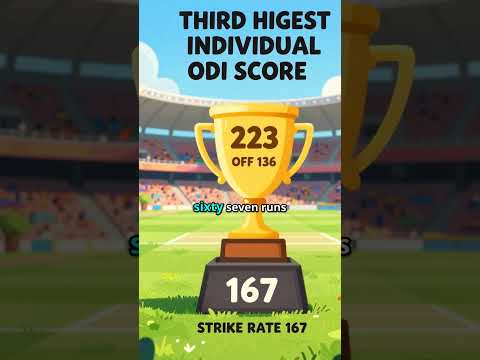
To put that in plain terms: Gill scored more than two centuries — in the time it takes most batters to score one. His strike rate meant he was hitting roughly 167 runs for every 100 balls faced. In a chase of 406, where most batters would be managing pressure and calculating required run rates, Gill was playing an entirely different game.
The knock lands as the third highest individual score in ODI cricket history. The two scores above it belong to a list so short it barely exists — and Gill’s 223 now sits in that same conversation, scored not in a dead rubber, not against a weak side, but in a chase that required every single run he made.
Rohit Sharma, batting alongside him, scored 101 in the same innings. On any other day, a Rohit century is the headline. In Guwahati, it was the supporting act.
The Record That Separates Gill From Almost Everyone
Here is the detail that stops you cold.
Gill is now only the second batter in the history of ODI cricket to score multiple double hundreds. Multiple. Not one landmark innings that defined a career — at least two separate occasions where he crossed 200 in a 50-over game.
That is not a hot streak. That is a pattern. And patterns in sport are how you separate the genuinely exceptional from the occasionally brilliant. Scoring one ODI double hundred is the kind of achievement a batter builds a career around. Scoring more than one means the first wasn’t a fluke — it was a preview.
He was born on 8 September 1999 in Fazilka, Punjab — a small city in the far southwest corner of the state, close to the Pakistan border. He is 26 years old. The record books suggest he is already running out of room to put new entries.
Why This Moment Feels Different
Guwahati 2026 isn’t just a big score. It’s a statement about what Indian batting has become.
India chased 406. Successfully. That is now India’s highest-ever successful ODI chase — a record that replaces whatever came before it by a margin that makes the previous record feel like a different era. The fact that two Indian batters — Gill and Rohit — combined to make it happen means this wasn’t a one-man rescue act. It was a batting unit operating at a level that the format rarely sees.
West Indies’ 405 for 7 was a genuine, aggressive total. It would have won most ODI matches in history. It wasn’t enough by the time Gill was done. When a 26-year-old scores 223 off 133 balls in a successful chase of 406, the argument that ODI cricket has nothing left to offer answers itself.
Final Thought
The easy framing is that Shubman Gill had a great night. But the 223 not out off 133 balls in Guwahati points to something more specific: Gill has now scored multiple ODI double hundreds at an age when most batters are still figuring out how to handle pressure chases. Whether he ever surpasses what sits above him on that all-time list or not, the fact that a 26-year-old from Fazilka is already the second batter in history to make 200 more than once tells you exactly where Indian batting is right now. And where Gill is heading.
Frequently Asked Questions
What score did Shubman Gill make against West Indies in 2026?
Shubman Gill scored 223 not out off just 133 balls against West Indies in Guwahati in September 2026, helping India chase a target of 406 runs with a strike rate of approximately 167.
Is Shubman Gill’s 223 one of the highest scores in ODI cricket history?
Yes, Gill’s 223 not out is the third highest individual score in ODI cricket history, scored during a pressure chase rather than a dead rubber or against a weak opposition.
Has any team ever successfully chased more than 406 in ODI cricket?
Only once in ODI history has a team chased more than 406 runs — South Africa chased 435 against Australia in Johannesburg in 2005/06, a record that cricket historians still regard as a once-in-a-generation achievement.
Recommended Reading
Explore these hand-picked resources to dive deeper into this topic:
- Sachin: My Cricketing Story by Sachin Tendulkar
- The Test: My Life Through Cricket by Marcus Trescothick
- Cricket Analytics: Data Science Kit
As an Amazon Associate, we earn from qualifying purchases. This helps support Fact Storm Hub at no extra cost to you.
Sources
- https://www.cricbuzz.com/cricket-news/140345/india-and-shubman-gills-record-breaking-night
- https://indianexpress.com/article/sports/cricket/shubman-gill-fastest-double-ton-record-india-vs-west-indies-10901325/
- https://en.wikipedia.org/wiki/Shubman_Gill
- https://www.cricinfo.com/cricketers/shubman-gill-1070173/tests-odi-t20-records
- https://www.youtube.com/watch?v=nfxhhbadqf8
🤖 AI Content Disclosure
This article was created using AI-assisted research and writing tools, then reviewed for quality and accuracy. Facts are sourced from publicly available web research, but readers should verify critical information from primary sources.
Published for educational and entertainment purposes. Last reviewed: October 2026