
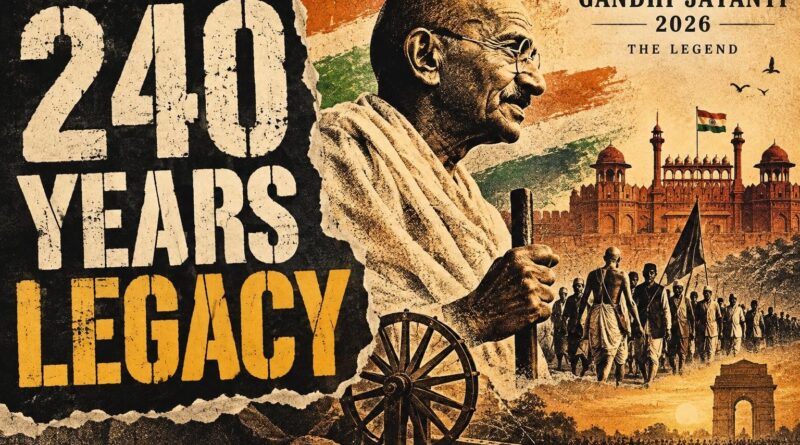
Gandhi Jayanti 2026: Facts About the Legend
Gandhi Jayanti 2026: Facts About the Legend
Today, October 2, 2026, marks 157 years since a child was born in Porbandar, a small coastal town in Gujarat, India. That child would grow up to challenge the most powerful empire on Earth — without firing a single shot.
Gandhi Jayanti is observed every year on this date. But this year, the number hits differently. 157 years. And if anything, the world needs what Gandhi stood for more than it did when he was alive.
The Town That Produced a Revolution
Porbandar sits on the western edge of Gujarat, a port city that most people outside India couldn’t locate on a map without help. On October 2, 1869, Mohandas Karamchand Gandhi was born there — the youngest child in his family, in a region that had no particular reason to produce a global icon.
There was nothing in Porbandar’s geography or history that pointed toward revolution. It was a trading town. Merchants, not warriors. And yet, the man who emerged from it would eventually be credited with inspiring civil rights movements across three continents — from the American South to South Africa to Southeast Asia.
That gap between origin and impact is worth sitting with. Most people assume world-changing figures come from centres of power — great capitals, wealthy families, elite institutions. Gandhi came from a coastal town that most of the world still struggles to place on a map. That’s the first thing the history books tend to gloss over.
The Idea That Outlived the Man
Mahatma Gandhi was assassinated decades ago. His body is gone. But on October 1, 2026 — the eve of Gandhi Jayanti — President Droupadi Murmu paid tribute and said something that stopped people mid-scroll: Gandhi’s message of peace and non-violence has become even more relevant amid global conflicts today.
Read that again. Not “still relevant.” More relevant.
That’s a remarkable claim in 2026, when the world has access to satellite weapons, drone warfare, and geopolitical tensions that would have been unimaginable in Gandhi’s lifetime. And yet India’s President — speaking to a modern, nuclear-armed nation — pointed back to a man born 157 years ago as the answer to what ails the world right now.
President Murmu specifically highlighted Gandhi’s ideal of Sarvodaya — a Sanskrit concept meaning the welfare and upliftment of all, not just the powerful, not just the majority, not just one nation. Every person. That principle is simple enough to explain to a child, and complex enough that entire governments still struggle to implement it.
Why “Sarvodaya” Is the Word You Should Know
Most people who know Gandhi’s name don’t know this word. And that’s a problem, because Sarvodaya is arguably the core of everything he believed.
It isn’t just charity. It isn’t just social welfare in the way modern governments define it. Sarvodaya — welfare for all — was Gandhi’s answer to a world that constantly sorts people into winners and losers, the deserving and the undeserving, the powerful and the powerless.
The concept cuts across political lines in a way that makes it uncomfortable for everyone. It challenges the left, because it isn’t purely about class. It challenges the right, because it isn’t purely about individual achievement. It asks a harder question: what does a society look like when no one is left behind?
President Murmu’s reference to Sarvodaya on Gandhi Jayanti 2026 wasn’t ceremonial filler. It was a direct link between Gandhi’s philosophy and India’s stated goal of becoming Viksit Bharat — a fully developed nation — by 2047. The argument being made is that development without equity isn’t really development at all.
The Anniversary That Lands Differently This Year
There’s a reason Gandhi Jayanti 2026 feels weightier than usual. Across the world right now, armed conflicts are ongoing. Diplomatic channels are strained. The instinct in times of conflict is to reach for harder power — bigger weapons, stronger alliances, louder threats.
Gandhi’s entire life was a counter-argument to that instinct.
He didn’t win by being louder. He didn’t win by being better armed. He won — and his methods inspired others to win — by making the cost of oppression higher than the cost of justice. That’s a strategy, not a sentiment. It required extraordinary discipline, extraordinary courage, and an extraordinary belief that the opponent could be moved by moral pressure.
President Murmu’s call on Gandhi Jayanti 2026 was for citizens to reaffirm their commitment to ethical conduct and active participation — to build what she called an Atmanirbhar Bharat, a self-reliant India. The connection being drawn is clear: Gandhi’s self-reliance wasn’t just economic. It was moral. A nation that depends on force to hold itself together is never truly self-reliant.
Final Thought
157 years after a child was born in Porbandar, the President of India stood up and said the world needs his ideas more than ever. That’s not nostalgia. That’s a diagnosis.
Gandhi’s Sarvodaya — the welfare of all — isn’t a relic from 1869. It’s the specific answer to the specific problem that keeps producing the conflicts President Murmu was referring to: the belief that some people’s lives matter more than others. Every war, every oppression, every injustice in history has started from that one assumption.
Gandhi spent his life dismantling it. On Gandhi Jayanti 2026, the question isn’t whether we remember him. It’s whether we’re actually willing to try what he was teaching.
Frequently Asked Questions
When and where was Mahatma Gandhi born?
Mahatma Gandhi was born on October 2, 1869, in Porbandar, a small coastal town in Gujarat, India. He was the youngest child in his family and grew up in this modest trading town before becoming a global icon.
Why is Gandhi Jayanti celebrated on October 2?
Gandhi Jayanti is celebrated on October 2 every year to mark the birth anniversary of Mohandas Karamchand Gandhi. In 2026, the occasion marks 157 years since his birth.
Is Gandhi’s message of non-violence still relevant today?
Yes, Gandhi’s message is considered more relevant than ever. On the eve of Gandhi Jayanti 2026, President Droupadi Murmu stated that Gandhi’s message of peace and non-violence has become even more relevant amid today’s global conflicts.
Recommended Reading
Explore these hand-picked resources to dive deeper into this topic:
- The Story of My Experiments with Truth by Mahatma Gandhi
- Gandhi: A Life by Jonathan Eig
- National Geographic India Magazine (monthly subscription)
As an Amazon Associate, we earn from qualifying purchases. This helps support Fact Storm Hub at no extra cost to you.
Sources
- https://theprint.in/india/gandhis-message-of-peace-non-violence-more-relevant-amid-conflicts-president-murmu/3059448/?amp
- https://ddnews.gov.in/en/president-murmu-highlights-relevance-of-mahatma-gandhis-message-of-peace-non-violence/
- https://newsonair.gov.in/gandhis-message-of-peace-and-non-violence-more-relevant-amid-global-conflicts-president-murmu/
- https://www.business-standard.com/india-news/gandhi-s-peace-non-violence-message-more-relevant-amid-wars-prez-murmu-126100101200_1.html
- https://www.pib.gov.in/PressReleaseDetail.aspx?PRID=2317868®=48&lang=1
🤖 AI Content Disclosure
This article was created using AI-assisted research and writing tools, then reviewed for quality and accuracy. Facts are sourced from publicly available web research, but readers should verify critical information from primary sources.
Published for educational and entertainment purposes. Last reviewed: October 2026