
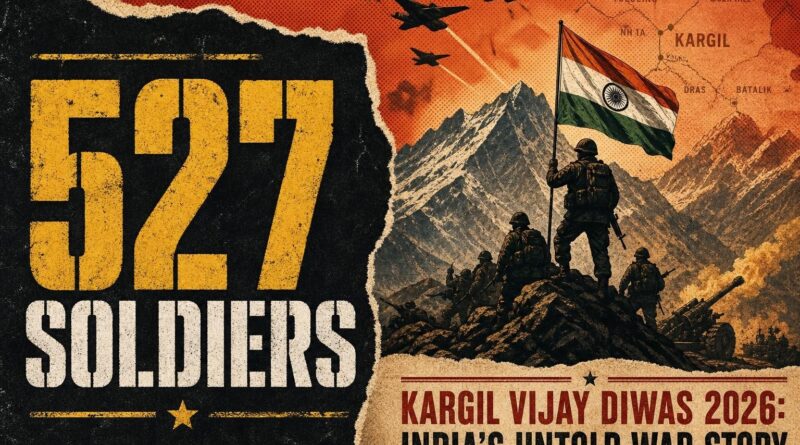
Kargil Vijay Diwas 2026: India’s Untold War Story
Kargil Vijay Diwas 2026: India’s Untold War Story
Tonight, on a rain-soaked hillside in Dras, Defence Minister Rajnath Singh handed a ceremonial kalash to the families of soldiers who never came home. The Kargil War Memorial glowed against the dark sky. Twenty-seven years had passed. And yet, standing there on July 25, 2026, the grief in that valley felt anything but old.
This is Kargil Vijay Diwas — July 26. The day Operation Vijay officially ended in 1999. But the story of how India reclaimed those frozen peaks is far more complicated, far more human, and far more extraordinary than any ceremony can fully capture.
The Mountain Nobody Was Supposed to Climb
The Kargil sector sits at altitudes where breathing itself becomes a battle. The peaks that Pakistani forces quietly occupied in early 1999 — Tiger Hill, Tololing, Point 4875 — weren’t just strategically significant. They were, by almost every military calculation, nearly impossible to retake from below.
Think about what that means. Indian soldiers were ordered to charge uphill, in daylight, against entrenched positions held by fighters who had months to dig in. The enemy had the high ground, the cover, and the cold on their side. The Indian Army had to go up anyway.
Military historians have consistently noted that attacking uphill against fortified positions is one of the most difficult operations in conventional warfare. The casualty risk multiplies with every metre of elevation. And yet, unit after unit went up those slopes — in some cases, scaling near-vertical rock faces at night to avoid detection.
The geography itself was the enemy’s greatest weapon. And India had to defeat both.
27 Years Later: What the 2026 Ceremony Actually Showed
The Shaurya Sandhya at Dras on July 25, 2026 wasn’t just a memorial. It was a statement.
Alongside the cultural programme honouring Ladakh’s heritage, the Army put something unexpected on display at the Shaurya Bhoj event at Vishwanathan Stadium — drones, robotic mules, and Army Martial Arts Routine drills. These weren’t decorations. They were a deliberate signal: the Indian Army of 2026 is not the same force that fought in 1999, and it wants that known.
Rajnath Singh, speaking at the ceremony, didn’t soften his words. “Even as the enemy’s intentions remain unchanged and it continues to employ nefarious tactics such as proxy wars and infiltration, the Indian Defence Forces stand fully prepared to face any challenge.” That sentence, spoken at a war memorial, carries weight that a press release never could.
The attendance list alone told a story. Ladakh LG V K Saxena, Army Chief General Dhiraj Seth, and Lieutenant General Pratik Sharma, General Officer Commanding-in-Chief of Northern Command, were all present. This was not a routine anniversary. The 27th commemoration — with its drone displays and robotic mules — was the Army showing the country, and perhaps others, how far it has come.
The Human Cost Behind the Ceremony
The ceremonial kalash that Rajnath Singh handed to families of fallen soldiers is not a symbolic gesture chosen at random. It carries the weight of specific loss — men with names, ranks, regiments, families who still set a place at the table out of habit.
Operation Vijay lasted roughly 60 days. In that time, hundreds of Indian soldiers were killed and many more were wounded — fighting in conditions that ground down the body even before a single shot was fired. Altitude sickness, frostbite, and exhaustion were constant companions. Supply lines were stretched thin. The terrain made evacuation of the wounded an ordeal in itself.
What made Kargil different from other conflicts in Indian military history was its visibility. For the first time, Indian television cameras were close enough to bring fragments of the war into living rooms across the country. Families watched news bulletins not knowing whether the face on screen would be the last image they’d see of someone they loved. That shared anxiety — felt across an entire nation simultaneously — is part of why Kargil still resonates the way it does, 27 years on.
The kalash ceremony acknowledges that the debt is not paid off by time. It compounds.
The Line That Held — And What It Means in 2026
Operation Vijay officially concluded on July 26, 1999, when India declared that all Pakistani-backed forces had been evicted from Indian territory. The Line of Control was restored. The peaks came back.
But “restored” is a word that flattens the reality. Every peak had to be taken individually, at enormous cost, by soldiers who knew the odds and climbed anyway. Tiger Hill. Tololing. Point 5140. Each name in the history of that conflict is a chapter of its own — a night assault, a fallen officer, a unit that kept moving despite losses that should have stopped them.
Twenty-seven years later, the Shradhanjali Samaroh on July 26, 2026, with Rajnath Singh as chief guest, closes this year’s commemorations at the same memorial where those names are carved in stone. The ceremony brings together the families, the survivors, the senior leadership — and a new generation of soldiers who were not yet born when Operation Vijay ended.
That generational shift is quietly significant. The soldiers displaying drone technology and robotic mules at Vishwanathan Stadium in 2026 represent an Army that has absorbed the lessons of 1999 and built on them. The terrain hasn’t changed. The altitude hasn’t changed. But the tools, the doctrine, and the preparedness have.
Final Thought
Kargil Vijay Diwas is often framed as a celebration of victory. And it is. But standing in Dras on a rain-soaked evening in July 2026, watching Defence Minister Rajnath Singh place a ceremonial kalash into the hands of a soldier’s family, the more honest framing surfaces: it is a reckoning with what victory costs.
The drone displays and robotic mules at this year’s Shaurya Bhoj aren’t a departure from that spirit — they are its continuation. The 1999 generation paid for those peaks in the hardest currency there is. The 2026 generation is saying, with every new capability it builds: we will not make that sacrifice cheap by being unprepared. Twenty-seven years on, that is the real message of July 26.
Final Thought
Kargil Vijay Diwas is often framed as a celebration of victory. And it is. But standing in Dras on a rain-soaked evening in July 2026, watching Rajnath Singh place a ceremonial kalash into the hands of a fallen soldier’s family, the more honest framing surfaces: it is a reckoning with what victory costs.
The drone displays and robotic mules at this year’s Shaurya Bhoj aren’t a departure from that spirit — they are its continuation. The 1999 generation paid for those peaks in the hardest currency there is. The 2026 generation, led by Army Chief General Dhiraj Seth, is saying with every new capability it builds: we will not make that sacrifice cheap by being unprepared. Twenty-seven years on, that is the real message carved into the Kargil War Memorial at Dras.
Frequently Asked Questions
What is Kargil Vijay Diwas and when is it celebrated?
Kargil Vijay Diwas is celebrated on July 26 every year to mark the day Operation Vijay officially ended in 1999, when India successfully reclaimed strategic peaks in the Kargil sector from Pakistani forces.
How did India recapture the peaks during the Kargil War?
Indian soldiers charged uphill in daylight against entrenched enemy positions on peaks like Tiger Hill and Tololing, sometimes scaling near-vertical rock faces at night to avoid detection, despite the extreme altitude and heavily fortified opposition.
What happened at the Kargil Vijay Diwas 2026 ceremony?
On July 25, 2026, Defence Minister Rajnath Singh attended the Shaurya Sandhya at the Kargil War Memorial in Dras, handing a ceremonial kalash to families of fallen soldiers and honoring Ladakh’s heritage through cultural programmes.
Recommended Reading
Explore these hand-picked resources to dive deeper into this topic:
- The Kargil War by Maroof Raza
- 1971: A Global History of the Creation of Bangladesh by Srinath Raghavan
- Kargil: The Untold Story (Documentary Series)
As an Amazon Associate, we earn from qualifying purchases. This helps support Fact Storm Hub at no extra cost to you.
Sources
- https://www.hindustantimes.com/india-news/drone-capabilities-display-shaurya-sandhya-army-hosts-anniversary-events-to-honour-kargil-heroes-101785006218926.html
- https://www.pib.gov.in/PressReleasePage.aspx?PRID=2289479
- https://newsonair.gov.in/shaurya-sandhya-ceremony-held-at-kargil-war-memorial-in-drass-to-mark-27th-kargil-vijay-diwas/
- https://www.etvbharat.com/amp/en/bharat/kargil-vijay-diwas-2026-rajnath-singh-says-enemy-continues-proxy-war-india-fully-prepared-enn26072506741
- https://www.hindustantimes.com/india-news/drone-capabilities-display-shaurya-sandhya-army-hosts-anniversary-events-to-honour-kargil-heroes-101785006218926-amp.html
🤖 AI Content Disclosure
This article was created using AI-assisted research and writing tools, then reviewed for quality and accuracy. Facts are sourced from publicly available web research, but readers should verify critical information from primary sources.
Published for educational and entertainment purposes. Last reviewed: July 2026