
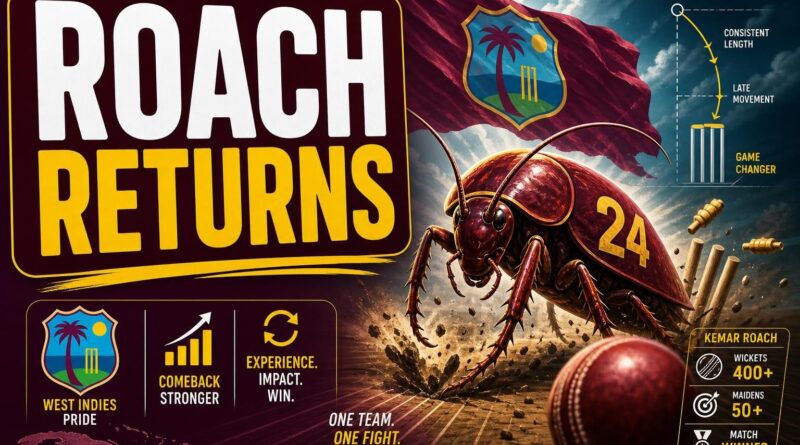
West Indies Cricket’s Stunning Comeback With Kemar Roach
West Indies Cricket’s Stunning Comeback With Kemar Roach
A team that once made the entire cricketing world nervous has spent years being written off. Then, quietly, one fast bowler crossed a line that only a handful of men in Test history have ever crossed — and reminded everyone why the Windies still matter. The obituaries were premature. They always are.
The Name That Still Means Something
West Indies cricket carries a weight that no other team name quite does. The Windies don’t represent one country. They represent a coalition — a group of mainly English-speaking Caribbean nations who, despite their size, built a cricketing identity so powerful that it shaped the modern game.
Think about what that actually means. A collection of small island nations, pooling talent, competing against countries with populations fifty times larger — and for decades, winning. The West Indies name on a cricket shirt has never just been geography. It has been a statement.
But statements need proof. And in recent years, the proof has been harder to find. Younger fans in India, Bangladesh, and beyond grew up watching West Indies teams that were inconsistent, unpredictable, and often outclassed in Test cricket. The narrative became familiar: They’re good in T20s, but Tests? Not anymore.
Kemar Roach spent his career quietly arguing against that narrative. Not with press conferences. With wickets.
300 — The Number That Puts You in Rare Company
Kemar Roach reached 300 Test wickets for West Indies — a milestone publicly congratulated by Cricket West Indies, and one that places him among a very small group of fast bowlers in the history of the game.
To understand what 300 Test wickets means, consider the context. Test cricket is the longest, most demanding format. Pitches vary wildly. Conditions shift. Batsmen have time to adjust. A fast bowler who survives long enough to take 300 wickets has done something that requires not just pace, but intelligence, durability, and the ability to reinvent himself season after season.
Cricket West Indies’ public acknowledgment matters. It signals that this is not just a personal milestone — it is a franchise moment. A proof point that West Indies Test cricket, even in a difficult era, can still produce players of genuine historical significance.
For Indian viewers who track Test cricket closely, 300 wickets is a number that demands respect. It is the kind of milestone discussed in the same breath as the greats — and Roach earned every single one of them.
The Sri Lanka Series: A Trophy, a Stadium, and the Weight of History
Roach’s 300th wicket didn’t arrive in a vacuum. It arrived during a Test series against Sri Lanka, with West Indies competing for the Sobers-Tissera Trophy in Antigua — and that context matters enormously.
The Sobers-Tissera Trophy carries names that mean something. Sir Garfield Sobers. A man widely regarded as the greatest all-rounder the game has ever seen. A West Indian. The trophy itself is a reminder that this rivalry has roots, that it has always been contested between two cricketing cultures with genuine pride at stake.
The 2nd Test of that series is scheduled at Sir Vivian Richards Stadium in North Sound on Friday, July 3, 2026. Pause on that venue name for a moment. Viv Richards. The man who batted without a helmet because he felt no fast bowler deserved that kind of acknowledgment. The man who represented West Indian defiance at its most complete.
That Roach reached his milestone in this setting — competing for a trophy bearing Sobers’ name, at a ground bearing Richards’ name — is not incidental. It is the whole story in miniature. West Indies cricket does not exist in spite of its history. It exists because of it. The ground itself is a reminder of what the Windies once were — and what they are still capable of producing.
India, the Middle East, and an Extraordinary Detour
West Indies toured India in October 2025 for two Test matches. India won the series 2-0, defeating West Indies by 7 wickets to clinch it. On paper, a comfortable Indian win.
But the story around that tour became something else entirely.
The West Indies cricket team was stranded in India amid tensions in the Middle East, with a charter flight eventually arranged to transport the team safely out of the country. A cricket tour becoming a logistical emergency — players from the Caribbean, far from home, waiting for a flight out of South Asia while events unfolded beyond anyone’s control.
It is the kind of detail that never makes the highlights reel. But it is exactly the kind of detail that reveals what international cricket actually involves. These are not just athletes playing matches. They are people navigating a complicated world, representing nations that carry little geopolitical weight, relying on boards and administrators to get them home safely.
The West Indies team handled it. They always do. That resilience — quiet, unspectacular, rarely celebrated — is woven into everything the Windies have ever done.
T20 World Cup 2026: The Reunion That Never Gets Old
West Indies played India in the ICC Men’s T20 World Cup 2026 — a matchup that Indian fans needed no introduction to. The history between these two sides in T20 cricket is layered and emotional, stretching back to moments that are still replayed on social media years later.
The T20 format has been the one arena where West Indies have most consistently reminded the world of their elite status. Two World Cup titles. A batting philosophy that changed what the format considered possible. And a fanbase in India that has followed West Indian players through IPL seasons long enough to feel genuine investment in how the Windies perform.
When these two sides meet at a World Cup, the occasion carries all of that accumulated history. It is never a neutral fixture. It is a contest between two cricketing cultures that have influenced each other in ways that go far beyond the scoreboard — and in 2026, with West Indies arriving off the back of Roach’s milestone and a hard-fought Sri Lanka series, the Windies brought something to that matchup that a team in decline simply cannot manufacture: momentum, and the quiet confidence of a side that knows it still belongs.
The obituaries for West Indies cricket keep getting written. They keep being wrong. Kemar Roach’s 300 Test wickets, a trophy series in Antigua, and a World Cup appearance against India in 2026 are not the story of a team fading out. They are the story of a team that refuses to go quietly — and probably never will.
Frequently Asked Questions
How many Test wickets has Kemar Roach taken?
Kemar Roach has taken 300 Test wickets for West Indies, a milestone publicly congratulated by Cricket West Indies that places him among a very small group of fast bowlers in the history of the game.
Why does the West Indies cricket team represent multiple countries?
West Indies cricket represents a coalition of mainly English-speaking Caribbean nations that pool their talent to compete as one team, an identity so powerful it helped shape the modern game of cricket.
Are West Indies still competitive in Test cricket?
Despite a narrative that West Indies are only strong in T20s, players like Kemar Roach have consistently argued otherwise, with his 300 Test wickets proving the team still produces elite Test-level talent.
Recommended Reading
Explore these hand-picked resources to dive deeper into this topic:
- Beyond a Boundary by C.L.R. James
- Fire in Babylon by Vivek Chaudhary
- ESPN+ Cricket Documentary Subscription
As an Amazon Associate, we earn from qualifying purchases. This helps support Fact Storm Hub at no extra cost to you.
Sources
- https://www.windiescricket.com/
- https://en.wikipedia.org/wiki/West_Indies_cricket_team
- https://www.icc-cricket.com/tournaments/mens-t20-world-cup-2026/matches/268125/india-vs-west-indies
- https://www.cricinfo.com/team/west-indies-4
- https://en.wikipedia.org/wiki/West_Indian_cricket_team_in_India_in_2025%E2%80%9326
Watch the Video
🤖 AI Content Disclosure
This article was created using AI-assisted research and writing tools, then reviewed for quality and accuracy. Facts are sourced from publicly available web research, but readers should verify critical information from primary sources.
Published for educational and entertainment purposes. Last reviewed: July 2026