
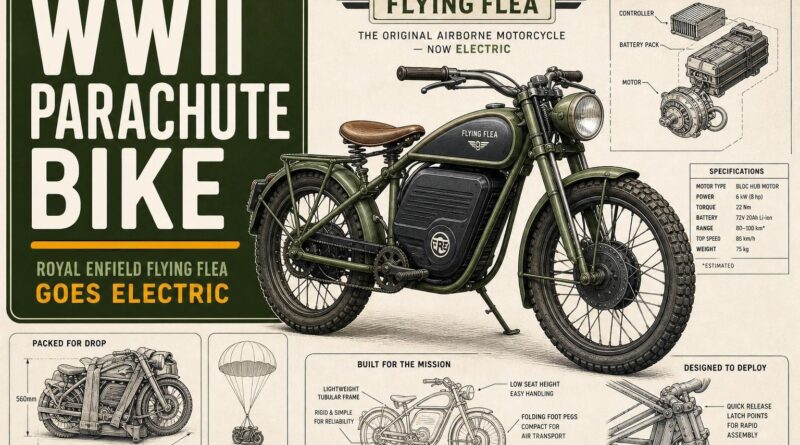
Royal Enfield Flying Flea: WWII Parachute Bike Goes Electric
Royal Enfield Flying Flea: WWII Parachute Bike Goes Electric
In 1942, British paratroopers jumped out of aircraft with something unusual strapped alongside them — a motorcycle small enough to fit inside a parachute drop canister. That bike was called the Flying Flea. In April 2026, Royal Enfield started delivering a new version of that same name. But this time, there’s no engine. No exhaust. Just 60 Nm of instant torque and a 0–60 km/h sprint of 3.7 seconds.
The name didn’t come back by accident. And the story of why Royal Enfield chose this name for this moment is far more interesting than another electric motorcycle launch.
The Original Flea: Built for War, Small Enough to Fall From the Sky
Lord’s, 1942. Actually — not Lord’s. A factory floor somewhere in Britain, where engineers were solving a problem nobody had faced before: how do you give paratroopers a vehicle they can actually use after they land?
The answer was a 125cc Royal Enfield motorcycle, stripped down to the absolute minimum. Compact. Lightweight. Rugged enough to survive a drop from altitude inside a wicker container. British paratroopers used it to move fast behind enemy lines — and the bike earned its nickname from soldiers who watched it buzz around like something small, quick, and impossible to swat.
What made the original Flying Flea remarkable wasn’t speed or power. It was purposeful smallness. Every unnecessary gram was an engineering problem. The bike had to do one thing: get a soldier moving the moment his boots hit the ground. That philosophy — build only what’s needed, strip out everything else — is exactly what Royal Enfield claims to have carried into 2026.
The name survived the war. The bike didn’t go into mass production afterward. For decades, the Flying Flea was a collector’s curiosity, a footnote in military history. Then Royal Enfield decided to bring it back — not as a retro tribute, but as the face of its entire electric future.
The Reveal: Milan, 2024, and a Very Deliberate Choice of Venue
Royal Enfield didn’t reveal the Flying Flea C6 at a tech conference or a motorcycle expo floor. They unveiled it at EICMA 2024 in Milan — specifically at the Officine del Volo, which translates directly as the workshops of flight.
A former aviation workshop. A bike named after something dropped from the sky. That’s not a coincidence — that’s a brand team working overtime to make a point.
The Officine del Volo setting connected the C6 back to the original Flea’s parachute origins without anyone having to say it out loud. The visual language did the work. And the motorcycle itself backed up the symbolism: at 124 kg, the Flying Flea C6 is the lightest Royal Enfield ever built. Lighter than a Classic 350. Lighter than a Meteor. Lighter than anything the company has put into production.
That Red Dot Design Award in 2025 — one of the most recognised product design honours in the world — confirmed what the Milan reveal suggested: this wasn’t just a new product. It was Royal Enfield making a statement about what electric motorcycles could look like when you didn’t just bolt a battery into an existing frame.
The C6 won that award before a single customer had ridden it on an Indian road. The design alone was enough.
What the Numbers Actually Mean
Here’s where the story gets specific — and where the C6 either earns its price or doesn’t.
The motor is a 15.4 kW permanent magnet synchronous unit. That produces 60 Nm of torque. For context, torque is the force that pushes you back in your seat when you accelerate — and electric motors deliver all of it instantly, from zero rpm. There’s no waiting for an engine to climb through its power band. You twist the throttle, and 60 Nm arrives immediately.
The result: 0 to 60 km/h in 3.7 seconds. Top speed is 115 km/h.
The battery is a 3.91 kWh pack. Royal Enfield’s IDC-rated range is 154 km — but IDC figures are laboratory measurements, not real-world ones. Honest estimates put real-world range closer to 100 km. That’s a significant gap, and it’s the number that matters for daily riders in Mumbai, Pune, or Lucknow who are calculating whether this bike fits their commute without range anxiety.
100 km covers most urban daily use. It does not cover long weekend rides. That tradeoff is the central tension of the C6’s market position — and Royal Enfield hasn’t hidden from it.
Why India, Why Now
Bookings opened in India in April 2026. First deliveries were described as weeks away as of April 19, 2026. The timing isn’t random.
India’s electric two-wheeler market has been growing fast, but it’s been dominated by scooters — Ola, Ather, Bajaj Chetak. The motorcycle segment had remained largely untouched by serious electric competition at the premium end. Royal Enfield, whose entire brand identity is built on premium motorcycles with emotional weight, couldn’t enter that space with a generic product.
The Flying Flea name solves a brand problem that no spec sheet can. Royal Enfield’s buyers don’t just purchase transportation — they buy into a story. The Bullet has decades of road mythology. The Himalayan has adventure credibility. The Classic 350 carries a visual language that references British motorcycling heritage.
The C6 needed its own mythology. A 1942 parachute bike that served in wartime, now reborn as the lightest, most technologically advanced motorcycle the company has ever built — that’s a story with weight. It connects the past to the present without pretending the past and present are the same thing.
The Flying Flea didn’t survive the war era because it was the fastest or most powerful bike available. It survived because it was exactly the right tool for a specific purpose. Royal Enfield is betting that the C6 carries the same logic into 2026: not the longest range, not the most powerful motor, but exactly the right motorcycle for the rider who wants an electric Royal Enfield that feels like a Royal Enfield.
Final Thought
The original Flying Flea was built in 1942 to solve a single, urgent problem: mobility after a parachute drop. It wasn’t designed to win races. It was designed to be just enough — light enough to fall from the sky, reliable enough to start when it hit the ground.
The C6, at 124 kg and 100 km of real-world range, carries the same design philosophy into a different kind of urgency. Indian cities in 2026 don’t need motorcycles that top out at 200 km/h. They need bikes that are light, fast off the line, and don’t require a petrol station. The 3.7-second 0–60 sprint and the Red Dot Award suggest Royal Enfield has built something that earns the name it borrowed.
Whether the C6 becomes the Bullet of the electric era depends on whether buyers accept the range tradeoff — and whether Royal Enfield can hold the line on what the Flying Flea means as the sub-brand grows. The name survived a world war. The harder test might be surviving a product roadmap.
Frequently Asked Questions
What is the Royal Enfield Flying Flea electric motorcycle?
The Royal Enfield Flying Flea is an electric motorcycle that began deliveries in April 2026, offering 60 Nm of instant torque and a 0–60 km/h sprint of 3.7 seconds, reviving a historic WWII-era bike name.
What was the original Royal Enfield Flying Flea used for in World War II?
The original Flying Flea was a lightweight 125cc motorcycle used by British paratroopers in 1942, small enough to be dropped from aircraft in a wicker canister so soldiers could move quickly after landing.
When did Royal Enfield start delivering the new electric Flying Flea?
Royal Enfield began delivering the new electric Flying Flea in April 2026, positioning it as the face of the brand’s entire electric motorcycle future rather than simply a retro tribute.
Recommended Reading
Explore these hand-picked resources to dive deeper into this topic:
- The Motorcycle Diaries by Ernesto “Che” Guevara
- Engineering Marvels: How Humans Built the World by Andrew Murray
- Royal Enfield Riding Gear (Premium protective equipment)
As an Amazon Associate, we earn from qualifying purchases. This helps support Fact Storm Hub at no extra cost to you.
Sources
- https://flyingflea.royalenfield.com/in/en/product/c6/
- https://www.youtube.com/watch?v=3ilBEQfyKzk
- https://thepack.news/royal-enfields-first-electric-motorcycle-the-flying-flea-c6-goes-on-sale-in-india/
- https://flyingflea.royalenfield.com/us/en/home/
- https://www.forbes.com/sites/billroberson/2024/11/11/royal-enfield-to-enter-electric-moto-market-with-flying-flea-urban-bike/

🤖 AI Content Disclosure
This article was created using AI-assisted research and writing tools, then reviewed for quality and accuracy. Facts are sourced from publicly available web research, but readers should verify critical information from primary sources.
Published for educational and entertainment purposes. Last reviewed: June 2026