
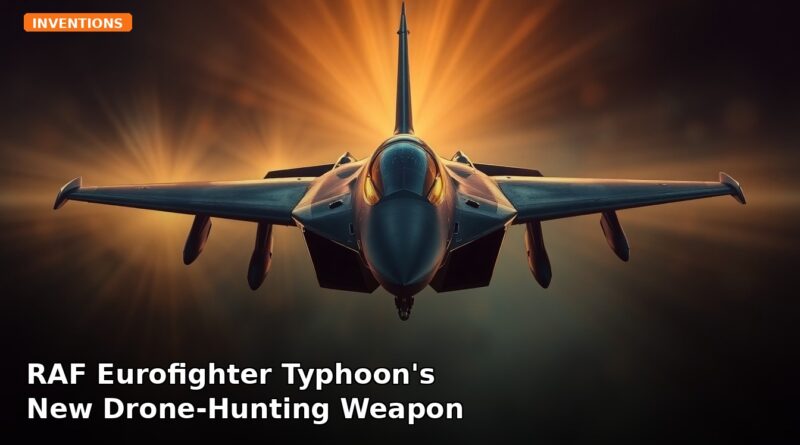
RAF Eurofighter Typhoon’s New Drone-Hunting Weapon
RAF Eurofighter Typhoon’s New Drone-Hunting Weapon
On 17 May 2026, a British defence company made an announcement that quietly rewrote the rules of modern air combat. The RAF’s Eurofighter Typhoon — one of the most advanced combat jets in the world — had just proven it could kill drones with laser-guided rockets. Not in a test range. Operationally. In the Middle East. Right now.
That’s the story. But to understand why it matters, you need to know what the Typhoon was never supposed to do.
Built to Fight Jets. Now Fighting Drones.
The Eurofighter Typhoon was designed in an era when the biggest threat in the sky was another fighter jet. It was built for speed, agility, and beyond-visual-range missile combat — the kind of high-stakes, pilot-versus-pilot dogfighting that Cold War planners spent decades preparing for.
Then came the drone revolution. Cheap, small, and increasingly lethal unmanned aircraft systems began flooding conflict zones — and suddenly, the Typhoon faced a problem its designers never anticipated. A £100 million jet armed with missiles costing hundreds of thousands of pounds each was being asked to shoot down drones that sometimes cost less than a used car. The economics were brutal. The missiles worked, but the math didn’t.
RAF Typhoons had already been engaging UAVs across the region using MBDA AIM-132 ASRAAMs and AIM-120/MBDA Meteor beyond-visual-range missiles — weapons engineered to destroy fast-moving aircraft, not slow-moving drones. It worked. But using a Meteor to kill a hobby-store-grade drone is like using a sledgehammer to crack a walnut. There had to be a smarter answer.
The Fix: A Rocket Designed for Exactly This
Enter the AGR-20A Advanced Precision Kill Weapon System — APKWS for short. This is a laser-guided rocket that threads the needle between cost and precision. It’s not a missile in the traditional sense. It’s a standard 70mm rocket upgraded with a laser-guidance kit, turning a relatively inexpensive munition into a surgical strike weapon.
QinetiQ, working under the UK Ministry of Defence’s Engineering Delivery Partnership, integrated the BAE Systems Inc. APKWS onto the Typhoon FGR4 and ran trials at the MOD Aberporth range earlier in 2026. The results were good enough to deploy — and on 17 May 2026, QinetiQ confirmed the system was already being used operationally in the Middle East.
That’s a remarkably fast pipeline from trial to combat. It signals something important: the drone threat in the region isn’t theoretical. It’s urgent enough that the RAF moved from testing to operational use within the same year.
The Target That Stood In for Real Threats
Here’s the detail that stops you mid-sentence. To test whether the Typhoon could actually kill modern drones with APKWS, QinetiQ needed something to shoot at. They used the Banshee Whirlwind — a high-speed uncrewed aerial target system manufactured in Kent — to simulate the kinds of drone threats Typhoon pilots are facing in real operations.
The Banshee Whirlwind isn’t a toy. It’s used by more than 30 countries for air-defence training. It’s fast, it’s realistic, and it’s specifically designed to stress-test air-defence systems by mimicking the flight profiles of actual threats. When the Typhoon’s APKWS integration was validated against the Banshee Whirlwind, it wasn’t a controlled, easy-mode test. It was as close to the real thing as you can legally run over a Welsh test range.
The fact that a platform built in Kent is now the global standard for simulating drone threats — used by over 30 nations — tells you something about how seriously the world is taking the unmanned threat.
Where the Typhoons Are Flying From
RAF Typhoons operating in the Middle East are based out of two locations: RAF Akrotiri in Cyprus and Al Udeid Airbase in Qatar. These aren’t temporary deployments. Akrotiri has been a permanent RAF base for decades, and Al Udeid is one of the most strategically significant air bases in the entire region.
From these positions, Typhoon FGR4 aircraft have been conducting counter-UAS operations across a wide area. The addition of APKWS gives pilots a more cost-effective and tactically flexible option — one that doesn’t require expending a beyond-visual-range missile every time a threat appears on radar.
Think of it as giving a fighter pilot a precision rifle alongside their existing arsenal. The missiles aren’t going anywhere. But now there’s a graduated response — a way to engage smaller, cheaper threats without burning through the most expensive weapons in the inventory.
Final Thought
The Eurofighter Typhoon was never designed to be a drone-killer. But the 17 May 2026 announcement from QinetiQ confirms that the RAF has adapted one of the world’s most capable combat jets to meet a threat that didn’t exist when the Typhoon was conceived. The APKWS integration — trialled at MOD Aberporth, validated against the Banshee Whirlwind, and now operational over the Middle East — isn’t just a weapons upgrade. It’s a signal that the era of drone warfare has matured to the point where even frontline fast jets need a dedicated, cost-effective answer. The question the RAF has now answered is: what do you do when your most expensive asset faces its cheapest threat? You give it a smarter weapon — not a bigger one.
Frequently Asked Questions
Can the Eurofighter Typhoon shoot down drones?
Yes, the RAF’s Eurofighter Typhoon has been operationally proven to shoot down drones using laser-guided rockets in the Middle East, offering a more cost-effective solution than traditional missiles.
What weapons does the RAF Typhoon use to destroy UAVs?
The RAF Typhoon uses the AGR-20A Advanced Precision Kill Weapon System (APKWS), a laser-guided 70mm rocket, alongside existing missiles like the ASRAAM and MBDA Meteor to engage drones.
Why is using missiles to shoot down drones a problem?
Using expensive missiles like the Meteor, costing hundreds of thousands of pounds, to destroy cheap drones is economically inefficient, prompting the RAF to adopt lower-cost precision weapons like the APKWS rocket.
Recommended Reading
Explore these hand-picked resources to dive deeper into this topic:
- Modern Air Combat by Carlo Kopp
- Unmanned Warfare by Peter L. Bergen
- DJI Air 3S Drone (Advanced aerial technology)
As an Amazon Associate, we earn from qualifying purchases. This helps support Fact Storm Hub at no extra cost to you.
Sources
- https://aerospaceglobalnews.com/news/raf-eurofighter-typhoon-apkws-middle-east-drones/
- https://www.janes.com/defence-intelligence-insights/defence-news-details/weapons/uk-typhoons-carrying-apkws-for-c-uas-in-middle-east
- https://www.baesystems.com/en/article/apkws-typhoon-trials
- https://breakingdefense.com/2026/04/bae-systems-trials-low-cost-counter-drone-solution-for-eurofighter-typhoon/
- https://www.youtube.com/watch?v=Px-ptELBTQw

🤖 AI Content Disclosure
This article was created using AI-assisted research and writing tools, then reviewed for quality and accuracy. Facts are sourced from publicly available web research, but readers should verify critical information from primary sources.
Published for educational and entertainment purposes. Last reviewed: May 2026