
Solar Storm That Lit Up England: 20-Year Mystery
Solar Storm That Lit Up England: 20-Year Mystery
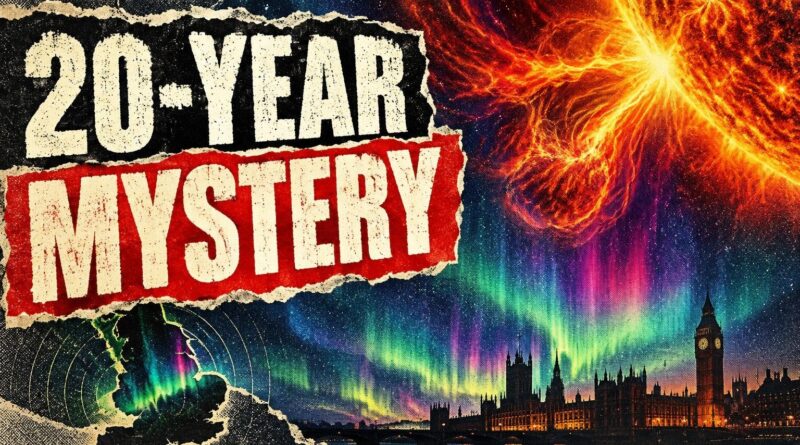
This week, people in Kent looked up and saw something most of them had never seen in their lives: the sky glowing green, pink, and violet. Not in Norway. Not in Iceland. In Kent, England — one of the most southern points of the British Isles.
That’s not normal. And the reason it happened tells a story far bigger than a pretty light show.
What Actually Happened Up There
The aurora borealis — the northern lights — isn’t just a visual phenomenon. It’s a symptom. It means Earth’s magnetic field is being hammered by a stream of charged particles fired out of the sun at millions of kilometres per hour.
When that stream is weak, the aurora stays near the poles — Scandinavia, northern Canada, Alaska. When it’s powerful, the aurora pushes south. And when it’s extreme, it reaches places that haven’t seen it in a generation.
That’s exactly what happened. Scientists classified this as an extreme geomagnetic storm — and the aurora wasn’t just visible in Scotland or northern England. It reached as far south as Kent. People in parts of the northern United States saw it too. Even the aurora australis, the southern lights, was reported during the same event.
The sky, quite literally, was on fire with light.
The Part That Puts It in Perspective
But here’s what makes this rare: this was the first extreme geomagnetic storm in two decades.
Two decades. That means anyone under roughly 30 years old has never experienced anything like this in their lifetime. The last time Earth was hit by a storm this powerful, most of today’s social media users were in primary school — or hadn’t been born yet.
Geomagnetic storms are measured on a scale from G1 (minor) to G5 (extreme). Most storms that produce visible aurora in Scotland or northern Scandinavia are G2 or G3 events. The extreme end of that scale is rare enough that entire careers in solar science can pass without one.
This storm sat at that extreme end — and that classification carries weight far beyond the light show it produced. A storm of this magnitude is the kind of event that gets flagged in satellite operations centres, power grid control rooms, and aviation management systems worldwide. The aurora is the beautiful part. The infrastructure risk is the part that keeps engineers awake.
Why the Sun Does This at All
The sun is not a stable, quiet object. It runs on an approximately 11-year cycle of activity — moving from a “solar minimum,” when its surface is relatively calm, to a “solar maximum,” when it erupts frequently with solar flares and coronal mass ejections.
A coronal mass ejection — or CME — is essentially a bubble of magnetised plasma the size of several Earths, launched from the sun’s surface at extraordinary speed. When one of those bubbles is aimed at Earth and arrives with enough force, it compresses our planet’s magnetic field on the side facing the sun, and stretches it on the opposite side.
That compression and stretching accelerates charged particles down toward the poles. Those particles collide with gases in our atmosphere — oxygen, nitrogen — and those gases release light. Green from oxygen at lower altitudes. Red from oxygen higher up. Blue and purple from nitrogen.
The aurora is, in the most literal sense, the atmosphere glowing from the impact of the sun.
What This Means Right Now
The fact that this storm was the first of its kind in two decades is not just a historical footnote. It’s a signal.
Solar scientists track the sun’s activity cycle closely, and the current cycle has been more active than many forecasters initially predicted. An extreme geomagnetic storm doesn’t arrive without warning — space weather agencies around the world monitor solar activity and issue alerts when a major CME is detected heading toward Earth.
But the gap between warning and impact can be short. And the infrastructure that runs modern life — GPS satellites, power grids, radio communications, aviation navigation systems — is far more dependent on stable electromagnetic conditions than it was two decades ago, the last time a storm of this classification hit.
That’s the part of this story that doesn’t make the aurora photographs. The light show over Kent is extraordinary. The question it raises is equally important: how ready are we for the next one?
Final Thought
The northern lights over Kent this week were beautiful — genuinely, historically beautiful. But they were also a reminder that the sun is not a backdrop. It’s an active force, and it just delivered its most powerful punch in twenty years.
The aurora reached Kent because an extreme geomagnetic storm — the first of its kind in a generation — tore through Earth’s magnetic field. The last time that happened, the world ran on less technology, fewer satellites, and simpler power grids. The gap between then and now isn’t just twenty years of calendar time. It’s twenty years of civilisation becoming more dependent on the very systems a storm like this can disrupt.
The sky glowed. That’s the story everyone shared. What comes next is the story worth watching.
Frequently Asked Questions
Why were the northern lights visible in England?
An extreme geomagnetic storm caused charged particles from the sun to hammer Earth’s magnetic field, pushing the aurora much further south than usual, making it visible as far south as Kent, England.
How rare is an extreme geomagnetic storm?
Extreme geomagnetic storms are very rare — this was the first one in two decades. Rated G5 on a scale of G1 to G5, they are rare enough that entire careers in solar science can pass without one occurring.
What causes the aurora borealis northern lights?
The aurora borealis is caused by streams of charged particles fired from the sun at millions of kilometres per hour, which interact with Earth’s magnetic field, producing the colourful green, pink, and violet light displays in the sky.
Recommended Reading
Explore these hand-picked resources to dive deeper into this topic:
- The Sun by Stuart Clark
- A Brief History of Time by Stephen Hawking
- National Geographic Solar System Model
As an Amazon Associate, we earn from qualifying purchases. This helps support Fact Storm Hub at no extra cost to you.
Sources
- https://www.ndtv.com/offbeat/skies-illuminate-in-colours-as-intense-solar-storm-brings-beautiful-auroras-worldwide-see-pics-9626723
- https://www.youtube.com/watch?v=mlJYUkwsY5g
- https://news.sky.com/story/strongest-solar-storm-in-decades-hits-earth-as-northern-lights-to-return-to-parts-of-uk-tonight-13133384
- https://timesofindia.indiatimes.com/world/us/powerful-solar-storm-brings-stunning-northern-lights-to-southern-us-parts-of-uk/articleshow/114139230.cms
🤖 AI Content Disclosure
This article was created using AI-assisted research and writing tools, then reviewed for quality and accuracy. Facts are sourced from publicly available web research, but readers should verify critical information from primary sources.
Published for educational and entertainment purposes. Last reviewed: October 2026