
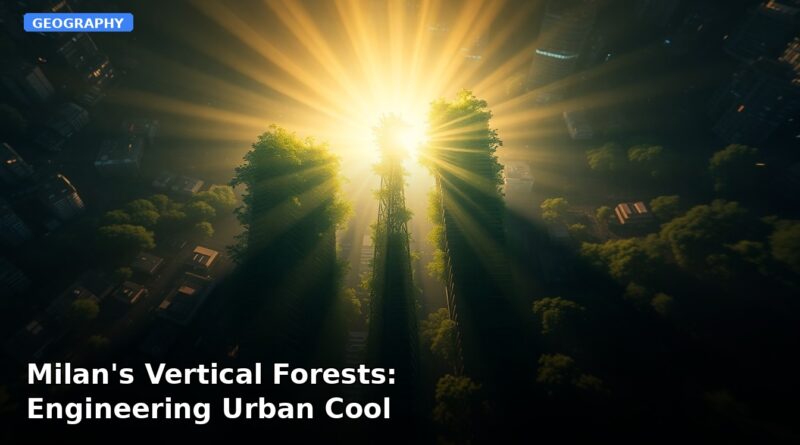
Milan’s Vertical Forests: Engineering Urban Cool
Milan’s Vertical Forests: Engineering Urban Cool
Twenty-one thousand plants. Eight hundred trees. Two towers in Milan.
If you spread every shrub, every perennial, every tree from those two buildings across flat ground, you’d cover 20,000 square meters of forest. Instead, Stefano Boeri stacked all of it vertically — and in doing so, accidentally engineered one of the most effective urban cooling systems on the planet.
This isn’t a green architecture story. It’s a climate engineering story hiding inside a real estate project.
What Bosco Verticale Actually Is
Most people who see photos of Bosco Verticale assume it’s a vanity project — rich Milanese apartments dressed up with plants for Instagram. The reality is more interesting.
Located in Milan’s Porta Nuova district, the two residential skyscrapers were designed by Boeri Studio — Stefano Boeri, Gianandrea Barreca, and Giovanni La Varra. Construction started in 2009, and the towers were completed and inaugurated in 2014. The taller tower reaches 116 metres; the shorter one, 84 metres.
What makes them structurally unlike anything built before isn’t the height — it’s the weight. Each of those 800 trees stands between three and nine metres tall and sits in a reinforced concrete planter cantilevered off the building’s facade. The engineering team had to calculate the load of soil, root systems, and fully grown trees at wind speeds experienced at the 20th floor. That’s not landscape design. That’s structural engineering at a scale most architects never attempt.
The result: 4,500 shrubs and 15,000 perennial plants from over 100 species, distributed across two towers — a living ecosystem suspended above a city.
The Cooling Effect Nobody Expected at This Scale
Three degrees Celsius. That’s the temperature difference residents inside Bosco Verticale experience compared to equivalent buildings without vegetation — confirmed by research cited by both the BBC and BIMsmith.
Three degrees sounds modest until you consider the mechanism. The foliage does two things simultaneously: it releases water vapour through transpiration, which cools the surrounding air directly, and it filters sunlight before it ever reaches the glass facade. In a conventional glass-and-steel tower, that sunlight becomes heat gain — energy that air conditioning systems then have to fight. Bosco Verticale’s trees intercept that load before it enters the building.
The effect compounds outward. It’s not just the apartments that cool down — the air immediately surrounding the towers is affected. In dense urban environments, where concrete, asphalt, and glass surfaces absorb and re-radiate heat, even a localised three-degree drop creates a measurable microclimate. Porta Nuova, a district that was a disused industrial zone before its redevelopment, now has a different thermal signature than the blocks surrounding it.
This is what urban planners mean when they talk about vertical forests engineering microclimates. It’s not metaphor — it’s fluid dynamics and thermodynamics operating at a neighbourhood scale.
The Water System That Makes It Possible
The obvious question: how do you water 21,000 plants on a skyscraper without turning the building into an ecological liability?
Boeri Studio’s answer was a closed-loop system that most green buildings don’t attempt. The irrigation infrastructure taps into groundwater sources beneath the site. Filtered greywater from the buildings themselves — water recovered from sinks, showers, and other non-toilet sources — feeds a drip irrigation network that delivers water directly to each individual planter. Solar-powered pumps offset the energy cost of moving water upward against gravity.
The elegance here is that the building’s own water waste becomes the input that keeps the ecosystem alive. Nothing is drawn from municipal supply. The trees are, in a meaningful sense, drinking the building’s discarded water — a circular system running quietly inside two towers most visitors only photograph from the street.
This infrastructure decision is also why the project earned LEED Gold certification. It wasn’t just the plants — it was the systems thinking behind them.
The Ratio That Changed How Cities Think About Green Buildings
Stefano Boeri built Bosco Verticale around a single design rule: two trees for every human inhabitant.
That ratio — two trees per resident — became the benchmark that subsequent vertical forest projects around the world reference and refine. It’s a deceptively simple number that forces architects to make a fundamental choice: the building’s ecological output must be proportional to its human density, not treated as decoration applied after the floor plans are drawn.
The towers won the 2014 International Highrise Award and were recognised as Best Tall Building Worldwide in 2015. But the more lasting impact isn’t the awards — it’s that the two-trees-per-inhabitant principle has entered the vocabulary of urban design globally.
Cities facing accelerating heat island effects — where urban cores run measurably hotter than surrounding areas because of heat-absorbing surfaces — are now looking at vertical forests not as architectural novelty but as deployable infrastructure. The question has shifted from “can you build this?” to “how many do you need to meaningfully alter a district’s temperature?”
Milan’s Porta Nuova gave planners a real-world data set to answer that question. The 20,000 square metres of forest equivalent, compressed into two towers, proved the concept at scale.
Final Thought
Bosco Verticale didn’t invent the idea of plants on buildings. What it proved — with 800 trees, a closed-loop irrigation system, and a measurable three-degree cooling effect in Porta Nuova — is that vegetation can be structural infrastructure, not ornament. The two-trees-per-inhabitant ratio Boeri established in 2014 is now the starting point for vertical forest projects being planned in cities across Asia, the Middle East, and Europe. The real question those cities are now working through isn’t whether vertical forests cool urban districts — Milan answered that. It’s whether the engineering can be replicated cheaply enough to deploy at the scale that actually moves a city’s temperature needle.
Frequently Asked Questions
What is Bosco Verticale in Milan?
Bosco Verticale is a pair of residential skyscrapers in Milan’s Porta Nuova district, completed in 2014 and designed by Boeri Studio. The towers host 800 trees, 4,500 shrubs, and 15,000 perennial plants across their facades, creating a vertical forest above the city.
How much does Bosco Verticale cool the temperature?
Residents inside Bosco Verticale experience temperatures approximately 3 degrees Celsius cooler compared to equivalent buildings without vegetation, making it one of the most effective urban cooling systems in the world.
How were the trees engineered onto the Bosco Verticale towers?
Each tree, standing between three and nine metres tall, sits in a reinforced concrete planter cantilevered off the building’s facade. Engineers calculated the load of soil, root systems, and fully grown trees at wind speeds experienced at the 20th floor.
Recommended Reading
Explore these hand-picked resources to dive deeper into this topic:
- The Nature Fix by Florence Williams
- Braiding Sweetgrass by Robin Wall Kimmerer
- Vertical Garden Kit (DIY hydroponic system)
As an Amazon Associate, we earn from qualifying purchases. This helps support Fact Storm Hub at no extra cost to you.
Sources
- https://www.bbc.com/culture/article/20250602-how-high-rise-forests-can-transform-city-life-and-make-us-happier
- https://blog.bimsmith.com/Vertical-Forests-How-Living-Architecture-Transforms-Urban-Density
- https://en.wikipedia.org/wiki/Bosco_Verticale
- https://www.usgbc.org/articles/polluted-metropolis-forest-city
- https://www.youtube.com/watch?v=YQtheEmbfkg
🤖 AI Content Disclosure
This article was created using AI-assisted research and writing tools, then reviewed for quality and accuracy. Facts are sourced from publicly available web research, but readers should verify critical information from primary sources.
Published for educational and entertainment purposes. Last reviewed: April 2026