
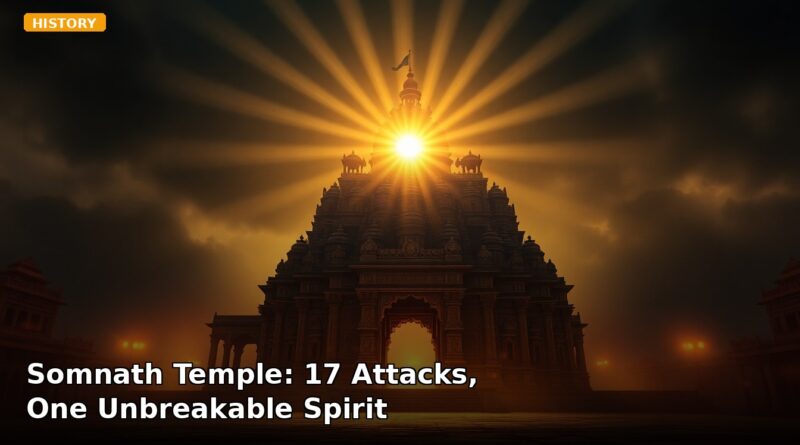
Somnath Temple: 17 Attacks, One Unbreakable Spirit
Somnath Temple: 17 Attacks, One Unbreakable Spirit
This week, PM Narendra Modi stood inside the Somnath Temple in Gujarat, chanting the Omkar Mantra, surrounded by cameras and crowds. Most people watching thought they understood what they were seeing — a religious ceremony, a political moment, a photo opportunity.
They were missing the real story entirely.
The Temple That Refused to Die
Somnath isn’t just one of the twelve Jyotirlingas — the holiest Shiva shrines in Hinduism. It’s something rarer: a structure that has been razed, looted, and erased from the earth repeatedly across centuries, and rebuilt every single time.
Ancient chronicles describe waves of invaders who targeted it precisely because of what it represented — not just wealth, but the spiritual center of a civilization. Destroy the temple, the logic went, and you break something deeper than stone.
They were wrong. Every time.
The temple kept coming back — not because stone is permanent, but because the idea behind it was. That stubbornness across centuries is what makes the building standing in Prabhas Patan, Gujarat today far more than an architectural achievement. It’s a 75-year-old answer to a very old question about whether a civilization can be erased by force.
The Reconstruction Nobody Talks About
The modern Somnath Temple — the one Modi stood inside this week — was rebuilt after Indian independence. Not an inevitability, but a civilizational argument disguised as a construction project.
Sardar Vallabhbhai Patel, the same figure whose statue Modi paid tribute to in Gir Somnath during his roadshow, was one of the driving forces behind it. The argument was direct: a newly independent India had the right, and perhaps the responsibility, to restore what centuries of destruction had taken.
Not everyone agreed. There were serious debates about whether the Indian state should be involved in rebuilding a religious site at all. Those debates mattered. They shaped what the reconstruction ultimately became — a project that drew on public will without becoming official state religion.
75 years later, Modi stood there calling it a “proud symbol of our civilisational courage.” That phrase carries the full weight of the original argument. The temple didn’t just survive. It made a point.
Why Prabhas Patan Is Not an Accident
The location itself is the detail most people skip past — and it’s the one that changes how you see everything else.
Prabhas Patan sits on the southwestern coastline of Gujarat, directly facing the Arabian Sea. Ancient geographers treated this exposed, wind-battered tip of the Saurashtra peninsula as a cosmologically significant point. Building one of Hinduism’s most sacred temples here wasn’t arbitrary. It was a statement about the center of a civilization’s spiritual geography — a deliberate planting of a flag at the edge of the known world.
That’s also why it was targeted. Conquerors understood that destroying a site is most powerful when the site itself carries symbolic meaning. Somnath wasn’t attacked despite its sacred status — it was attacked because of it. The coastline made it visible, accessible, and therefore vulnerable. The same geography that made it spiritually significant made it a military target.
Standing there today, during the Somnath Amrut Mahotsav, the 75-year anniversary celebrations, that geography still matters. The Arabian Sea is still visible from the temple complex. The coordinates haven’t changed. What changed is who controls the narrative of what this place means.
What 75 Years Actually Means
Three generations. That’s what 75 years represents in human terms.
The people who saw Somnath as a ruin — who remembered what it looked like before reconstruction — are now elderly or gone. The people attending the Somnath Swabhiman Parv celebrations this week grew up with the rebuilt temple as a given. For them, its existence isn’t a triumph. It’s simply a fact.
That shift is significant. The Amrut Mahotsav isn’t just a milestone — it’s the moment when the reconstruction transitions from living memory into history. Modi’s visit, his chanting of the Omkar Mantra, the roadshow through Gujarat’s Prabhas Patan — all of it functions as a formal handover. We are now officially in the era where Somnath’s survival is heritage, not news.
The question that remains is the one every rebuilt thing eventually faces: now that the argument has been won — the temple stands, the civilization endured — what does it stand for going forward?
Final Thought
Sardar Patel’s argument, made in the years after independence, was that rebuilding Somnath was an act of civilizational self-respect, not religious triumphalism. 75 years on, that distinction still matters. The temple has outlasted every attempt to make it a symbol of division — it keeps getting reclaimed as a symbol of persistence instead.
Whether you’re a history reader tracking the long arc of what gets destroyed and what gets rebuilt, or someone who only heard about Somnath for the first time this week, the real story is the same: the most durable things aren’t built from stone. They’re built from the refusal to stay gone.
Frequently Asked Questions
How many times was the Somnath Temple destroyed and rebuilt?
The Somnath Temple was destroyed and rebuilt multiple times across centuries by waves of invaders who targeted it as a spiritual center of civilization, yet it was reconstructed every single time.
Who rebuilt the Somnath Temple after Indian independence?
Sardar Vallabhbhai Patel was one of the driving forces behind rebuilding the modern Somnath Temple after Indian independence, arguing that India had the right to restore what centuries of destruction had taken.
Why is the Somnath Temple so important in Hinduism?
Somnath is one of the twelve Jyotirlingas, considered among the holiest Shiva shrines in Hinduism. It represents not just a religious site but the spiritual center of an entire civilization.
Recommended Reading
Explore these hand-picked resources to dive deeper into this topic:
- The Wonder That Was India by A.L. Basham
- India: A History by John Keay
- Bharat Ek Khoj Documentary Series (historical exploration collection)
As an Amazon Associate, we earn from qualifying purchases. This helps support Fact Storm Hub at no extra cost to you.
Sources
- https://www.youtube.com/watch?v=kR65lbi9g0c
- https://www.youtube.com/watch?v=dB9Z1bHzc7A
- https://www.moneycontrol.com/news/india/pm-modi-offers-prayers-at-somnath-says-temple-is-a-proud-symbol-of-our-civilisational-courage-13766813.html
- https://www.thestatesman.com/india/gujarat-pm-modi-offers-prayers-at-somnath-temple-plays-damru-at-shaurya-yatra-1503538818.html
- https://www.hindustantimes.com/india-news/pm-modi-offers-prayers-at-somnath-temple-in-gujarat-somnath-swabhiman-parv-101768058775387.html
Watch the Video
🤖 AI Content Disclosure
This article was created using AI-assisted research and writing tools, then reviewed for quality and accuracy. Facts are sourced from publicly available web research, but readers should verify critical information from primary sources.
Published for educational and entertainment purposes. Last reviewed: May 2026