
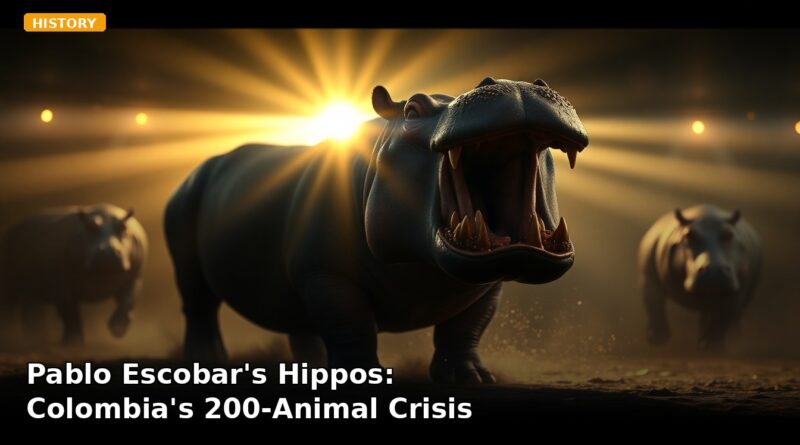
Pablo Escobar’s Hippos: Colombia’s 200-Animal Crisis
Pablo Escobar’s Hippos: Colombia’s 200-Animal Crisis
In the news this week, an Indian billionaire made a headline-grabbing offer: adopt up to 80 hippos from Colombia and relocate them to a private wildlife reserve in Gujarat. It sounds like a plot from a thriller novel. But the story behind that offer goes back decades — to a drug lord, a private zoo, and one of the strangest ecological accidents in modern history.
Four Animals. One Decision. A Crisis Four Decades Later.
Pablo Escobar didn’t just build a cocaine empire. He built a fantasy world to go with it.
Somewhere near Doradal, Colombia, Escobar constructed a private ranch that included its own zoo. In the 1980s, he illegally imported four hippos — two female, two male — to live on the property. For a man who controlled vast stretches of Colombian territory, acquiring exotic African megafauna was simply another line item.
Then, in 1993, the Colombian government seized Escobar’s properties. The animals were confiscated, rehomed, auctioned — except the hippos. They were too large, too dangerous, and too expensive to move. So they were left behind.
Nobody captured them. Nobody relocated them. Nobody had a plan.
The hippos walked into the Magdalena River basin, found the warm, vegetation-rich Colombian waterways to their liking, and started doing what hippos do best: reproducing.
From 4 to 200: The Math Nobody Wanted to Do
Cold fact: scientists now estimate there are approximately 200 hippos roaming freely around Doradal.
That number deserves a pause. Four animals, left unmanaged for roughly three decades, have produced a population of 200. In Africa, hippo herds are kept in check by drought, predators, and territorial competition. Colombia has none of those natural brakes. The climate is warm year-round, the rivers are full, and there is nothing in the Colombian ecosystem that has ever learned to threaten a hippopotamus.
The result is the only wild herd of hippos outside Africa — not in a reserve, not behind a fence, but freely roaming a South American river system that evolved for millions of years without them.
At current growth rates, researchers warn the population could reach numbers that make today’s crisis look manageable by comparison.
What 200 Hippos Actually Do to a River
Here’s where this stops being a quirky wildlife story and becomes a genuine ecological emergency.
Biologist Nataly Castelblanco-Martinez has studied what the hippos are doing to Colombia’s waterways, and the findings are stark. Hippos deposit enormous quantities of waste into lakes and riverbeds. That waste changes the water’s pH levels and strips oxygen from the water — the oxygen that underwater plants and fish depend on to survive.
The local food chain isn’t just being disrupted. It’s being restructured from the bottom up, by an animal that was never part of it.
native fish species, aquatic plants, and the communities that depend on those rivers for food and water are all caught in the downstream effects of one man’s decision to import African wildlife to his backyard. Hippos are also territorial and aggressive — encounters with local communities near Doradal have been reported for years.
The 2026 Reckoning — and a Billionaire’s Offer
By mid-April 2026, Colombia’s government had run out of road on the “wait and see” approach. An official plan was announced to control the hippo population — including culling up to 80 animals that year.
The announcement triggered immediate international pushback. Conservation groups, animal welfare organizations, and wildlife advocates objected loudly. Culling hippos — animals that are classified as vulnerable in their native Africa — felt to many like punishing the animals for a human mistake.
That’s when the Indian billionaire’s offer entered the picture. Relocate up to 80 hippos to a private wildlife reserve in Gujarat rather than kill them. It reframes the problem: instead of a cull, a transfer. Instead of an ending, a relocation.
Whether that offer is logistically viable — moving 80 large, dangerous animals across continents is an extraordinary undertaking — remains to be seen. But it has shifted the conversation in a way that pure policy debate hadn’t managed to.
Final Thought
The Colombian hippo crisis is, at its core, a story about consequences that outlive the people who created them. Pablo Escobar died in 1993 — the same year the government seized his ranch and left four hippos to fend for themselves in the Magdalena River basin. He has been gone for over three decades. The hippos are still multiplying.
Two hundred animals now define one of the most unusual ecological problems on Earth, and the debate in 2026 isn’t just about wildlife management — it’s about who bears responsibility when a private act of excess becomes a public ecological crisis. Colombia didn’t import those hippos. But Colombia, and its rivers, and the communities along the Magdalena are living with them. Whether Gujarat becomes part of the answer, or whether the cull goes ahead, the harder question remains: how do you undo a decision that was made before the consequences were imaginable?
Frequently Asked Questions
How did hippos end up in Colombia?
Drug lord Pablo Escobar illegally imported four hippos to his private zoo in Colombia in the 1980s. After his death in 1993, the government seized his properties but left the hippos behind because they were too large and dangerous to relocate.
How many hippos are in Colombia now?
Scientists estimate there are now approximately 200 hippos roaming freely around Doradal, Colombia. The population grew from just four original animals over roughly three decades with no natural predators or environmental pressures to control their numbers.
Why are Pablo Escobar’s hippos a problem in Colombia?
Colombia has no natural predators or environmental conditions to control the hippo population, unlike their native Africa. With warm weather, full rivers, and no threats, the hippos reproduce unchecked, creating a growing ecological crisis in the Magdalena River basin.
Recommended Reading
Explore these hand-picked resources to dive deeper into this topic:
As an Amazon Associate, we earn from qualifying purchases. This helps support Fact Storm Hub at no extra cost to you.
Sources
- https://www.npr.org/2026/05/08/nx-s1-5814169/cocaine-hippos-colombia-india
- https://www.opb.org/article/2026/05/08/from-doradal-to-gujarat-cocaine-hippos-get-a-billionaire-sponsored-lifeline/
- https://www.youtube.com/watch?v=VAn2iaiXDPY
- https://www.northcountrypublicradio.org/news/npr/nx-s1-5814169/colombia-s-rogue-hippos-could-find-refuge-in-india
- https://www.youtube.com/watch?v=z2diRVIUZp4

Watch the Video
🤖 AI Content Disclosure
This article was created using AI-assisted research and writing tools, then reviewed for quality and accuracy. Facts are sourced from publicly available web research, but readers should verify critical information from primary sources.
Published for educational and entertainment purposes. Last reviewed: May 2026