
Deep Ocean Mystery: The Golden Orb Scientists Can’t Explain
Deep Ocean Mystery: The Golden Orb Scientists Can’t Explain
This week, scientists finally answered a question that had been sitting in a laboratory freezer for over two years: what exactly is that strange golden object pulled from the bottom of the Gulf of Alaska?
The answer took DNA sequencing, structural analysis, and a team of specialists working across multiple disciplines. And when the answer came, it was stranger than most of the guesses.
A Robot Finds Something Nobody Can Name
Over two miles below the surface of the Gulf of Alaska — at a depth of more than 3,250 meters — a remotely operated vehicle attached to the NOAA research vessel Okeanos Explorer was scanning the seafloor when its cameras landed on something that stopped the team cold.
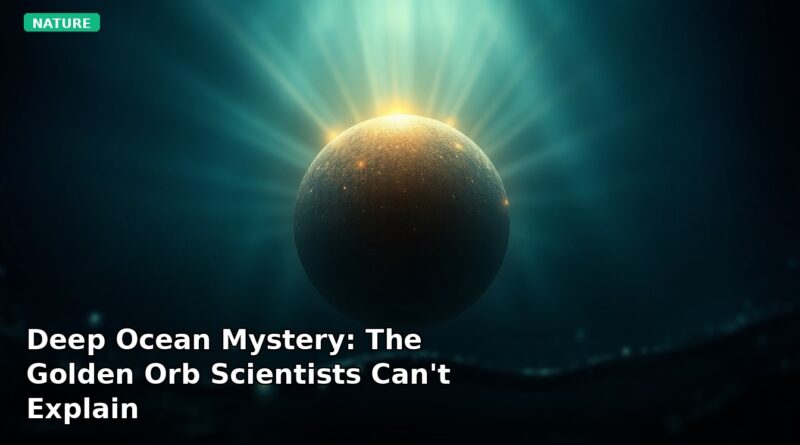
Attached to a rock in near-total darkness sat a smooth, glowing, golden orb. It wasn’t moving. It had no obvious features. It didn’t match any known species in the team’s reference database. At roughly the size of a softball, it looked almost artificial — the kind of object you’d expect to find in a science fiction film, not on the floor of the Pacific Ocean.
The ROV collected it. Scientists named it “the golden orb” and sent it to the lab.
That was 2023. What followed was more than two years of investigation.
Why It Took Two Years to Identify
The deep ocean is not a place where science moves quickly. Fewer than 25% of the ocean floor has been mapped in detail — meaning every expedition into the deep is genuinely exploratory. When an object doesn’t match anything in the existing record, there’s no quick answer. You run tests. The tests come back inconclusive. You run different tests.
That’s exactly what happened here. Initial analyses of the golden orb failed to produce a clear identification. The object was made of dead cells, which complicated DNA extraction. The structure was unusual. The team had to bring in specialists from multiple fields: deep-sea biology, genetics, morphology, bioinformatics.
Dr. Allen Collins, one of the researchers involved, put it plainly: “This was a complex mystery that required morphological, genetic, deep-sea and bioinformatics expertise to solve.”
That sentence alone tells you something important about the state of deep-sea science. A single unidentified object required four separate scientific disciplines just to name it.
What the Golden Orb Actually Is
The answer, when it finally came, was both anticlimactic and remarkable at the same time.
The golden orb consists of dead cells that once formed the base of a giant deep-sea anemone — specifically, a species called Relicanthus daphneae. This is not a household name. It’s a rarely seen creature that belongs to the cnidarian family, the same broad group that includes jellyfish, corals, and sea anemones.
The breakthrough came from a specific cellular signature. Researchers confirmed the presence of stinging cells — called cnidocytes — that are found exclusively in cnidarians. No other animal group on Earth produces them. Once those cells were identified in the structure of the golden orb, the classification locked into place.
What the team had found wasn’t a living organism. It was the detached base of a giant anemone — essentially the anchor structure the animal uses to hold itself to the seafloor. The animal itself was gone. What remained was this strange, preserved, golden remnant, sitting alone on a rock in the dark.
The Part That Changes How We Think About the Deep Ocean
Relicanthus daphneae is not a new species — it has been documented before. But encounters with it are rare enough that finding even a fragment of one at 3,250 meters counts as a significant data point.
The deeper story here isn’t really about one golden orb. It’s about what the ocean floor is hiding in plain sight.
NOAA Captain Bill Mowitt, acting director of NOAA Ocean Exploration, said the discovery “highlights how advancing technologies, like DNA analysis, can expand our exploration tool kit.” That’s a careful, measured statement — but read between the lines. The implication is that before modern DNA sequencing existed, this object would have been collected, studied briefly, and filed away as “unknown.” The identification only became possible because the tools caught up with the question.
Consider what that means for every object collected before those tools existed. How many specimens in museum storage rooms around the world are misidentified — or simply labeled “unidentified” — because the technology to read their biology didn’t exist yet?
The golden orb is one answer. It points toward thousands of unanswered questions.
How Deep Is Deep Enough to Change Everything
Three thousand, two hundred and fifty meters. That number is worth sitting with for a moment.
At that depth, sunlight is completely absent. Water pressure is more than 320 times what you feel standing at sea level. Temperatures hover just above freezing. Food is scarce — most of what arrives drifts down from the surface world as what marine biologists call “marine snow”: dead organic material slowly sinking through the water column.
And yet life is down there. Not just microbial life. Complex, multicellular life. Giant anemones. Animals with stinging cells and structured bodies, anchored to rocks in a world with no light and almost no food.
The golden orb was found attached to a rock — not buried in sediment, not floating freely, but fixed in place the way an anemone lives. Whatever creature left that structure behind had chosen that specific rock, at that specific depth, as its home.
That’s not a passive existence. That’s an organism with a strategy for surviving in one of the most hostile environments on the planet.
Final Thought
The golden orb spent over two years as an unsolved mystery — and the fact that it took DNA sequencing, structural analysis, and four scientific disciplines to identify a single detached animal base tells you everything about how little we actually know about the deep ocean. Relicanthus daphneae was already in the scientific record. Its base was sitting on a rock at 3,250 meters, glowing gold under an ROV’s lights, and we still couldn’t name it without a two-year investigation. The question isn’t just what else is down there — it’s how many things we’ve already collected, labeled “unknown,” and shelved because the tools to read them didn’t exist yet.
Frequently Asked Questions
What is the golden orb found in the Gulf of Alaska?
The golden orb is a mysterious smooth, glowing object discovered over two miles deep in the Gulf of Alaska by a NOAA remotely operated vehicle. It took more than two years of DNA sequencing and structural analysis to identify.
How deep was the golden orb found in the ocean?
The golden orb was found at a depth of more than 3,250 meters, which is over two miles below the surface of the Gulf of Alaska, attached to a rock on the seafloor.
Why did it take so long to identify the mysterious golden orb?
Identification took over two years because the object was made of dead cells, complicating DNA extraction, and it didn’t match any known species. Scientists from multiple disciplines including deep-sea biology, genetics, and morphology were required.
Recommended Reading
Explore these hand-picked resources to dive deeper into this topic:
- The Deep by Rivers Solomon
- The Soul of an Octopus by Sy Montgomery
- National Geographic Deep Sea Explorer Kit
As an Amazon Associate, we earn from qualifying purchases. This helps support Fact Storm Hub at no extra cost to you.
Sources
- https://www.msn.com/en-in/news/insight/noaa-identifies-deep-sea-golden-orb-as-giant-anemone-remnant/gm-GMB789310A?gemSnapshotKey=GMB789310A-snapshot-1&uxmode=ruby
- https://m.dailyhunt.in/news/india/english/the+sunday+guardian-epaper-sndygrde/noaa+golden+orb+identification+mystery+object+found+two+miles+deep+in+gulf+of+alaska+finally+identified+as+rare+giant+deepsea+anemone-newsid-n709733369
- https://www.newsweek.com/noaa-golden-orb-identification-deep-sea-11871079
- https://www.msn.com/en-in/news/insight/noaa-identifies-deep-sea-golden-orb-as-giant-anemone-remnant/gm-GMB789310A?gemSnapshotKey=GMB789310A-snapshot-1
- https://sundayguardianlive.com/science/noaa-golden-orb-identification-mystery-object-found-two-miles-deep-in-gulf-of-alaska-finally-identified-as-rare-giant-deep-sea-anemone-186094/

🤖 AI Content Disclosure
This article was created using AI-assisted research and writing tools, then reviewed for quality and accuracy. Facts are sourced from publicly available web research, but readers should verify critical information from primary sources.
Published for educational and entertainment purposes. Last reviewed: June 2026