
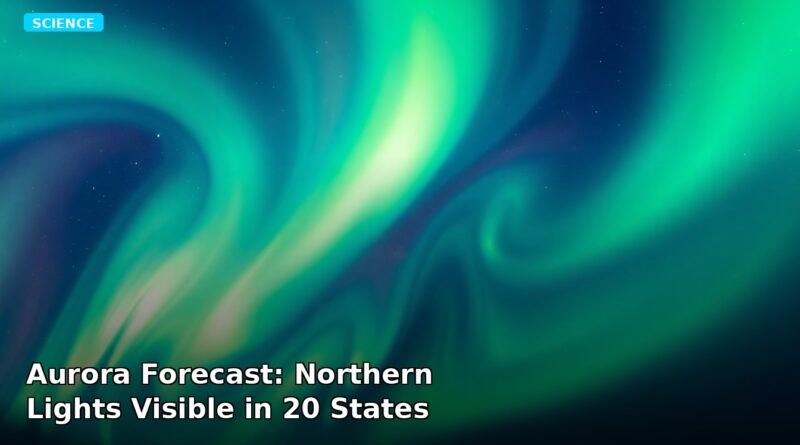
Aurora Forecast: Northern Lights Visible in 20 States
Aurora Forecast: Northern Lights Visible in 20 States
This week, up to 20 northern U.S. states were forecast to see the northern lights — and most people had no idea it was coming until 30 minutes before it happened.
That’s not a failure of science. That’s actually how aurora forecasting works. And the reason why is far stranger than you’d expect.
The Night That Put 20 States on Alert
On the night of April 18 into April 19, 2026, NOAA’s Space Weather Prediction Center issued a forecast covering a sweep of northern U.S. states — from New York to Idaho, stretching across the Upper Midwest. Twenty states. Potentially visible northern lights, on a Saturday night, for anyone willing to step outside and look up.
It wasn’t the first alert that week. A G2 geomagnetic storm had already given the northern United States a shot at the aurora on April 17. Two nights in a row. That’s the kind of back-to-back window that aurora hunters wait months for — and it happened because of something happening 93 million miles away on the surface of the sun.
The question most people never think to ask: how do scientists even know this is coming?
The Sun Has a Schedule — and Scientists Exploit It
Here’s the part that sounds almost too convenient to be true. The sun rotates on its axis once every 27 to 28 days, as seen from Earth. That’s a predictable cycle. And it’s the entire foundation of one of aurora science’s most useful tools: the 27-Day Aurora Forecast.
The logic is elegant. Active regions on the sun — the areas most likely to fire off the solar wind streams that trigger geomagnetic storms — tend to rotate back into Earth-facing position roughly every 27 days. If a region caused a geomagnetic storm this week, there’s a meaningful chance it’ll be pointed at Earth again in about four weeks.
Aurora hunters use this. Scientists use this. It’s not a guarantee — the sun is chaotic, and active regions can intensify, decay, or disappear entirely during that rotation. But it gives forecasters a baseline. A 27-day lookahead that’s built not on guesswork, but on the geometry of our own solar system.
That long-range view is only one piece of the forecasting toolkit.
The 30-Minute Window That Changes Everything
Long-range forecasts tell you when to be ready. The 30-minute forecast tells you when to go outside.
NOAA’s Aurora 30-Minute Forecast is built on something called the OVATION model. It takes real-time solar wind data and translates it into a prediction of where the aurora will appear — and how intense it will be — in the next 30 to 90 minutes. The Space Weather Prediction Center also runs an experimental Aurora Viewline product, which maps the predicted aurora boundary over North America for tonight and tomorrow night.
Thirty minutes. That’s your window. Not days, not hours — thirty minutes between “the data looks promising” and “go stand in a field right now.”
This is why aurora chasing has a reputation for being equal parts science and scramble. You can plan for weeks using the 27-day forecast. You can narrow it down to a night using the G-storm alerts. But the final call — the moment you grab your jacket and run for a dark sky — comes down to a 30-to-90-minute model that’s updating constantly.
For the April 18 event, that model was pointing as far south as the Upper Midwest and the northern tier of states from New York to Idaho. Not just Alaska. Not just Canada. New York. Idaho. Twenty states.
What Alaska Sees on a Quiet Night
While the lower 48 were tracking a G2 storm, the University of Alaska Fairbanks Geophysical Institute was forecasting something far more routine: low aurora activity, with low-level displays potentially visible overhead from Utqiaġvik to Fairbanks.
That contrast tells you something important about how aurora geography works. For communities in Alaska’s far north, a night with low aurora activity is still a night where the lights might be overhead. Utqiaġvik — the northernmost city in the United States — sits so deep inside the auroral oval that the northern lights are less a rare event and more a seasonal fixture.
For the rest of the country, a G2 storm is a news headline. For Fairbanks, it’s a Tuesday.
The auroral oval is a permanent ring of activity encircling the magnetic poles. It expands during strong geomagnetic storms — which is exactly why a G2 event can push visibility down into New York and Idaho. On quiet nights, it contracts back toward the poles, and Alaska’s northern communities remain inside it almost by default.
Final Thought
The April 18–19 aurora window wasn’t luck. It was the product of three overlapping systems working simultaneously: a 27-day solar rotation cycle that gave forecasters advance warning, a G2 geomagnetic storm that expanded the auroral oval far enough south to cover 20 states, and a 30-to-90-minute OVATION model that told people exactly when to step outside.
Most people think of the northern lights as something wild and unpredictable — a natural phenomenon you either stumble into or miss entirely. The real story is that NOAA’s Space Weather Prediction Center is running continuous forecasts, experimental viewline products, and near-real-time storm alerts specifically so that a Saturday night in New York or Idaho doesn’t have to be a mystery. The aurora is still nature. But now, at least, it texts you first.
Frequently Asked Questions
How do scientists predict the northern lights?
Scientists predict the northern lights using solar rotation patterns and NOAA’s Space Weather Prediction Center. Because the sun rotates every 27-28 days, active regions that triggered past storms are likely to face Earth again about four weeks later.
How far in advance can aurora be forecast?
Aurora forecasting is highly short-range, with many alerts issued just 30 minutes before the event. However, scientists use the 27-Day Aurora Forecast based on the sun’s rotation cycle to identify windows of potential activity weeks ahead.
How many states can see the northern lights during a geomagnetic storm?
During a significant geomagnetic storm, up to 20 northern U.S. states can potentially see the northern lights. On April 18-19, 2026, NOAA issued a forecast covering states from New York to Idaho across the Upper Midwest.
Recommended Reading
Explore these hand-picked resources to dive deeper into this topic:
- Astrophysics for People in a Hurry by Neil deGrasse Tyson
- The Universe in a Nutshell by Stephen Hawking
- Celestron 70mm Refractor Telescope (portable stargazing tool)
As an Amazon Associate, we earn from qualifying purchases. This helps support Fact Storm Hub at no extra cost to you.
Sources
- https://www.yahoo.com/news/articles/northern-lights-forecast-20-states-222215225.html
- https://www.gi.alaska.edu/monitors/aurora-forecast
Watch the Video
🤖 AI Content Disclosure
This article was created using AI-assisted research and writing tools, then reviewed for quality and accuracy. Facts are sourced from publicly available web research, but readers should verify critical information from primary sources.
Published for educational and entertainment purposes. Last reviewed: April 2026