
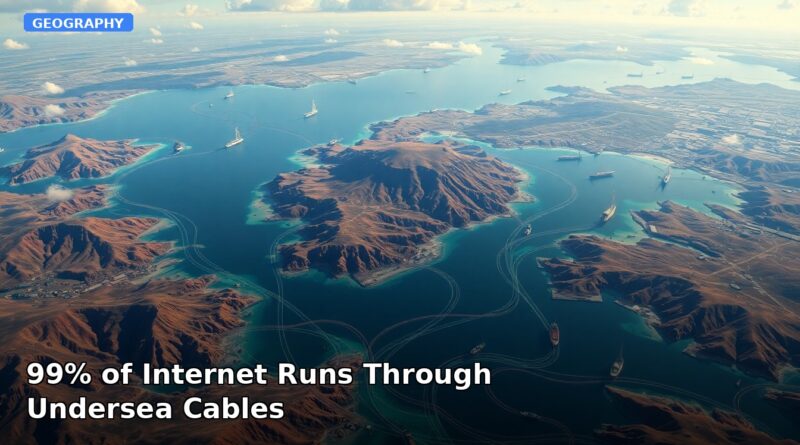
99% of Internet Runs Through Undersea Cables
99% of Internet Runs Through Undersea Cables
Somewhere beneath the Atlantic Ocean, right now, the email you sent this morning is travelling as a pulse of light through a cable thinner than a garden hose. Not through a satellite. Not through the cloud. Through the seabed. And almost every digital thing you did today — every search, every stream, every payment — took the same route.
The number that stops people cold: around 99 percent of global internet traffic is routed via subsea cables. Not some of it. Not most of it. Virtually all of it. The “wireless” world is, at its foundation, wired to the ocean floor.
The Infrastructure Nobody Talks About
Pull up a map of the world’s undersea cable network and it looks like a circulatory system. There are 485 multiterabit-per-second undersea data cables spanning the world’s oceans — crossing the Atlantic, threading through the Indian Ocean, looping around the Pacific. Together they carry the weight of the entire digital economy.
What surprises most people is where those cables make landfall. The geography isn’t random. Cables can’t just come ashore anywhere. They need specific conditions: accessible coastline, proximity to major population centres, and — critically — the right underwater terrain leading up to the beach. That combination of factors is rarer than you’d think, which is why cable landing points cluster together in specific locations rather than spreading evenly around the world’s coastlines.
The result is that a handful of tiny, often obscure places end up sitting at the centre of the global internet. Villages that most people couldn’t find on a map are, in a very real sense, the hinge points of modern civilisation.
Why Deep Water Is Actually the Safe Part
Here’s the counterintuitive truth about subsea cables: the deep ocean is where they’re safest.
In deep water, cables can rest on a relatively flat seabed, away from rocks, fishing trawlers, ship anchors, and the constant abrasion of shallow-water hazards. The dangerous zones are the shallow coastal approaches — where the cable has to transition from open ocean to dry land. That final stretch, where the cable crawls up the continental shelf and onto a beach, is where most damage historically occurs.
So cable engineers spend enormous effort finding landing sites where the underwater approach is as clean and gradual as possible. A village that happens to sit at the end of a smooth, deep-water corridor into the ocean becomes extraordinarily valuable — not because of anything the village did, but because of what the geology beneath it allows.
This is why certain coastal spots keep appearing on cable maps decade after decade. The geography doesn’t change. Once a location proves viable, every new cable operator looks at the same coastline and reaches the same conclusion.
The Part That Should Unsettle You
The concentration of so much traffic through so few physical points isn’t just a geography curiosity. It’s a vulnerability that defence agencies have been tracking with growing urgency.
The UK Ministry of Defence exposed a coordinated Russian undersea operation involving an Akula-class nuclear-powered attack submarine targeting critical internet cables in the Atlantic. Not a hypothetical threat. A documented, active operation aimed at the physical infrastructure that carries nearly all of global internet traffic.
Think about what that means in practice. These cables don’t just carry cat videos and social media arguments. They carry financial transactions, government communications, military coordination, and the real-time data flows that keep modern economies functioning. Cutting a cable in the right location — or even credibly threatening to — is a form of leverage that no satellite network can currently replace.
The 485 cables crossing the world’s oceans are, in that sense, both the backbone of the modern world and its most exposed nerve. They’re buried in international waters, largely unguarded, and irreplaceable on any short timeline.
Final Thought
The village-at-the-centre-of-the-internet story is really two stories running in parallel. The first is an engineering marvel: 485 cables, carrying 99 percent of global traffic, positioned by geology and physics into a network that has quietly powered the digital age. The second is a strategic reality that the Akula-class submarine operation made impossible to ignore — that the same concentration making the network efficient also makes it fragile. The question facing governments and infrastructure planners right now isn’t whether subsea cables are critical. It’s whether a network this central to modern life should ever have been allowed to converge in so few places, with so little protection, on the floor of an ocean that no single nation owns.
Frequently Asked Questions
How much of the world’s internet traffic travels through undersea cables?
Around 99 percent of global internet traffic is routed via subsea cables. Despite the world feeling wireless, virtually all digital activity — searches, streams, and payments — travels through cables on the ocean floor.
How many undersea internet cables are there in the world?
There are 485 multiterabit-per-second undersea data cables spanning the world’s oceans, crossing the Atlantic, threading through the Indian Ocean, and looping around the Pacific, collectively carrying the entire digital economy.
Why do undersea internet cables land in the same places?
Cable landing points cluster together because cables require specific conditions to come ashore, including accessible coastline, proximity to major population centres, and suitable underwater terrain, making ideal landing locations rarer than most people expect.
Recommended Reading
Explore these hand-picked resources to dive deeper into this topic:
- The Grid by Matt Ridley
- Tubes: A Journey to the Center of the Internet by Andrew Blum
- National Geographic Atlas of the World (Reference Edition)
As an Amazon Associate, we earn from qualifying purchases. This helps support Fact Storm Hub at no extra cost to you.
Sources
- https://medium.com/aha-science/95-of-all-the-worlds-data-travels-through-underwater-cables-e5d71801b45e
- https://ryanferguson.co.uk/blogs/blog/subsea-internet-cables?srsltid=AfmBOorDIzU66qk0NdQh1hIefLfr6RC4374zrvXXTvoxfQFOjkuhHt5e
- https://www.cnn.com/2019/07/25/asia/internet-undersea-cables-intl-hnk
- https://armyrecognition.com/news/navy-news/2026/uk-exposes-russian-submarines-targeting-critical-internet-cables-in-the-atlantic-for-over-one-month
Watch the Video
🤖 AI Content Disclosure
This article was created using AI-assisted research and writing tools, then reviewed for quality and accuracy. Facts are sourced from publicly available web research, but readers should verify critical information from primary sources.
Published for educational and entertainment purposes. Last reviewed: April 2026