
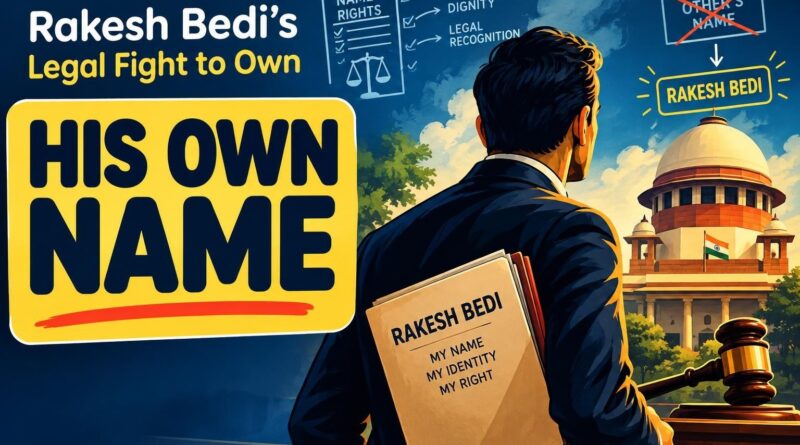
Rakesh Bedi’s Legal Fight to Own His Name
Rakesh Bedi’s Legal Fight to Own His Name
This week, an actor who has appeared in more than 150 films since the 1970s walked into the Delhi High Court — not for a role, not for a contract dispute, but to legally claim ownership of his own face, his own voice, and his own name.
Rakesh Bedi filed a personality rights suit on September 23, 2026. And the story behind that filing is far bigger than one actor protecting himself.
The Man Behind 150 Films
Most people who grew up watching Hindi cinema know Rakesh Bedi’s face before they know his name.
Born on December 1, 1954, Bedi has been a working actor for over four decades. More than 150 films. Television appearances too numerous to count. A career that outlasted trends, survived the shift from single-screen cinemas to streaming platforms, and kept going long enough to earn him a new generation of fans through his role as Jameel Jamali in the Dhurandhar films.
That’s not a cameo career. That’s a life’s work.
And yet, in 2026, someone — or something — was using that life’s work without his permission. His name. His voice. His likeness. The very things that took four decades to build were being used by others, and Bedi had no automatic legal wall to stop it.
So he built one.
What “Personality Rights” Actually Means
Here’s where most people’s eyes glaze over — but stay with this, because it affects every celebrity, athlete, and public figure in India.
Personality rights is not a complicated idea. It’s simply the legal recognition that your identity — your name, your face, your voice — belongs to you. Nobody else can use it to sell products, create fake endorsements, or generate content without your consent.
In the age of AI-generated audio, deepfake videos, and synthetic voices that can clone anyone’s speech in minutes, this matters more than it ever has before.
The Delhi High Court has already seen this argument succeed. Justice Anup Jairam Bhambhani, before whom the matter first came up, presides over a court that has previously granted this protection to actress Tabu, cricketers Yuvraj Singh and Abhishek Sharma, Congress leader Shashi Tharoor, and Andhra Pradesh Deputy CM Pawan Kalyan.
That’s a telling list. Actors. Cricketers. Politicians. The Delhi High Court is quietly building a body of law that India never had before — and Rakesh Bedi just added his name to it.
Why This Matters Right Now
The case has been sent to the bench that handles Intellectual Property Division matters — which signals the court is treating this seriously, not as a one-off celebrity complaint but as a question of intellectual property law.
That framing is significant.
Personality rights cases in India don’t have a dedicated statute behind them yet. Every ruling is built on existing copyright law, tort law, and judicial interpretation. Each new case that succeeds adds another brick to a legal framework that millions of Indians — not just celebrities — will eventually benefit from.
Think about what’s happening in the broader world right now. AI tools can clone a voice from a few seconds of audio. Deepfake technology can put anyone’s face on any body in any video. Social media can spread that content to millions before the real person even knows it exists.
For a working actor with four decades of recorded voice and screen presence, the exposure is enormous. Every interview, every film, every television appearance becomes raw material that someone with the right software could weaponize.
Rakesh Bedi is not being paranoid. He’s being early.
The Bigger Picture for Indian Cinema
Bedi’s suit arrives at a moment when the Indian entertainment industry is grappling with questions it has never had to answer before.
Who owns a voice that has been recorded hundreds of times? Who owns a face that has appeared on screen for forty years? Can an AI model trained on an actor’s old films produce new “performances” without consent? Can a brand use a synthesized version of a celebrity’s endorsement without paying them?
These are not hypothetical questions. They are happening — in India and globally — right now.
The actors and athletes who have already won personality rights protection from the Delhi High Court have set a precedent. But precedent is not legislation. Every new case still requires a fresh legal argument, a fresh hearing, a fresh ruling.
What Rakesh Bedi’s filing does is expand the conversation beyond the obvious A-list names. He is not a Bollywood superstar with a team of lawyers on permanent retainer. He is a working actor — the kind of professional who built Indian cinema scene by scene, film by film, across more than 150 appearances. If the court extends protection to him, it signals that personality rights in India are not a privilege reserved for the famous few.
Final Thought
Rakesh Bedi spent four decades building something recognizable — a voice, a face, a screen presence that audiences trusted. The September 23, 2026 filing is not a defensive move by a worried actor. It is a direct challenge to the legal system to answer a question that AI has made urgent: does the work of building a public identity give you ownership over it?
The Delhi High Court’s Intellectual Property Division will have to answer that. And whatever they decide will matter far beyond one actor’s name — it will shape how India protects every public figure in the age of synthetic media.
Frequently Asked Questions
Why did Rakesh Bedi file a court case in 2026?
Rakesh Bedi filed a personality rights suit at the Delhi High Court on September 23, 2026, to legally protect his name, face, and voice from being used without his permission, particularly in the age of AI deepfakes and synthetic media.
What are personality rights and why do they matter in India?
Personality rights are the legal recognition that your name, face, and voice belong to you. They prevent others from using your identity for fake endorsements or AI-generated content without consent, and are increasingly relevant for Indian celebrities and public figures.
How many films has Rakesh Bedi acted in?
Rakesh Bedi has appeared in more than 150 films over a career spanning four decades since the 1970s, and is also known for his television work and his role as Jameel Jamali in the Dhurandhar films.
Recommended Reading
Explore these hand-picked resources to dive deeper into this topic:
- The India Way by S. Jaishankar
- India’s Struggle for Independence by Rammohan Guha
- Legal Rights Handbook (Indian law guide)
As an Amazon Associate, we earn from qualifying purchases. This helps support Fact Storm Hub at no extra cost to you.
Sources
- https://www.bignewsnetwork.com/news/279326214/actor-rakesh-bedi-moves-delhi-hc-for-personality-rights-protection
- https://www.livelaw.in/high-court/delhi-high-court/rakesh-bedi-actor-personality-rights-protection-suit-filed-551358
- https://legal.economictimes.indiatimes.com/amp/news/litigation/actor-rakesh-bedi-moves-delhi-hc-for-personality-rights-protection/134427958
- https://en.wikipedia.org/wiki/Rakesh_Bedi
- https://www.imdb.com/name/nm0066075/
🤖 AI Content Disclosure
This article was created using AI-assisted research and writing tools, then reviewed for quality and accuracy. Facts are sourced from publicly available web research, but readers should verify critical information from primary sources.
Published for educational and entertainment purposes. Last reviewed: September 2026