
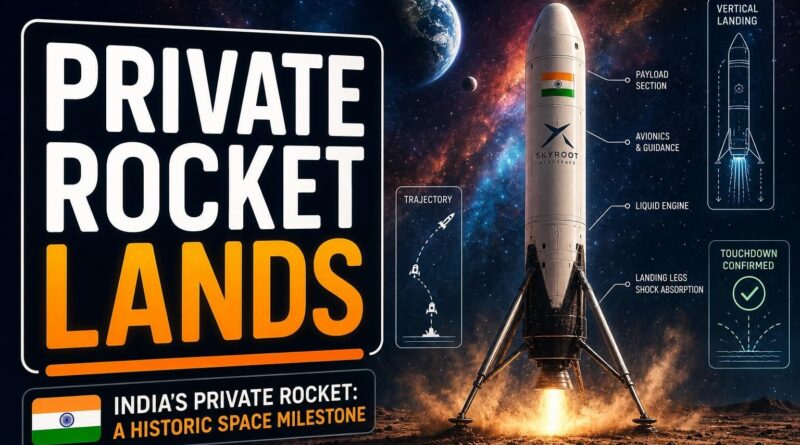
India’s Private Rocket: A Historic Space Milestone
India’s Private Rocket: A Historic Space Milestone
On 18 July 2026, a rocket built by an eight-year-old Indian startup cleared the atmosphere and reached orbit. Not a government rocket. Not an ISRO mission. A privately built, privately funded vehicle — from a company that didn’t exist until 2018, founded by two engineers who quit their jobs and started with nothing but a name and a plan.
Eight years. Two founders. One orbital rocket. Here’s the story behind the number that changed everything.
The Company That Started With a Borrowed Dream
Hyderabad, 2018. Two engineers — Pawan Kumar Chandana and Naga Bharath Daka — walked away from stable careers and registered a company called Skyroot Aerospace on 12 June 2018.
Their headquarters, named MAX-Q, sits in Hyderabad, Telangana. The name is itself a signal. In rocketry, Max-Q is the moment of maximum aerodynamic stress — the point where a rocket is most likely to break apart. Naming your base after that moment tells you everything about the founders’ mindset. They weren’t building a comfortable company. They were building something designed to survive the hardest pressure.
Chandana took on the roles of CEO and CTO simultaneously. Daka became COO. Between them, they had to solve one of the hardest engineering problems on Earth: building a rocket from scratch, in a country where private space companies had never done it before.
Six years later, they had over 1,000 people on payroll and ₹100.6 crore in revenue for FY26 — roughly US$11 million. Not enormous by global aerospace standards, but remarkable for a company that was a blank page less than a decade ago.
What Makes Vikram-1 Different From Every Rocket Before It
The rocket that reached orbit on 18 July 2026 is called Vikram-1. The name is a tribute — Vikram Sarabhai is considered the father of India’s space programme, the man who convinced the world that a developing nation had every right to reach for the stars.
But Vikram-1 isn’t a museum piece named after a legend. It’s a genuinely modern machine, built using technologies that didn’t exist in Sarabhai’s era.
Two features stand out. First: 3D-printed engines. Traditional rocket engines are machined from metal over weeks or months, requiring precision manufacturing at enormous cost. 3D printing collapses that timeline and cuts cost dramatically — it’s the same reason SpaceX’s engines and Rocket Lab’s Rutherford engines use additive manufacturing. It’s faster, lighter, and allows geometries that conventional machining simply can’t produce.
Second: carbon composite structures. Carbon composites are stronger than steel at a fraction of the weight. In rocketry, every kilogram saved on the vehicle’s body is a kilogram added to the payload. Skyroot didn’t copy older designs. They built Vikram-1 for the economics of modern spaceflight — lean, efficient, and purpose-built for a competitive global launch market.
The Mission Name That Said It All
The mission that carried Vikram-1 to orbit was named “Mission Aagaman” — an Urdu and Hindi word meaning “arrival.”
The naming was deliberate, and it earns its weight. This wasn’t a test hop. This wasn’t a suborbital demonstration designed to claim partial credit. This was a full orbital insertion — a rocket circling the Earth — from a company operating on ₹100.6 crore in annual revenue.
For context on what that means technically: the gap between suborbital and orbital flight is not a small step. Suborbital means going up and coming back down. Orbital means achieving enough horizontal velocity — roughly 28,000 kilometres per hour — to continuously fall around the Earth rather than into it. The guidance systems, the sustained thrust profile, the structural demands: all of it is harder, more precise, and more unforgiving than anything suborbital flight requires.
Skyroot solved that problem on their first attempt at orbital flight. Mission Aagaman wasn’t just a name. It was an accurate description of what happened: India’s private sector arrived, and it arrived at the hardest level.
Why “Third Country” Is the Statistic That Changes Everything
Let’s be precise about what happened on 18 July 2026, because the headline number is easy to underestimate.
According to Wikipedia’s documentation of the launch, Skyroot Aerospace made India the third country in the world to reach orbit with a privately built rocket. Third. In the world.
That is not a regional milestone. That is not an emerging-market story. That is a global ranking, and most of the planet didn’t make it onto the list.
Consider what that means in practice: the majority of nations with active, funded space programmes — including many across Europe — have not produced a private orbital-class rocket. The club is that exclusive. Skyroot, operating out of Hyderabad on the revenue of a mid-sized regional business, joined it before they did.
The two countries ahead of India in this category are the United States and China — nations with defence budgets and aerospace ecosystems that dwarf anything available to an Indian startup in 2018. That Skyroot reached orbit before better-funded programmes across Europe, Japan, and elsewhere is the detail that deserves to be repeated until it lands.
Final Thought
Vikram-1 reaching orbit on 18 July 2026 isn’t just a milestone for Skyroot Aerospace — it’s proof that the orbital launch market is no longer the exclusive territory of superpowers and their contractors. A company founded in 2018 by two engineers, now employing 1,000 people and generating ₹100.6 crore in annual revenue, just joined the United States and China in the only club that actually matters: nations whose private sector can reach orbit.
India is third. The list is short. And Skyroot got there in eight years.
Frequently Asked Questions
Who founded Skyroot Aerospace and when was it started?
Skyroot Aerospace was founded by Pawan Kumar Chandana and Naga Bharath Daka on 12 June 2018 in Hyderabad. Both engineers left stable careers to build India’s first private orbital rocket from scratch.
What is the Vikram-1 rocket and why is it significant?
Vikram-1 is the privately built rocket by Skyroot Aerospace that reached orbit on 18 July 2026, making India the third country to launch a private orbital rocket. It is named in tribute to Vikram Sarabhai, the father of India’s space programme.
How much revenue does Skyroot Aerospace make?
Skyroot Aerospace reported revenue of ₹100.6 crore, approximately US$11 million, for FY26. The company also grew to over 1,000 employees, a remarkable achievement for a startup founded less than a decade ago.
Recommended Reading
Explore these hand-picked resources to dive deeper into this topic:
- The Space Barons by Christian Davenport
- A Brief History of Time by Stephen Hawking
- Estes Model Rocket Kit (beginner-friendly launcher)
As an Amazon Associate, we earn from qualifying purchases. This helps support Fact Storm Hub at no extra cost to you.
Sources
- https://www.ndtv.com/india-news/skyroot-ceo-pawan-chandana-2-july-18s-46-years-apart-and-abdul-kalam-connections-to-vikram-1-launch-11789564
- https://en.wikipedia.org/wiki/Skyroot_Aerospace
- https://www.bloomberg.com/news/articles/2026-07-02/skyroot-plans-india-s-first-private-sector-rocket-launch-in-july
- https://www.linkedin.com/posts/cnbc-tv18_indias-private-space-dream-takes-flight-activity-7483924724125876225-fs4P
- https://www.exolaunch.com/news_140.html

Watch the Video
🤖 AI Content Disclosure
This article was created using AI-assisted research and writing tools, then reviewed for quality and accuracy. Facts are sourced from publicly available web research, but readers should verify critical information from primary sources.
Published for educational and entertainment purposes. Last reviewed: July 2026