
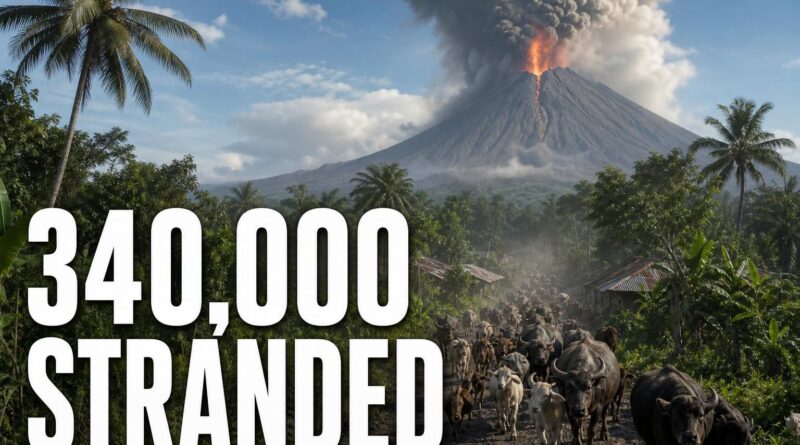
Indonesia Volcano Strands 340,000 Overnight
Indonesia Volcano Strands 340,000 Overnight
This week, a volcano 150 kilometres from Jakarta woke up — and paralysed one of the world’s busiest aviation networks before most people had finished their morning coffee.
Anak Krakatau erupted late on a Friday night, sending lava fountains into the sky and pushing a thick plume of volcanic ash across Indonesia’s Sunda Strait. By Sunday morning, Jakarta’s Soekarno-Hatta International Airport had grounded every flight. By the time the dust — literally — began to settle, nearly 3,000 flights had been disrupted and more than 340,000 passengers were stranded across the country.
But here’s what the flight cancellation headlines missed: this isn’t just a breaking news story. Anak Krakatau has been doing this — erupting, collapsing, rebuilding, erupting again — for longer than most countries have existed. And the fact that a volcano 150 kilometres away can shut down a capital city’s airport tells you something extraordinary about the raw power sitting beneath that small, restless island.
The Eruption That Stopped a Nation
Late Friday, Anak Krakatau shifted from its usual low-level rumbling into something far more dramatic. Lava fountains broke through the crater, and the eruption column pushed volcanic ash high enough for the wind to carry it across the Sunda Strait — directly toward Java.
By Sunday morning, the ash had reached Jakarta. Soekarno-Hatta International Airport, one of the busiest airports in Southeast Asia, made the call: no flights. Five airports across Indonesia followed. The closures weren’t lifted until past midnight on Tuesday, when Soekarno-Hatta finally resumed operations at 00:30 local time — more than 48 hours after the first groundings.
The scale of disruption is hard to picture. Nearly 3,000 flights cancelled. More than 340,000 passengers stranded — families mid-journey, workers stuck in cities they weren’t meant to be in, tourists with nowhere to sleep. All because a volcano island, roughly the size of a small suburb, decided to exhale.
Anak Krakatau remained seismically active throughout the entire weekend, keeping authorities on edge even as they worked to reopen the airports.
Why This Volcano Is Unlike Any Other on Earth
Anak Krakatau’s name translates from Indonesian as “Child of Krakatau” — and that name carries the weight of one of history’s most violent geological events.
The original Krakatau volcano was destroyed in a catastrophic eruption that sent shockwaves around the planet multiple times and triggered tsunamis that killed tens of thousands of people across Java and Sumatra. The sound of that eruption was reportedly heard thousands of kilometres away — one of the loudest sounds ever recorded in human history.
For decades after, the sea where Krakatau once stood was quiet. Then, roughly 40 years later, a new island broke the surface. Anak Krakatau — the child — had been born from the same underwater volcanic system that destroyed its parent. It has been growing, erupting, and reshaping itself ever since.
What makes Anak Krakatau genuinely unusual is that it sits at the junction of two tectonic plates, making it one of the most persistently active volcanoes on the planet. It doesn’t erupt once and go quiet for a century. It erupts regularly, in cycles, as though it’s breathing.
The Ocean, the Wildlife, and the Danger Zone
Anak Krakatau doesn’t exist in isolation. It sits in the Sunda Strait, a narrow stretch of ocean between the islands of Java and Sumatra — one of the most biologically rich marine corridors in the world.
The waters around the volcano are part of Indonesia’s vast marine ecosystem, home to coral reefs, dolphins, sea turtles, and an extraordinary variety of fish species. The Sunda Strait sits along major migration routes for marine wildlife, and the nutrient-rich waters stirred up by volcanic activity can, in some conditions, actually support bursts of marine life.
On land, the islands near Anak Krakatau are part of the Ujung Kulon National Park region — a UNESCO World Heritage area and one of the last habitats of the critically endangered Javan rhinoceros. When Anak Krakatau erupts, the ash fall, the tsunamis it can trigger, and the seismic activity ripple outward through this entire ecosystem.
Nature and geological violence have always coexisted here. But as human infrastructure — airports, shipping lanes, coastal cities — grows denser around the Sunda Strait, the cost of each eruption grows with it.
Final Thought
The airports have reopened. The 340,000 stranded passengers have, for the most part, found their way home. But Anak Krakatau remains seismically active — it was still rumbling as the last flights resumed at Soekarno-Hatta at 00:30 on Tuesday.
That’s the part worth sitting with. A volcano 150 kilometres away, on a small island in the middle of a strait, can halt a capital city’s aviation network for two full days in 2026. Not through a catastrophic once-in-a-century event — but through a single active weekend.
The “Child of Krakatau” is still growing. And the Sunda Strait, for all its extraordinary wildlife and marine richness, is also one of the most geologically volatile stretches of ocean on Earth. The next eruption isn’t a question of if. It never has been.
Frequently Asked Questions
How many flights were cancelled due to the Anak Krakatau eruption?
Nearly 3,000 flights were cancelled and over 340,000 passengers were stranded across Indonesia after Anak Krakatau erupted, forcing Jakarta’s Soekarno-Hatta International Airport and five other airports to ground all flights.
How far is Anak Krakatau from Jakarta?
Anak Krakatau is approximately 150 kilometres from Jakarta. Despite this distance, volcanic ash from the eruption reached the capital and forced the closure of Soekarno-Hatta International Airport for more than 48 hours.
How long was Jakarta airport closed after the Anak Krakatau eruption?
Jakarta’s Soekarno-Hatta International Airport was closed for more than 48 hours, with operations only resuming at 00:30 local time on Tuesday after the eruption began late on Friday night.
Recommended Reading
Explore these hand-picked resources to dive deeper into this topic:
- Krakatoa: The Day the World Exploded by Simon Winchester
- The Last Volcano by Roy Chester
- National Geographic Volcano Explorer Kit
As an Amazon Associate, we earn from qualifying purchases. This helps support Fact Storm Hub at no extra cost to you.
Sources
- https://www.bbc.com/news/articles/czezydp4l97o
- https://www.cnn.com/2026/09/06/travel/anak-krakatau-indonesia-eruption-airports-intl-hnk
- https://www.youtube.com/watch?v=eKKomU6FIJU
- https://www.reuters.com/business/environment/indonesia-reopens-jakarta-airport-four-others-after-anak-krakatau-ash-clears-2026-09-08/
- https://www.aljazeera.com/news/2026/9/8/indonesia-airports-reopen-after-volcanic-ash-disrupts-thousands-of-flights

🤖 AI Content Disclosure
This article was created using AI-assisted research and writing tools, then reviewed for quality and accuracy. Facts are sourced from publicly available web research, but readers should verify critical information from primary sources.
Published for educational and entertainment purposes. Last reviewed: September 2026