
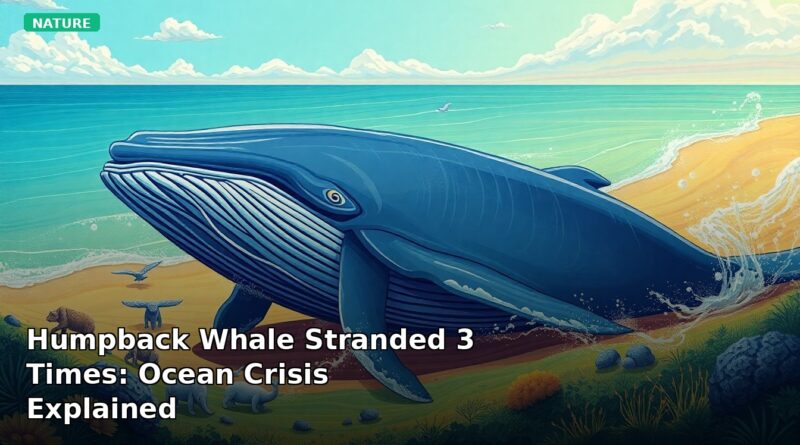
Humpback Whale Stranded 3 Times: Ocean Crisis Explained
Humpback Whale Stranded 3 Times: Ocean Crisis Explained
This week, a humpback whale stranded itself on a sandbank off the German island of Poel, in the Bay of Wismar. Then it did it again. And again. Three times in the space of a couple of weeks, rescuers waded into the Baltic Sea trying to save an animal that, by every biological measure, was already running out of time. A group of multimillionaire Germans pooled their own money for a last-ditch rescue attempt involving air cushions. The world watched. And ultimately, hope was abandoned.
But the whale’s story didn’t start on that sandbank. It started long before — tangled in fishing rope, starving, exhausted — and it raises a question that marine scientists have been asking for decades: when we find a stranded whale, are we actually saving it, or are we just watching the final chapter of a story we wrote much earlier?
The Moment Everyone Saw — And the Months Nobody Did
By the time the humpback appeared in the Bay of Wismar, it was already a shadow of what a healthy whale should be. Rescuers noted significant loss of health and nutritional condition — the kind of deterioration that doesn’t happen overnight.
The culprit was fishing gear. The whale had been entangled in ropes before it ever touched that sandbank. Entanglement is one of the quietest killers in the ocean. It doesn’t make headlines when it happens. There’s no footage of the moment a rope wraps around a fin or a tail. The whale simply struggles, burns energy it can’t replace, and begins to starve.
Here’s the biological reality that makes this worse: whales don’t drink seawater. They get almost all their hydration from the fish they eat. A whale that can’t hunt doesn’t just go hungry — it dehydrates. Every day the entanglement prevented this animal from feeding was a day it was dying of thirst in the middle of the ocean. By the time it beached on the Baltic coast, the damage was already done. The sandbank was a symptom. The rope was the sentence.
Three Strandings, One Brutal Truth
Lord’s Cricket Ground has its famous “five minutes of madness.” The Bay of Wismar had two weeks of desperate hope.
The whale stranded at least three times across those weeks. Each time, rescuers worked to refloat it. Each time, the animal returned to shore. That pattern — beach, refloat, beach again — is not random. According to the British Divers Marine Life Rescue (BDMLR), many cetacean strandings happen because the animal is already unhealthy due to disease, injury, starvation, exhaustion, or old age. Stranding, in their assessment, is a symptom of a serious underlying problem that is often very difficult, if not impossible, to resolve in an acute stranding situation.
Read that again slowly. The stranding is the symptom. Not the problem.
This is the part that breaks the rescue narrative wide open. When we see a whale on a beach, our instinct is to push it back into the water. That instinct is human and understandable. But for an animal that has already lost significant body condition — that is dehydrated, weakened, possibly still entangled — the ocean isn’t salvation. It’s just a larger place to die. The whale came back to shore twice after being refloated. That wasn’t confusion. That was a body that had run out of options.
The Multimillionaires, the Air Cushions, and the Limits of Money
Wealthy Germans pooling funds to save a single marine animal makes for a compelling headline. And to be clear — the impulse behind it is genuinely admirable. These were people who saw a creature suffering and reached for whatever resource they had.
The planned method — using air cushions to lift and free the whale — reflects real innovation in marine rescue. These aren’t beach balls. Inflatable lifting systems are used in industrial salvage operations and have been adapted for large cetacean rescue in specific circumstances. The logistics of deploying them around a living, stressed, multi-ton animal in shallow water are staggering.
But here’s what money cannot buy: time that has already passed. The entanglement happened before anyone knew this whale existed. The nutritional collapse happened in open water, invisible to every satellite and research vessel. By the time the funds were pooled and the air cushions were planned, the whale’s body had already been fighting a losing battle for weeks, possibly longer.
This is not a criticism of the rescuers. It’s a structural problem. Marine rescue, no matter how well-funded, is always responding to damage that was done upstream — sometimes literally, sometimes chronologically. The rescue operation in the Bay of Wismar was extraordinary. The system that allowed the entanglement to happen in the first place was entirely ordinary.
What Humpback Whales Actually Are — Before We Talk About Losing Them
Step back from the sandbank for a moment. Humpback whales are among the most acoustically complex animals on Earth. Their songs — produced only by males — can travel hundreds of miles through ocean water and last for hours. Different populations sing different songs, and those songs evolve over time, spreading across ocean basins like a slow-moving cultural wave. Researchers have documented how a new phrase introduced in one population gradually gets adopted by whales thousands of miles away. That’s not instinct. That’s culture.
Humpbacks are also among the most acrobatic of the great whales — their breaching behaviour, where they launch most of their body clear of the water, has been observed in contexts ranging from communication to parasite removal to what researchers cautiously describe as play. They migrate vast distances between feeding and breeding grounds, navigating open ocean with a precision that still isn’t fully understood.
This is the animal that washed up on a German sandbank, tangled in fishing rope, too weak to stay in the water. Not an abstraction. Not a statistic. A creature that sings evolving songs across ocean basins, that has a culture, that breaches for reasons we’re still trying to understand.
The Parable the Guardian Called It — And Why That Word Is Exactly Right
The Guardian described the German whale as “a parable of our troubled relationship with these sea giants.” A parable is a story where the surface events point toward a deeper truth. The whale stranded. Rescuers tried. Hope was abandoned. That’s the surface.
The deeper truth is the architecture of how these animals end up in these situations. Fishing gear drifts through waters these whales have migrated through for thousands of years. The rope doesn’t know it’s a death sentence. The fishery that lost it didn’t intend to harm a humpback. And yet the entanglement happens, the body condition collapses, and three weeks later a group of humans stands on a Baltic beach trying to undo with air cushions what accumulated over months.
BDMLR’s position is worth sitting with: stranding is a symptom of a serious underlying problem that is often very difficult, if not impossible, to resolve acutely. That’s an organization whose entire mission is cetacean rescue, telling us honestly that by the time they arrive, the hardest part of the story is already written.
The Bay of Wismar rescue wasn’t a failure of effort or funding or compassion. It was a collision between a crisis response and a structural problem — and structural problems don’t yield to crisis responses alone.
Final Thought
The whale that stranded three times off the island of Poel in April 2026 will be remembered, if it’s remembered at all, as a sad story from the Baltic coast. But the fishing rope that started this before anyone was watching — that’s the part that should stay with us. Humpback whales navigate entire ocean basins, sing songs that spread like culture across thousands of miles, and have done so for longer than our species has existed. The question the Bay of Wismar forces us to ask isn’t whether we should try harder to rescue stranded whales. It’s whether we’re willing to address the entanglement — literal and systemic — that puts them on the beach in the first place.
Frequently Asked Questions
Why did the humpback whale keep stranding itself in Germany?
The humpback whale repeatedly stranded in the Bay of Wismar because it was already severely weakened from fishing rope entanglement, which left it starving, exhausted, and in critical health long before it ever reached the sandbank.
How does fishing gear entanglement kill whales?
Entanglement in fishing ropes prevents whales from hunting, causing them to starve and dehydrate, since whales get hydration from the fish they eat rather than seawater, leading to a slow and often invisible decline.
Can stranded whales be saved after they beach themselves?
By the time most whales strand, the underlying damage from threats like entanglement has already been done for months. Rescue efforts may address the immediate beaching but often cannot reverse the severe deterioration that preceded it.
Recommended Reading
Explore these hand-picked resources to dive deeper into this topic:
- The Soul of an Octopus by Sy Montgomery
- Braiding Sweetgrass by Robin Wall Kimmerer
- BBC Planet Earth II (Documentary Series)
As an Amazon Associate, we earn from qualifying purchases. This helps support Fact Storm Hub at no extra cost to you.
Sources
- https://www.theguardian.com/environment/2026/apr/18/stranded-dying-german-whale-troubled-relationship-sea-timmy
- https://globalnews.ca/news/11806063/whale-stranded-germany-rescue-mission-millionaires/
- https://bdmlr.org.uk/statement-stranded-humpback-whale-in-germany
- https://www.beehive.news/news/aee8fbeb-1167-498d-990a-346686f90c2a
- https://www.theguardian.com/world/2026/apr/16/millionaires-fund-last-ditch-attempt-to-save-humpback-whale-stranded-in-germany
Watch the Video
🤖 AI Content Disclosure
This article was created using AI-assisted research and writing tools, then reviewed for quality and accuracy. Facts are sourced from publicly available web research, but readers should verify critical information from primary sources.
Published for educational and entertainment purposes. Last reviewed: April 2026