
Why the Godavari River Isn’t Called What You’d Expect
Why the Godavari River Isn’t Called What You’d Expect
There is a river in peninsular India that begins small enough to step across.
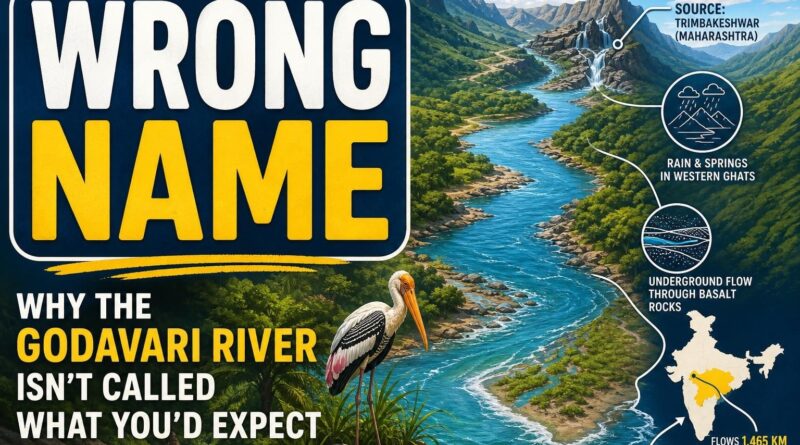
Near Trimbakeshwar, in the Nashik district of Maharashtra, the Godavari pushes out of the Brahmagiri Mountain in the Western Ghats — quietly, without announcement. At its source, it is nothing. By the time it reaches the Bay of Bengal, 1,465 kilometres later, it has passed through five states, fed one of India’s most sacred pilgrimage cities, and earned a title that the Ganga itself would recognise as a compliment.
That title is Dakshin Ganga — the Ganges of the South. And the story of how a river earns a name like that is worth following, kilometre by kilometre.
Born in the Western Ghats, 1,465 Kilometres From the Sea
The Godavari doesn’t begin with drama. It begins with geography.
Its source is the Brahmagiri Mountain near Trimbakeshwar, Nashik — deep inside the Western Ghats, one of the world’s recognised biodiversity hotspots. At that elevation, the river is a trickle. There is no sign of what it will become.
From there, the Godavari travels approximately 1,465 kilometres — roughly the straight-line distance from Mumbai to Kolkata, except the river takes none of the shortcuts. It curves. It widens. It collects tributaries, absorbs monsoon runoff, and builds momentum across an entire subcontinent’s worth of terrain before it finally fans out into a delta on the Andhra Pradesh coast and empties into the Bay of Bengal.
That 1,465-kilometre journey makes the Godavari India’s second longest river. Only the Ganga is longer. That comparison isn’t just a number — it sets up everything that comes next.
Why They Call It the Dakshin Ganga
The title Dakshin Ganga — the Ganges of the South — was not given casually, and it was not given recently.
For centuries, the Godavari has held the same spiritual gravity in peninsular India that the Ganga holds in the north. Pilgrims have travelled to its banks to mark births, mourn deaths, and seek something that rivers, across every culture, have always seemed to offer. The river is woven into the religious and cultural fabric of the region in ways that no single event can fully represent — but one event comes close.
Nashik, the city that sits on the Godavari’s banks at the river’s origin district, hosts the Kumbh Mela — described as one of the largest human conglomerations in the world for a religious event. Millions of pilgrims from across India and beyond converge on this single stretch of river. No stadium, no arena, no infrastructure built for crowds comes close to the scale of what the Godavari’s banks absorb during those gatherings.
That a river originating in the same district could anchor that kind of human presence tells you everything about why the name Dakshin Ganga stuck. It wasn’t borrowed from the north. It was earned in the south.
Five States, One River
Most rivers, in the popular imagination, belong to one place. The Godavari has never accepted that arrangement.
From its origin in Maharashtra, the river moves through Chhattisgarh and Telangana, then into Andhra Pradesh, with Odisha also falling within its basin — five states, dozens of languages, hundreds of distinct communities, all sharing the same water source. The Godavari does not recognise the administrative boundaries drawn across it. It simply keeps moving east.
That shared ownership matters practically, not just symbolically. When the river rises in its upper reaches, the water arriving downstream is carrying the accumulated rainfall of Maharashtra’s hills and Chhattisgarh’s forests together. The river at any given point is not local — it is the sum of everything upstream. Five states means five sets of monsoon patterns, five sets of tributaries, five sets of communities whose lives are shaped by what this single river does each year.
The Godavari’s basin is one of the largest in India. Its reach is not a metaphor. It is a measurement.
What the Delta Knows
By the time the Godavari reaches the Andhra Pradesh coast, it has undergone a complete transformation.
The river that squeezed out of a mountain gap in Nashik has, by this point, spread into a wide, braided delta before emptying into the Bay of Bengal. Deltas form where rivers slow down and deposit the sediment they have been carrying for hundreds of kilometres — and the Godavari has been carrying a great deal. Every monsoon season that sends water rushing through the river’s upper reaches also sends sediment downstream, where it settles and builds.
The result is delta soil that is extraordinarily fertile — built, layer by layer, over geological time, by the same seasonal floods that cause concern upstream. The agriculture the delta supports today is, in a direct sense, a product of every flood the river has ever run. The river’s contribution does not end at the coastline, either. The nutrients carried by the Godavari into the Bay of Bengal support marine ecosystems that extend well offshore, making the river’s reach longer, in ecological terms, than even its 1,465-kilometre length suggests.
Final Thought
The Godavari runs 1,465 kilometres from a mountain spring near Trimbakeshwar to the Bay of Bengal — through five states, past the Kumbh Mela crowds at Nashik, across the Deccan, and into a fertile delta that the sea has been receiving for thousands of years.
It is India’s second longest river. It is the Dakshin Ganga. And it does not need the comparison to the north to justify that name — its own journey, from a trickle in the Western Ghats to a braided delta on the eastern coast, is argument enough.
Frequently Asked Questions
How long is the Godavari river?
The Godavari river is 1,465 kilometres long, making it India’s second longest river after the Ganga. It originates near Trimbakeshwar in Nashik, Maharashtra, and flows into the Bay of Bengal.
Where does the Godavari river originate?
The Godavari river originates from the Brahmagiri Mountain near Trimbakeshwar in the Nashik district of Maharashtra, deep within the Western Ghats, one of the world’s recognised biodiversity hotspots.
Why is the Godavari river called Dakshin Ganga?
The Godavari is called Dakshin Ganga, meaning the Ganges of the South, because it holds the same deep spiritual significance in peninsular India that the Ganga holds in northern India. This title reflects centuries of religious reverence.
Recommended Reading
Explore these hand-picked resources to dive deeper into this topic:
- The Godavari: A History by Ramachandra Guha
- Rivers of India by Francine Frankel
- National Geographic River Explorer Kit
As an Amazon Associate, we earn from qualifying purchases. This helps support Fact Storm Hub at no extra cost to you.
Sources
- https://en.wikipedia.org/wiki/Godavari_River
- https://earth.fm/recordings/river-godavari/
- https://kids.britannica.com/students/article/Godavari-River/324749
- https://mapy.com/en/?source=osm&id=112735453
- https://www.scribd.com/presentation/684971919/The-River-Godavari
🤖 AI Content Disclosure
This article was created using AI-assisted research and writing tools, then reviewed for quality and accuracy. Facts are sourced from publicly available web research, but readers should verify critical information from primary sources.
Published for educational and entertainment purposes. Last reviewed: August 2026