
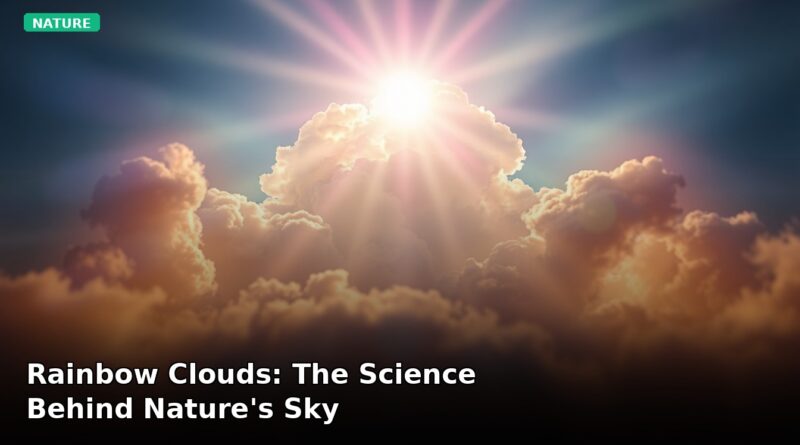
Rainbow Clouds: The Science Behind Nature’s Sky
Rainbow Clouds: The Science Behind Nature’s Sky
This week, traffic stopped in Jonggol, Indonesia. Not because of an accident. Not because of a celebrity. Because people looked up.
On May 5, 2026, a display of iridescent rainbow clouds appeared in the sky southeast of Jakarta — vivid, layered bands of color draped across the clouds like something a special effects team had painted in post-production. Footage spread across social media within hours. And almost immediately, the debate began: Is this real, or is it AI?
Popular Science confirmed it. The rainbow clouds were genuine. And the science behind them is far more interesting than the controversy.
What Actually Creates a Rainbow Cloud
Forget everything you think you know about rainbows. The arc you see after a storm is caused by raindrops refracting sunlight at a specific angle. Rainbow clouds work differently — and in some ways, they’re rarer.
The phenomenon happens inside the cloud itself. When a cloud contains tiny water droplets or ice crystals of unusually uniform size, sunlight passing through doesn’t just refract — it diffracts. The light bends around the particles and splits into a spectrum of color, the same way light behaves when it passes through a very fine grating. The result is color that seems to live inside the cloud rather than arc above it.
The key word is “uniform.” Most clouds are a chaotic mix of droplet sizes, which washes the colors out into white or grey. When the droplet sizes are consistent — typically in the thin, wispy edges of growing cumulus clouds — the diffraction aligns, and the spectrum appears. It’s a condition that requires the right cloud type, the right stage of development, and the right viewing angle all at once.
That’s why these displays are fleeting. According to WABC meteorologist Lee Goldberg, they can last for only a few moments before the cloud structure shifts and the colors dissolve.
Why the Sun’s Position Changes Everything
Jonggol, May 5, 2026. A towering cumulus cloud was building in the sky — the kind of tall, vertical cloud that forms when warm, moist air rises rapidly. That cloud became both the backdrop and the mechanism for what happened next.
Ida Pramuwardani, Acting Director of Public Meteorology at Indonesia’s climate agency BKMG, explained that the towering cumulus was partially blocking the sun. That partial blockage was critical. Rainbow clouds are most visible when the sun is almost hidden — when a thicker cloud or a mountain edge shields the direct glare, allowing the eye to focus on the diffracted light in the thinner cloud layers nearby.
Look directly at the sun, and you see nothing but brightness. Shield it just enough, and the colors hiding in the surrounding clouds snap into focus.
This is why the phenomenon tends to appear near the sun’s position in the sky rather than opposite it, unlike a traditional rainbow. It also explains why most people never see one — you have to be in the right place, at the right time, looking in the right direction, with the sun positioned just so. In Jonggol, all of those conditions aligned simultaneously. The result stopped traffic.
Real or AI? Why People Couldn’t Believe Their Eyes
The social media response to the Jonggol footage was immediate — and divided. Comments ranged from awe to outright skepticism. Dozens of users argued the images had to be AI-generated or digitally enhanced. The colors were too saturated. The effect too cinematic. Nature, they argued, doesn’t look like that.
It does, though. And this moment of collective disbelief says something worth paying attention to.
We’ve reached a point where genuinely extraordinary natural events are being dismissed as fabrications — not because the science is wrong, but because AI-generated imagery has made people distrust their own eyes. The irony is sharp: the more sophisticated our image-generation tools become, the harder it gets to appreciate something real.
Popular Science stepped in to confirm what meteorologists already knew. The clouds were authentic. The colors were produced by diffraction, not software. No filters. No prompts. Just physics.
The fact that thousands of people needed a science publication to confirm that a cloud was real is, in its own way, a remarkable moment in how we relate to the natural world.
What Rainbow Clouds Actually Tell You About the Weather
Here’s the part that surprises most people: rainbow clouds are not a sign that a storm is coming. At least, not directly.
The presence of iridescent clouds indicates that convective clouds — the tall, vertically growing type — are developing in the area. That growth suggests atmospheric instability: warm, moist air is rising, which can eventually lead to rain. But the rainbow cloud itself is a byproduct of that early-stage development, not a warning siren.
Think of it this way. The iridescence appears in the thin, delicate edges of a young cumulus cloud. As that cloud grows taller and denser, those thin edges thicken, the droplets become more varied in size, and the diffraction effect disappears. The rainbow cloud, in a sense, is the beginning of a process that eventually destroys the conditions that created it.
So if you see one, you might want to enjoy it quickly — and perhaps carry an umbrella. Not because the rainbow cloud means rain is certain, but because the same atmospheric conditions that produced it are the kind that can develop further. BKMG’s assessment of the Jonggol event was consistent with this: convective activity was building, and the possibility of rainfall existed.
The cloud gives you a window. A beautiful, brief, physics-powered window.
Final Thought
The Jonggol rainbow clouds lasted only moments before the cumulus tower grew too dense and swallowed the effect. By the time most people saw the footage online, the sky had already moved on.
That brevity is the point. Iridescent clouds don’t linger for photographers. They don’t repeat on schedule. They emerge from a precise collision of droplet size, sunlight angle, and atmospheric timing — and then they’re gone. What happened over Jonggol on May 5, 2026 wasn’t a glitch in the sky or a product of software. It was diffraction doing exactly what physics says it should, in conditions rare enough that most people will never see it in person.
The real question the footage raised wasn’t “is this AI?” It was simpler, and more important: when did we stop expecting nature to be extraordinary? The sky has always been capable of this. We just stopped looking up.
Frequently Asked Questions
What causes rainbow clouds to form?
Rainbow clouds form when a cloud contains tiny water droplets or ice crystals of unusually uniform size, causing sunlight to diffract and split into a color spectrum. Most clouds appear white or grey because their droplet sizes are inconsistent.
Are rainbow clouds real or fake?
Rainbow clouds are a real meteorological phenomenon, not AI or digital manipulation. The iridescent clouds that appeared over Indonesia on May 5, 2026 were confirmed as genuine by Popular Science.
How long do rainbow clouds last?
Rainbow clouds are very fleeting and can last only a few moments before the cloud structure shifts and the colors dissolve, according to WABC meteorologist Lee Goldberg. They require a precise combination of cloud type, development stage, and viewing angle.
Recommended Reading
Explore these hand-picked resources to dive deeper into this topic:
- The Sky is Everywhere by Jandy Nelson
- Braiding Sweetgrass by Robin Wall Kimmerer
- National Geographic Telescope (stargazing optical instrument)
As an Amazon Associate, we earn from qualifying purchases. This helps support Fact Storm Hub at no extra cost to you.
Sources
- https://www.hindustantimes.com/trending/real-or-illusion-rare-rainbow-clouds-spotted-in-sky-over-indonesia-watch-101777955254136.html
- https://www.ndtv.com/offbeat/rare-rainbow-cloud-stuns-residents-in-indonesia-internet-calls-it-breathtaking-11451724
- https://www.popsci.com/environment/rainbow-clouds-indonesia-ai/
- https://www.nbcnews.com/video/shorts/iridescent-rainbow-cloud-spotted-in-indonesia-262663749646
- https://www.indiatoday.in/trending-news/story/rare-rainbow-cloud-spotted-in-indonesia-leaves-viewers-asking-if-its-ai-or-real-2907043-2026-05-05
Watch the Video
🤖 AI Content Disclosure
This article was created using AI-assisted research and writing tools, then reviewed for quality and accuracy. Facts are sourced from publicly available web research, but readers should verify critical information from primary sources.
Published for educational and entertainment purposes. Last reviewed: May 2026