
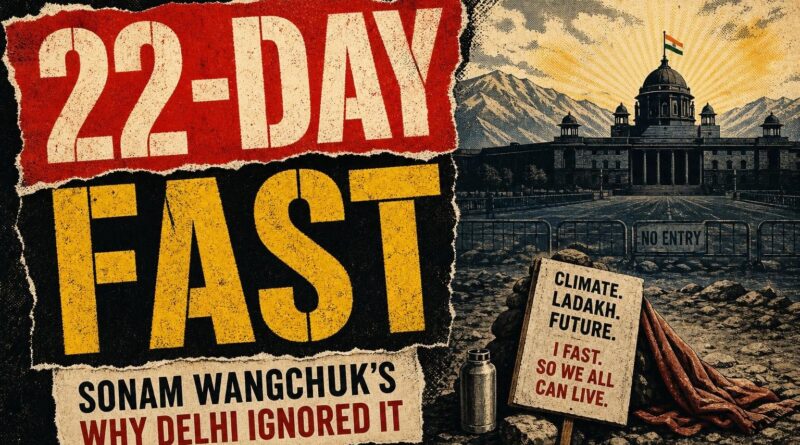
Sonam Wangchuk’s 22-Day Fast: Why Delhi Ignored It
Sonam Wangchuk’s 22-Day Fast: Why Delhi Ignored It
In the middle of July 2026, a man in Ladakh refused to eat. Not for a day. Not for a week. Twenty-two days. And the government’s response? Silence.
That’s the story that’s trending right now. But the real story — the one that explains why Sonam Wangchuk keeps doing this, and why millions of Indians keep watching — starts much earlier, in one of the most complicated political arrangements in modern Indian history.
The Region That Fell Through the Cracks
When Jammu & Kashmir was reorganised in 2019, Ladakh became a Union Territory — directly governed by the Centre, with no state legislature of its own. For many in Ladakh, this felt like a promise. No more domination by Srinagar. Direct access to Delhi. A fresh start.
What they got instead was something closer to political limbo.
A Union Territory without a legislature means the elected representatives of Ladakh have almost no formal power over their own land, their own budget, or their own laws. Decisions that affect Ladakhi farmers, herders, and students are made by administrators appointed from Delhi — people who may never have spent a winter at 11,500 feet above sea level.
This is the core grievance. It’s not abstract. It’s about who controls land rights, who protects tribal communities, who decides how money is spent in a region that shares borders with both Pakistan and China. Two groups — the Leh Apex Body (LAB) and the Kargil Democratic Alliance (KDA) — have been demanding two things: statehood for Ladakh, and protection under the Sixth Schedule of the Indian Constitution, which gives tribal communities legal safeguards over their land and culture.
Those demands have been on the table for years. The fast is what happens when the table stays empty.
The Man Who Won’t Stop
Sonam Wangchuk is not a politician. That’s precisely why people listen to him.
He’s an engineer and educator from Ladakh, best known internationally as the inspiration behind the character Phunsukh Wangdu in the Bollywood film 3 Idiots. But in Ladakh, he’s known for something more concrete: he built ice stupas — artificial glaciers that store winter water and release it in spring, giving Himalayan farmers water when they need it most. He built schools. He redesigned how education works in the region.
When someone like that goes on a hunger strike, it carries a different weight than a press conference.
This is not his first fast. Each time, the pattern has been similar: he fasts, attention builds, negotiations begin, he stops. This time, something is different. As of July 11, 2026 — 22 days in — LAB co-chairman Chering Dorjay Lakrook confirmed that Wangchuk had made clear he had “no intention” of calling off his fast. The Leh Apex Body had planned to send an eight-member delegation to New Delhi to persuade him to end it. They cancelled the trip. There was no point going, they decided, if Wangchuk himself wasn’t ready to come to the table.
Twenty-two days without food is not a protest. It’s a ultimatum.
The May Meeting That Changed the Equation
Here’s the detail that most coverage buries — and it’s the one that makes this situation genuinely complicated.
On May 22, 2026, representatives from LAB, KDA, and a sub-committee of the Ministry of Home Affairs (MHA) sat down together. The minutes of that meeting recorded something significant: the Centre had agreed to explore a customised Article 371-like model for Ladakh. This would cover executive, financial, and legislative powers for an elected body at the Union Territory level — a meaningful step toward giving Ladakhi representatives real authority.
Article 371 is the constitutional provision that gives special protections to several northeastern states, recognising their unique cultural and geographic circumstances. Applying a version of it to Ladakh would be a significant constitutional move.
So why is Wangchuk still fasting?
Because “agreed to explore” is not the same as “agreed to do.” And in Indian politics, the distance between those two phrases can stretch across years.
The Omar Abdullah Angle Nobody Expected
Then came the comment that turned a regional story into a national one.
J&K Chief Minister Omar Abdullah publicly accused the Centre of double standards. His argument: Delhi is willing to discuss Article 371-like safeguards for Ladakh — a Union Territory — while continuing to deny statehood to Jammu & Kashmir, which was itself a full state before 2019.
The National Conference, Omar Abdullah’s party, announced a protest at Jantar Mantar in New Delhi on July 20, specifically demanding the restoration of J&K’s statehood.
This is the political knot at the centre of everything. Ladakh wants more autonomy. J&K wants its statehood back. The Centre is trying to manage both demands without setting precedents that complicate either. And caught in the middle of all this institutional chess is a man in Ladakh who hasn’t eaten in three weeks.
Wangchuk’s arrest at some point during this period drew criticism from both Omar Abdullah and Arvind Kejriwal — a rare moment of agreement across very different political positions.
Why This Matters Beyond Ladakh
It would be easy to read this as a local dispute — a remote region, a niche constitutional question, a hunger strike that most of urban India will scroll past.
But the Ladakh question touches something fundamental about how India governs its most sensitive borders.
Ladakh shares frontiers with both Pakistan and China. The region saw serious military tension with China in recent years. Its people — Buddhists, Muslims, farmers, nomads — live in conditions that most Indians will never experience. And yet the decisions that shape their lives are made by administrators who answer to Delhi, not to Ladakh.
The Sixth Schedule protections that LAB and KDA are demanding exist precisely because India’s constitution-makers understood that tribal communities in remote, border-adjacent regions need legal insulation from outside land acquisition and cultural erosion. Ladakh wasn’t included in that schedule in 2019. The demand to include it now is not a radical ask — it’s a request to be treated the same as other tribal regions already covered by the constitution.
When Wangchuk fasts, he’s not asking for something new. He’s asking why Ladakh is still waiting for something the constitution already offers others.
Final Thought
Twenty-two days into a hunger strike, with a delegation cancelled and no talks scheduled, the question is no longer whether Sonam Wangchuk will stop. The question is whether the Centre will move before the situation forces a harder choice. The May 22 MHA meeting showed that dialogue is possible — the framework of an Article 371-like model is already on paper. What’s missing is the political will to convert a sub-committee minute into a formal commitment. Wangchuk has spent decades building ice stupas to solve problems that governments ignored. This time, he’s betting that his own body is the only structure left that Delhi can’t melt away.
Frequently Asked Questions
Why is Sonam Wangchuk fasting in 2026?
Sonam Wangchuk is fasting to demand statehood for Ladakh and protection under the Sixth Schedule of the Indian Constitution, which would give tribal communities legal safeguards over their land and culture. The Indian government has not responded to these longstanding demands.
What happened to Ladakh after the 2019 reorganisation of Jammu and Kashmir?
Ladakh became a Union Territory directly governed by Delhi with no state legislature, leaving elected representatives with almost no formal power over their land, budget, or laws. Decisions are made by Delhi-appointed administrators unfamiliar with the region.
What is the Sixth Schedule of the Indian Constitution and why does Ladakh want it?
The Sixth Schedule provides tribal communities with legal protections over their land and culture. Ladakhi groups like the Leh Apex Body and Kargil Democratic Alliance are demanding it to safeguard local communities from decisions made by distant administrators in Delhi.
Recommended Reading
Explore these hand-picked resources to dive deeper into this topic:
- Three Idiots by Chetan Bhagat
- The Monk Who Sold His Ferrari by Robin Sharma
- TED Talks: The Official TED Guide to Public Speaking by Chris Anderson
As an Amazon Associate, we earn from qualifying purchases. This helps support Fact Storm Hub at no extra cost to you.
Sources
- https://timesofindia.indiatimes.com/india/sonam-wangchuk-refuses-to-end-fast-cm-omar-abdullah-targets-centre-over-ladakh-jk-double-standards/articleshow/132336346.cms
- https://topnewsjk.in/national/sonam-wangchuk-refuses-to-end-fast-cm-omar-abdullah-targets-centre-over-ladakh-jk-double-standards-india-news/
- https://theprint.in/india/nobody-found-fault-with-wangchuk-when-he-was-praising-modi-omar-on-ladakh-violence-aftermath/2753234/
- https://thefederal.com/category/news/sonam-wangchuk-arrest-omar-abdullah-kejriwal-centre-208718
- https://www.ndtv.com/india-news/centre-failed-on-its-commitments-on-jammu-kashmir-ladakh-statehood-omar-abdullah-9363979
Watch the Video
🤖 AI Content Disclosure
This article was created using AI-assisted research and writing tools, then reviewed for quality and accuracy. Facts are sourced from publicly available web research, but readers should verify critical information from primary sources.
Published for educational and entertainment purposes. Last reviewed: July 2026