
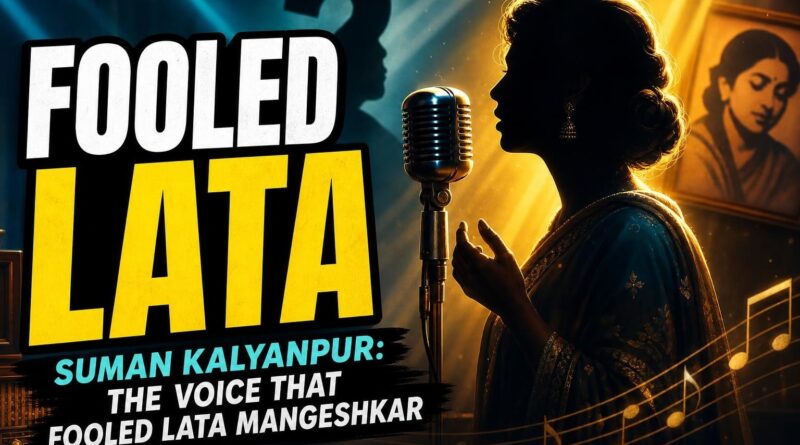
Suman Kalyanpur: The Voice That Fooled Lata Mangeshkar
Suman Kalyanpur: The Voice That Fooled Lata Mangeshkar
India woke up on June 1, 2026, to the news that Suman Kalyanpur had passed away at 89. Most people under 40 had never heard her name. But here’s the thing that stops you cold: for nearly four decades, millions of listeners heard her voice and thought they were listening to someone else entirely.
That someone else was Lata Mangeshkar.
The Voice That Lived in Someone Else’s Shadow
Born Suman Hemmady on 28 January 1937 in Dhaka, Bengal Presidency — in what is now Bangladesh — she grew up in a subcontinent that was still under British rule. By 1953, she had stepped into Hindi cinema as a playback singer. She was sixteen years old.
The timing was both her gift and her curse. Lata Mangeshkar had already claimed the throne of Hindi film music. The two voices carried such similar tone and texture that listeners — genuine, devoted music lovers — routinely confused them. Radio audiences would hear a Suman Kalyanpur track and write letters praising Lata. Film producers would cast her partly because she could deliver that same crystalline quality.
For any other singer, that comparison might have been a compliment. For Suman Kalyanpur, it became a ceiling. She was extraordinary, but she was extraordinary in a way that the industry kept attributing to someone else.
Eleven Languages. One Career. Zero Compromise.
Cold number: Suman Kalyanpur recorded songs in over 11 languages across her career.
Hindi. Bengali. Marathi. Assamese. Gujarati. Kannada. Angika. Bhojpuri. Rajasthani. Odia. Punjabi.
That list isn’t just impressive — it’s a portrait of India itself. Each of those languages carries its own musical grammar, its own emotional register, its own relationship between melody and meaning. A singer who masters one is celebrated. A singer who masters eleven is something rarer: a cultural bridge.
She wasn’t doing this for commercial reach in the way a modern artist might chase streaming numbers across markets. This was the 1950s through the 1980s. Regional film industries operated in relative isolation. Recording in Bhojpuri or Assamese meant travelling to different studios, working with different composers, learning the phonetic weight of words she hadn’t grown up speaking. She did it anyway. The career ran from 1953 to 1988 — thirty-five years of that kind of discipline.
The Duets That Defined an Era
Mohammed Rafi is one of the most celebrated male voices in the history of Indian cinema. When two voices are paired repeatedly, it’s because something happens between them that neither can manufacture alone — a chemistry that composers hear and keep returning to.
Suman Kalyanpur and Mohammed Rafi had that. Their duets became touchstones of the era. “Na Na Karte Pyar” and “Tumne Pukara” weren’t just popular songs — they were the kind of tracks that attached themselves to specific memories for an entire generation. The kind you hear thirty years later and are immediately somewhere else: a bus ride, a monsoon afternoon, a particular summer.
Rafi’s voice had a warmth that could make even grief sound like a gift. Paired with Suman Kalyanpur’s clarity, the combination produced something that the Hindi film industry of that period kept reaching for. She wasn’t a supporting act in those recordings. She was half the architecture.
What the “Lata Comparison” Actually Tells Us
Kohli had the records. Tendulkar had the mythology. Every generation creates these comparisons that flatten what makes each person distinct.
The persistent confusion between Suman Kalyanpur and Lata Mangeshkar wasn’t a mistake listeners should be embarrassed about. The two voices genuinely occupied similar sonic territory — high, clear, emotionally precise. But listen closely to Suman Kalyanpur’s recordings and you hear something specific to her: a directness, a lack of ornamentation that made certain kinds of emotion land harder.
The comparison also reveals something about how the Hindi film industry worked. There was room for one dominant voice at the top of the hierarchy. Everyone else, no matter how gifted, was positioned relative to that voice. Suman Kalyanpur recorded prolifically, worked with major composers, delivered songs that audiences loved — and still spent her career being described as “similar to Lata” rather than as herself.
That’s not a personal failing. That’s an industry structure that has repeated itself across every art form, in every country, in every era.
A Quiet Exit, 38 Years After Her Last Recording
She had been unwell for a little over a month. On the evening of May 31, 2026, at around 8 pm, Suman Kalyanpur passed away peacefully at her residence in Lokhandwala, Mumbai. She was 89.
Her last recorded work dates to 1988 — nearly four decades before her death. That gap between the end of a public career and the end of a life is something that doesn’t get discussed enough. She spent more years in retirement than most singers spend in their entire careers. What that silence contained — whether it was peace, regret, contentment, or simply the ordinary texture of a long life — only she knew.
Lokhandwala, where she spent her final years, is a neighbourhood in Mumbai that has housed generations of film industry figures. There’s something fitting about that geography: a woman whose voice shaped Hindi cinema, living out her final chapter in the same city that had both celebrated and underestimated her.
Final Thought
The tributes that followed Suman Kalyanpur’s death on May 31, 2026 described her, almost universally, as “underrated.” That word is doing a lot of work. A singer who records in 11 languages over 35 years, delivers duets with Mohammed Rafi that generations still remember, and builds a body of work stretching from 1953 to 1988 is not underrated because she lacked talent. She was underrated because the industry she worked in had one slot at the top and she wasn’t in it. The real question her career raises isn’t whether she deserved more recognition — she clearly did. It’s whether any music industry, then or now, has actually figured out how to celebrate excellence that doesn’t fit the dominant shape of the moment. Suman Kalyanpur’s voice was never the problem. The frame was.
Frequently Asked Questions
Who was Suman Kalyanpur and why was she compared to Lata Mangeshkar?
Suman Kalyanpur was a Hindi playback singer whose voice was so similar in tone and texture to Lata Mangeshkar’s that listeners and radio audiences routinely confused the two, often mistakenly crediting her songs to Lata.
How many languages did Suman Kalyanpur sing in?
Suman Kalyanpur recorded songs in over 11 languages, including Hindi, Bengali, Marathi, Gujarati, Kannada, Bhojpuri, Rajasthani, and Punjabi, making her a rare multilingual voice in Indian film music.
When was Suman Kalyanpur born and when did she start her singing career?
Suman Kalyanpur was born on 28 January 1937 in Dhaka, Bengal Presidency. She entered Hindi cinema as a playback singer in 1953 at just sixteen years old.
Recommended Reading
Explore these hand-picked resources to dive deeper into this topic:
- The Melody Lingers On: Reminiscences of Lata Mangeshkar by Lata Mangeshkar
- India’s Playback Singers: A Social History by Tejaswini Niranjana
- The Golden Age of Indian Cinema (Documentary Series)
As an Amazon Associate, we earn from qualifying purchases. This helps support Fact Storm Hub at no extra cost to you.
Sources
- https://www.ndtv.com/entertainment/singer-suman-kalyanpur-dies-at-89-11572975
- https://en.wikipedia.org/wiki/Suman_Kalyanpur
- https://indianexpress.com/article/entertainment/music/singer-suman-kalyanpur-dies-at-89-10717425/
- https://timesofindia.indiatimes.com/entertainment/hindi/bollywood/news/veteran-singer-suman-kalyanpur-of-passes-away-at-89-fans-remember-her-for-songs-like-na-na-karte-pyar-aaj-kal-tere-mere-pyar-ke-charche-and-more/articleshow/131427991.cms
- https://www.etvbharat.com/en/entertainment/suman-kalyanpur-passes-away-at-89-revisiting-5-timeless-solo-songs-of-the-padma-bhushan-awardee-enn26060100931

🤖 AI Content Disclosure
This article was created using AI-assisted research and writing tools, then reviewed for quality and accuracy. Facts are sourced from publicly available web research, but readers should verify critical information from primary sources.
Published for educational and entertainment purposes. Last reviewed: June 2026