
Saturn at 784 Million Miles: What It Means
Saturn at 784 Million Miles: What It Means
This week, most people walked past a small miracle without noticing it. On October 4, 2026, Earth swept directly between the sun and Saturn — a moment astronomers call opposition — and for one night, a planet surrounded by rings wide enough to swallow continents was hanging in plain sight above the southeastern horizon. No telescope required. No special equipment. Just a clear sky and the knowledge of where to look.
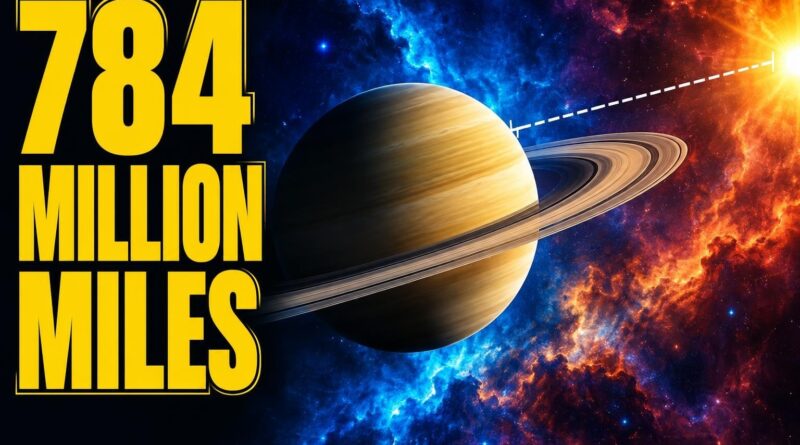
Close, of course, is relative. Saturn was still 784 million miles away.
That number is so large it barely registers. So here’s a way to feel it: light, the fastest thing in the universe, takes about 70 minutes to travel from Saturn to your eyes. When you looked up at that pale yellow dot in the sky this week, you were seeing light that left Saturn over an hour ago. You weren’t seeing Saturn. You were seeing Saturn’s past.
That’s the kind of planet we’re dealing with.
What Opposition Actually Means
Most people assume planets are brightest when they’re closest to the sun. That’s not how it works.
Opposition is when Earth lines up directly between the sun and an outer planet — Saturn, in this case. At that moment, the sun is behind us and Saturn is directly ahead. The sun’s light hits Saturn head-on and reflects straight back toward Earth. No angle. No shadow. Maximum brightness.
On October 4, 2026, Saturn hit a brightness of magnitude 0.3. In astronomy, the lower the magnitude number, the brighter the object. At 0.3, Saturn was one of the most prominent objects in the night sky — easy to spot even from a city with significant light pollution.
For observers in India, the timing was particularly clean. Saturn rose at around 6:11pm on October 4, right around sunset, and climbed to its highest point in the sky at approximately 12:17am. That peak position matters because it means Saturn was above the thickest, most distorting layer of the atmosphere — giving the clearest possible view.
Through a telescope, Saturn’s disk stretched 19.7 arcseconds across. That’s a tiny measurement, but in telescope terms, it’s enough to clearly see the rings, the gap between the rings and the planet, and even some of the larger moons.
The Physics Behind the Brighter Rings
Saturn’s rings don’t just brighten gradually as opposition approaches — they spike. Suddenly, noticeably, in a way that stumped astronomers for decades before researchers eventually identified the cause and gave it a name: the Seeliger effect.
Here’s why it happens. Saturn’s rings are made of billions of pieces of ice and rock, ranging from tiny grains to chunks the size of a house. Normally, these particles cast tiny shadows on each other. But at the exact moment of opposition, those shadows disappear — because the sun is directly behind the observer. Every particle is fully lit, with no shadow falling on its neighbor.
The result is a sudden, dramatic brightening of the rings that goes beyond what simple geometry would predict. During the 2026 opposition, this effect was in full force. Observers with even a modest telescope reported the rings appearing almost luminous — unusually vivid compared to Saturn’s appearance at other times of year.
This is not a trick of the eye. It’s real physics. The Seeliger effect is one of those rare moments where a planet shows you something that requires no enhancement, no filter, no special equipment — just the right alignment and a clear sky.
The Whale and the Ringed Planet
Saturn appeared in front of the constellation Cetus the Whale during the 2026 opposition. Cetus is one of the largest constellations in the sky, but one of the dimmest. Saturn, at magnitude 0.3, outshone an entire dim constellation from 784 million miles away — which is worth sitting with for a moment.
Here is exactly what happened to the light you saw. Sunlight left the sun and spent roughly eight and a half minutes crossing space before striking Saturn’s rings. Those rings — billions of ice and rock particles, each one tumbling in its own orbit — caught that light and bounced it outward. It then spent another 70 minutes crossing 1.26 billion kilometers of empty space, entered Earth’s atmosphere, passed through miles of air and turbulence, and landed in your eye.
Every second you looked at Saturn, that relay was completing itself in real time. The pale yellow point in the southeastern sky wasn’t a static image — it was an active, continuous delivery of light across a distance that no human has ever physically traveled.
You can also use that light as a diagnostic tool. Stars twinkle because their light arrives as a pinpoint, easily jostled by atmospheric turbulence. Saturn, even at 784 million miles, subtends enough of an angle that its light arrives more steadily. If you saw a point in the sky that glowed without flickering, you were almost certainly looking at a planet.
Why 784 Million Miles Is Hard to Imagine (And Why You Should Try)
Saturn’s distance from Earth at opposition — 8.43 astronomical units, or roughly 784 million miles — is the kind of number that sounds impressive but doesn’t land emotionally.
One comparison that helps: the distance from Earth to the moon is about 239,000 miles. Saturn, at its closest during this opposition, was more than 3,000 times farther away than the moon. And this is Saturn at its closest point of the year. For the rest of 2026, it only gets farther.
What makes this more striking is that Saturn was still clearly visible to the naked eye. No telescope required. Just look up, find the brightest steady point in the southeastern sky, and you’re looking at a planet of unimaginably vast scale — surrounded by a ring system of equally staggering width — all of it catching sunlight well enough to outshine most stars from 784 million miles away.
The solar system is not abstract. Its scale is written in the sky every clear night. Most people just don’t know what they’re looking at.
Final Thought
Saturn’s 2026 opposition on October 4 wasn’t just a calendar event for astronomers. It was a reminder that the universe doesn’t require a ticket or a telescope. It just requires you to look up, know what you’re seeing, and let the numbers do what numbers rarely do — make you feel something.
Frequently Asked Questions
What is Saturn opposition and when did it happen in 2026?
Saturn opposition occurred on October 4, 2026, when Earth aligned directly between the sun and Saturn. This alignment causes sunlight to reflect straight back toward Earth, making Saturn appear at its brightest, reaching a magnitude of 0.3.
How far away is Saturn from Earth right now?
During Saturn’s opposition on October 4, 2026, Saturn was approximately 784 million miles from Earth. Light from Saturn takes about 70 minutes to reach our eyes, meaning we see the planet as it appeared over an hour in the past.
Can you see Saturn without a telescope during opposition?
Yes, Saturn is visible to the naked eye during opposition. On October 4, 2026, Saturn reached a brightness of magnitude 0.3, making it one of the most prominent objects in the night sky, easily spotted even from light-polluted cities.
Recommended Reading
Explore these hand-picked resources to dive deeper into this topic:
- Astrophysics for People in a Hurry by Neil deGrasse Tyson
- The Planets by Andrew Cohen
- Celestron 70mm Refractor Telescope (portable stargazing tool)
As an Amazon Associate, we earn from qualifying purchases. This helps support Fact Storm Hub at no extra cost to you.
Sources
- https://earthsky.org/astronomy-essentials/saturn-at-opposition-closest-brightest-best/
- https://www.moneycontrol.com/science/saturn-to-take-over-night-sky-on-october-4-will-india-see-the-ringed-planet-tonight-article-14044271.html
- https://www.youtube.com/watch?v=SJQiTb85QFs
- https://www.hindustantimes.com/india-news/saturn-at-opposition-tonight-what-is-the-seeliger-effect-and-how-to-spot-it-in-india-101791095978224.html
🤖 AI Content Disclosure
This article was created using AI-assisted research and writing tools, then reviewed for quality and accuracy. Facts are sourced from publicly available web research, but readers should verify critical information from primary sources.
Published for educational and entertainment purposes. Last reviewed: October 2026