
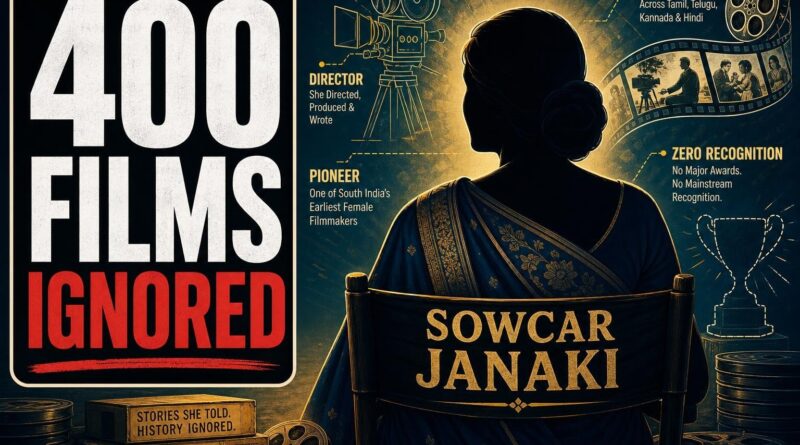
Sowcar Janaki: 400 Films, Zero Recognition
Sowcar Janaki: 400 Films, Zero Recognition
She wasn’t a star. She was something rarer.
Sowcar Janaki — born Sankaramanchi Janaki on 12 December 1931 in Rajahmundry — spent over seven decades in front of a camera, appeared in nearly 400 films across Telugu, Tamil, Malayalam, and Kannada, and only received India’s fourth-highest civilian honour in 2022. She passed away on 21 August 2026 in Chennai at the age of 94. The tributes that followed used one word more than any other: Amma. Mother. Not icon. Not legend. Mother — which tells you everything about the kind of presence she was and nothing about why that presence deserves to be remembered on its own terms.
But tributes fade. What deserves to stay is the story of how she built one of the longest careers in Indian cinema — quietly, film by film, language by language — without ever becoming the name on the poster.
The Girl from Rajahmundry Who Walked Into Four Industries at Once
Rajahmundry, East Godavari, in the early decades of Indian cinema — this was not a place where film careers were expected to begin, especially not for women. The industry was centred in cities. Opportunities were scarce. The social stigma around women acting on screen was real and heavy.
Janaki walked in anyway.
What makes her career genuinely difficult to process is the scale of it. Nearly 400 films. Four languages. Seven decades. Most actors considered “prolific” in Indian cinema have worked in one, maybe two languages. Crossing into a third requires learning new scripts, new directors, new co-stars, new audience expectations. Janaki did it across four — Telugu, Tamil, Malayalam, and Kannada — at a time when there were no subtitles on sets, no language coaches on payroll, and no algorithm telling you which market to target next.
She didn’t cross over because a studio packaged her for it. She crossed over because she was good enough that four different industries wanted her.
1959: The Kannada Film That Was Supposed to Be Impossible
In 1959, a Kannada film called Mahishasura Mardini was released. It was the first Kannada pan-Indian film. Sowcar Janaki was in it, alongside Dr. Rajkumar — a name that needs no introduction to anyone who has spent five minutes around South Indian cinema.
Think about what “pan-Indian” meant in 1959. There was no streaming. No national multiplex chain. No social media to carry a trailer across state lines. A film reaching audiences beyond its home state required physical distribution deals, dubbed prints, and a cast that audiences in other regions would actually recognise and trust.
Janaki was that cast. She was already known enough, credible enough, and versatile enough to anchor a film designed to travel. This wasn’t a cameo. This was a statement about where she stood in the industry at that point in her career.
The film itself was built around the story of Goddess Durga defeating the demon Mahishasura — a story every South Indian household knows. But the choice to cast Janaki alongside Rajkumar signals something the history books underplay: she was considered a peer to the biggest names of her era, not a supporting act.
The Award That Arrived 53 Years Late
In 1969, Sowcar Janaki received the Kalaimamani — Tamil Nadu’s state award for excellence in the arts. She was recognised early. That recognition was real.
But the Padma Shri came in 2022.
She had been working since the early 1950s. She had appeared in nearly 400 films. She had crossed four language industries. She had acted alongside legends. And India’s fourth-highest civilian honour arrived when she was 90 years old.
This is not a complaint — it is a data point. The Padma Shri is not a small thing. It is awarded by the Government of India and carries genuine weight. But the timing raises a question worth sitting with: how many artists build careers of this scale and only receive national recognition at the very end?
Her younger sister, Krishna Kumari, was also a noted actress — which means this was a family that gave South Indian cinema two significant careers, not one. That kind of contribution, across generations and across languages, rarely gets a single headline. It gets footnotes.
The 2022 Padma Shri was not a footnote. But it should have come sooner.
What “Seven Decades” Actually Means
Seven decades in any profession is rare. Seven decades in front of a camera — where physical appearance is scrutinised, where trends shift every few years, where the audience’s taste is constantly moving — is something close to extraordinary.
Indian cinema changed completely across the span of Janaki’s career. Black-and-white gave way to colour. Single-screen theatres gave way to multiplexes. VHS gave way to DVD gave way to streaming. Political climates shifted. Language industries that were once separate began to overlap. The entire economics of how a film gets made, distributed, and watched transformed multiple times over.
Janaki worked through all of it.
The actors who survive one transition in the industry are celebrated. Surviving several is the mark of someone who understood something deeper about the craft — something that wasn’t tied to a particular era’s style or a particular decade’s idea of what a lead actress should look like.
Nearly 400 films is not a number that happens by accident. It happens because directors keep calling. And directors keep calling because the work, consistently, is worth calling for.
Final Thought
She was born in Rajahmundry in 1931. She received the Kalaimamani in 1969. She received the Padma Shri in 2022. She died in Chennai on 21 August 2026 at 94. Between those dates, she appeared in nearly 400 films across four languages — and spent most of those decades being the most reliable person in any room she walked into.
Not the star. The foundation.
That is a harder thing to build. And a much harder thing to replace.
Frequently Asked Questions
How many films did Sowcar Janaki act in?
Sowcar Janaki appeared in nearly 400 films across four languages — Telugu, Tamil, Malayalam, and Kannada — over a career spanning more than seven decades, making her one of the most prolific actresses in Indian cinema history.
When did Sowcar Janaki die and how old was she?
Sowcar Janaki passed away on 21 August 2026 in Chennai at the age of 94. She was born Sankaramanchi Janaki on 12 December 1931 in Rajahmundry.
What award did Sowcar Janaki receive from the Indian government?
Sowcar Janaki received India’s fourth-highest civilian honour in 2022, a recognition that came after decades of prolific work across four South Indian film industries.
Recommended Reading
Explore these hand-picked resources to dive deeper into this topic:
- The Courtesan, the Mahatma, and Me by Mallika Sarabhai
- Francesca by Khushwant Singh
- Amar Chitra Katha Collection (Indian cinema history comics)
As an Amazon Associate, we earn from qualifying purchases. This helps support Fact Storm Hub at no extra cost to you.
Sources
- https://en.wikipedia.org/wiki/Sowcar_Janaki
- https://timesofindia.indiatimes.com/topic/Sowcar-Janaki
- https://www.imdb.com/name/nm0417310/
- https://tv.apple.com/us/person/sowcar-janaki/umc.cpc.1xuk24kwwz2a3vvro5kpumcpp
- https://indianexpress.com/article/entertainment/telugu/veteran-actor-sowcar-janaki-hospitalised-in-chennai-10842134/
🤖 AI Content Disclosure
This article was created using AI-assisted research and writing tools, then reviewed for quality and accuracy. Facts are sourced from publicly available web research, but readers should verify critical information from primary sources.
Published for educational and entertainment purposes. Last reviewed: August 2026